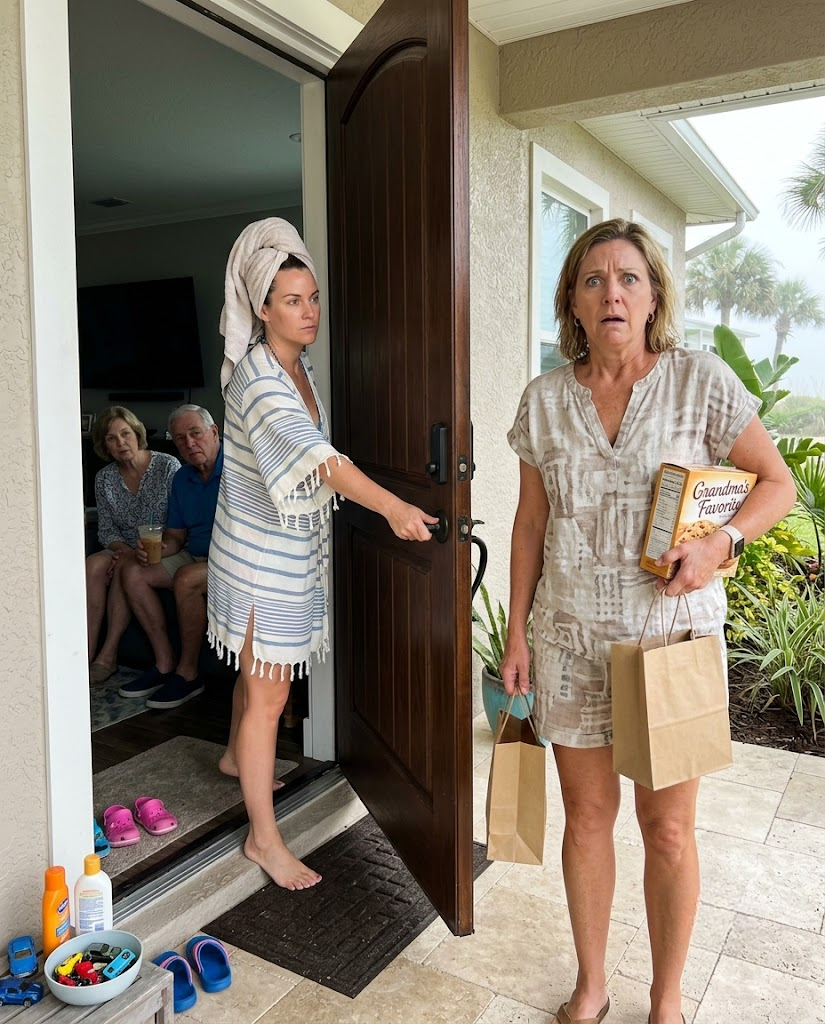
The apartment door opened before I could knock a second time, and there stood Oliver with a tired smile that did not match the life he was trying to hide from me. Behind him was a cramped place far from the beach house I had bought so he could focus on school. The room was small, the walls were worn, and his textbooks sat wherever there was space because there was barely room for a desk.
I had spent the drive there trying to prepare myself for answers. I expected anger. I expected confusion. I expected him to tell me there had been some misunderstanding.
I did not expect to see my son looking like he had been carrying a burden alone for weeks.
“Hey, Mom,” he said quietly.
That was the first thing that broke me. He was trying to act normal.
I stepped inside and looked around. A few students shared the apartment. There were basic dishes on the counter, a laundry basket near the wall, and a stack of college books on the floor. Nothing about the place looked like the future I had imagined when I bought him the beach house.
I had pictured Oliver walking out the door with his backpack, coming home after classes, making coffee in the kitchen, and having a safe place to land while he figured out adulthood.
Instead, he had been starting over somewhere else and saying nothing.
“Why are you living here?” I asked.
Oliver looked down.
For a moment, he seemed younger than eighteen. Not like a child, but like someone who had spent too much time trying to solve a problem nobody should have left him to solve alone.

He finally told me what happened.
Lindsay had needed somewhere to stay after separating from her husband. According to Oliver, the family said the beach house made more sense for her and her two boys. They told him it would only be temporary.
Temporary became longer.
Longer became uncomfortable.
Then uncomfortable became impossible.
The house that was supposed to be his safe place slowly stopped feeling like his home.
What hurt most was not just that he lost the room. It was that everyone around him acted like it was normal.
When Oliver tried to explain what was happening, he did not feel like anyone wanted to hear him. He said he did not want to bother me because he knew I had worked hard to give him that opportunity. He thought handling it alone was somehow protecting me.
That was the part I struggled to understand.
My son had spent weeks believing his problems were something he needed to hide from his own mother.
I thought about the calls we had shared. Every other day, I heard his voice. Sometimes it was only a quick conversation between classes. Sometimes he complained about cold lecture halls or joked about the socks I kept sending him.
I thought I knew how he was doing.
But I only knew what he was willing to tell me.
When I stood outside that beach house earlier, holding the cookies I had brought him, I had been focused on the wrong question. I wanted to know why Oliver left.
Now I understood I needed to know why Oliver felt like leaving was his only option.
He sat down on the edge of the bed and rubbed his hands together.
Then he told me about the conversation with his father.
When he asked Matt for help, Matt did not treat it like an emergency. He told Oliver he was eighteen and needed to handle his own problems. He said I protected him too much and acted like Oliver needed to learn independence.
But independence was not supposed to mean being pushed aside when family made decisions over your head.
I listened without interrupting.
I wanted to be angry. I wanted to call people immediately. I wanted answers from everyone who had watched this happen.
But looking at my son sitting in that small apartment, I knew the first thing he needed was not a fight.
He needed someone to believe him.
I told him he should have called me.
He nodded.
“I know,” he said. “I just didn’t want you to feel like you failed.”
That sentence stayed with me.
Because he had misunderstood the entire reason I bought that house.
It was never about creating a perfect college experience. It was never about controlling his life. It was never about proving I was a good parent.
It was about making sure he had a place where he felt wanted.
And somehow, while I was trying to give him security, he had been sitting in a borrowed apartment feeling like he was an inconvenience.
I looked around the room again. The worn carpet. The crowded shelves. The books stacked on the floor.
Then I looked back at Oliver.
“Show me everything,” I said.
He hesitated.
“Everything?”
“Yes.”
Because I knew there was more he had not said yet.
The beach house was not just a place. It was the reason I had trusted certain people to look out for him when I could not be there.
And now I needed to understand exactly what happened after my son stopped sleeping there.
PART 3 — THE HOUSE THAT WAS NEVER THEIRS
PART 1 — SHOW ME EVERYTHING
Oliver did not answer immediately.
He stared at the floor between his shoes as if the truth were scattered there among the corners of his textbooks.
Then he reached beneath his mattress and pulled out a thick blue folder.
The sight of it made something inside me go cold.
Eighteen-year-old boys did not create evidence folders unless someone had taught them that their word would not be enough.
He set it in my lap.
Inside were printed text messages, photographs, copies of bills, and a handwritten timeline.
The first message was from Lindsay.
It had arrived six weeks earlier.
We need the upstairs room for the boys tonight.
You can sleep on the couch for a few days.
The next message came three days later.
Mom and Dad agree that it makes more sense for you to use the small room downstairs.
You are only one person.
Then there was a photograph of Oliver’s bedroom.
His bed had been pushed against the wall.
Cartoon sheets covered it.
Plastic bins filled with children’s toys stood where his desk had been.
His laptop charger and notebooks were piled in a laundry basket beside the door.
“She packed your things?” I asked.
Oliver nodded.
“While I was in class.”
I turned another page.
The next photograph showed the downstairs storage room.
There was no proper window.
A camping mattress lay between a water heater and shelves of cleaning products.
“They expected you to sleep there?”
“At first.”
His voice was so quiet that I almost missed the last two words.
“At first?”
He swallowed.
“Then Uncle Ryan came over.”
Ryan was Lindsay’s estranged husband.
I had met him only a handful of times, but I remembered a man who spoke loudly when he was nervous and smiled too quickly when anyone asked about money.
“What happened?”
“He and Lindsay fought in the kitchen.”
Oliver rubbed his palms against his jeans.
“He said she had no right to move into a house that wasn’t hers.”
“He was correct.”
“Grandpa told him Dad had promised the house to Lindsay.”
My fingers tightened around the folder.
“Matt promised her my house?”
Oliver looked up.
“They kept saying it was Dad’s family property.”
For several seconds, the room seemed to lose all sound.
I heard only the blood beating behind my ears.
I had bought that house eighteen months after my divorce from Matt.
The down payment came from the sale of the small software company I had built with my friend Priya.
The mortgage, taxes, insurance, repairs, and furniture had all been paid from my accounts.
Matt’s name had never appeared on a single ownership document.
Not once.
Yet somewhere inside that family, my sacrifice had been rewritten as their inheritance.
“Keep going,” I said.
Oliver’s eyes searched my face.
“Mom, you look pale.”
“I am angry.”
I placed one hand over his.
“But I am not angry with you.”
That distinction mattered.
I could see it mattering in the way his shoulders lowered by half an inch.
He opened the folder to a series of screenshots.
The messages came from Matt.
Don’t call your mother and create drama.
Lindsay has two young children and nowhere safe to go.
You have friends.
Be mature about this.
Another message followed two days later.
Your mother bought that place for family.
Lindsay is family too.
Then came the message Oliver had saved under a red line.
If you make Andrea interfere, everyone will know you care more about a bedroom than two children.
I read it twice.
The cruelty was not loud.
That made it worse.
Matt had not simply refused to help.
He had turned Oliver’s compassion into a weapon and aimed it at him.
“Is this why you left?” I asked.
Oliver shook his head.
“Not exactly.”
He flipped to the next page.
There was a photograph of the front door.
The keypad had been removed.
A new lock sat in its place.
“I came home after my economics exam,” he said.
“My key didn’t work.”
I looked at him.
“They locked you out?”
“Lindsay said one of the boys had gotten outside, so she changed it for safety.”
“Did she give you a new key?”
His silence answered me.
“Where were your belongings?”
“In garbage bags under the covered patio.”
My hand began to shake.
Oliver noticed and reached for the folder.
“You don’t need to read the rest right now.”
I held it tighter.
“Yes, I do.”
He looked frightened then.
Not of me.
He was frightened of what the truth might do to me.
That was when I understood how thoroughly the adults around him had reversed our roles.
They had made an eighteen-year-old responsible for protecting everyone except himself.
“Oliver,” I said, “you are not responsible for keeping me comfortable while someone hurts you.”
His mouth trembled.
He turned his face toward the wall.
“I should have stood up to them.”
“You did.”
“I left.”
“Leaving a place where people are mistreating you is standing up for yourself.”
“It didn’t feel like it.”
“Courage rarely feels impressive while you are surviving it.”
For the first time since I had arrived, his careful expression cracked.
He covered his eyes with one hand.
“I thought you’d be disappointed.”
I moved the folder aside and sat beside him on the narrow bed.
“The only disappointment I feel is that I taught you how to solve equations, change a tire, cook six meals, and write a scholarship essay, but somehow failed to teach you that you never have to earn the right to call me.”
He leaned forward.
I wrapped my arms around him.
For several minutes, my grown son cried silently against my shoulder.
I did not tell him to stop.
I did not tell him everything would be all right.
Promises made too quickly had already done enough damage.
I said the only thing I knew was true.
“You are not handling this alone anymore.”
PART 2 — THE COST OF SILENCE
When Oliver finally pulled away, he looked embarrassed.
I handed him a tissue from the box on the windowsill.
“How much is this room?” I asked.
“Six hundred a month.”
“Where did you get the deposit?”
His eyes moved toward the plastic drawer unit.
“Oliver.”
“I sold some things.”
“What things?”
“My bike.”
The bike had been his graduation gift from me.
He had spent four months choosing it.
“What else?”
“My gaming computer.”
“The one you built with Grandpa Daniel?”
Daniel was my father, who had died three years earlier.
Oliver nodded.
I closed my eyes.
That computer had not been valuable because of its parts.
It was valuable because my father’s fingerprints had once been on every screw.
“Why didn’t you use the emergency card?”
“Dad said you were having money problems.”
I opened my eyes.
“What?”
“He said the company sale didn’t go as well as people thought.”
“That is not true.”
“He said the beach house was stretching you thin and that you might have to sell it.”
The lie was clever.
It gave Oliver a reason not to call me, a reason to surrender the house, and a reason to feel guilty for every dollar he needed.
“Did he tell you anything else about my finances?”
Oliver hesitated.
“He said you only put the house in your name because you wanted control after the divorce.”
There it was.
The old story Matt told whenever reality offended him.
If I made a decision, I was controlling.
If I asked questions, I was suspicious.
If I drew a boundary, I was cruel.
During our marriage, I had spent years sanding down the edges of my own certainty so he would not feel challenged by it.
The divorce had ended that habit for me.
Apparently, it had merely redirected it toward our son.
“Listen carefully,” I said.
“The beach house has no mortgage.”
Oliver blinked.
“What?”
“I paid it off last year.”
“Dad said—”
“Your father does not have access to my accounts.”
I took out my phone and opened the property records I kept in secure storage.
I showed him the deed, the tax receipt, and the insurance policy.
Every document carried my name.
“You did not cost me that house,” I said.
“You did not take anything from me by living there.”
His face changed slowly as the lie inside him lost its grip.
“Why would Dad tell me that?”
I wanted to answer honestly.
I also wanted to avoid poisoning him against his father simply because Matt had made it easy.
“I do not know all of his reasons,” I said.
“But I know the result.”
I tapped the folder.
“He convinced you that asking me for help would harm me, and that made it easier for other people to take what was yours to use.”
Oliver looked toward the open textbook on the floor.
“I’ve missed classes.”
The confession came suddenly.
“How many?”
“A lot.”
“Because the apartment is far away?”
“That, and work.”
“What work?”
“Night shifts at the grocery warehouse.”
I stared at him.
“You have a full academic scholarship.”
“It doesn’t cover this rent.”
“How many hours are you working?”
“Thirty-two.”
“A week?”
He nodded.
I looked at the dark circles beneath his eyes again.
They were no longer mysterious.
He had been attending college, commuting by bus, and lifting boxes through the night because his family had taken over a fully paid house intended for him.
“What happens to the scholarship if your grades fall?”
“I’m already on warning in two classes.”
His voice broke on the last word.
The house suddenly felt like only one piece of the disaster.
The greater theft was time.
They had taken hours of sleep, lectures, confidence, and the quiet focus he needed to build his future.
Money could replace a bicycle.
It could not return a failed semester without scars.
I stood.
“Pack a bag.”
Oliver looked alarmed.
“Where are we going?”
“To a hotel near campus tonight.”
“Mom, I signed a lease.”
“We will deal with the lease properly.”
“What about Lindsay?”
“We will deal with her properly too.”
He recognized my tone.
“You’re going back to the house.”
“Not tonight.”
“Why not?”
“Because anger is useful only when it works for you.”
I picked up the blue folder.
“Tonight, we make you safe.”
PART 3 — THE WOMAN WHO KEPT RECORDS
My attorney, Elena Ruiz, answered on the second ring.
We had met twelve years earlier when she helped negotiate the sale of my company.
Elena believed two things with almost religious certainty.
First, never sign a document you have not read.
Second, never threaten someone when a calendar invitation will frighten them more.
I explained what had happened while Oliver packed.
She interrupted only to ask exact questions.
Whose name was on the deed?
Mine.
Did Matt have a tenancy agreement?
No.
Did Oliver?
No, but I had written proof that he had permission to occupy the property.
Had I ever given Lindsay permission to live there?
No.
Had anyone altered the locks?
Yes.
Had mail or utilities been transferred?
I did not know.
“Do not enter tonight,” Elena said.
“Even though I own it?”
“Especially because you own it.”
“Explain.”
“People who know they are wrong sometimes manufacture confusion.”
I could hear her keyboard moving quickly.
“We are going to remove every opportunity for confusion.”
“How soon?”
“I can meet you at eight tomorrow morning.”
“At the house?”
“At my office.”
“Elena.”
“Andrea.”
Her voice softened.
“Your job tonight is to be Oliver’s mother.”
“And tomorrow?”
“Tomorrow, you may be the woman whose name is on the deed.”
I ended the call.
Oliver had stopped packing and was listening.
“Are they going to be arrested?” he asked.
“I don’t know.”
“I don’t want Mason and Leo scared.”
Even after their mother had put his belongings in garbage bags, he was thinking about her children.
“Neither do I.”
“They didn’t do anything.”
“I know.”
I stepped closer.
“Protecting children does not require letting adults escape consequences.”
He nodded, but worry remained in his face.
“Can we get my grandfather’s computer back?”
That question nearly undid me.
“We will try.”
We checked into a quiet hotel three blocks from campus.
I ordered soup, sandwiches, and the kind of chocolate cake Oliver used to request every birthday.
He ate half a bowl of soup before falling asleep fully dressed on top of the comforter.
I removed his shoes and covered him with a blanket.
Then I sat in the chair by the window and opened the blue folder again.
At midnight, I found the first detail Oliver had missed.
One of Lindsay’s messages mentioned a contractor coming to measure the deck.
At twelve fifteen, I found a photograph showing a real estate lockbox hanging briefly from the side gate.
At twelve thirty, I found a group message from Susan.
Once the summer renters begin arriving, there should be enough income for everyone.
I read the sentence again.
Summer renters.
They were not merely occupying my house.
They planned to rent it.
I searched the property address online.
The listing appeared on the third vacation rental site I checked.
Oceanfront Family Escape.
Four bedrooms.
Sleeps ten.
Available beginning next month for eight hundred fifty dollars a night.
The photographs were mine.
They had been taken from the listing I saw when I bought the house.
The host name was Lindsay M.
There were already eleven reserved dates.
I took screenshots of everything.
Then I noticed the final photograph.
It showed the small downstairs room staged as a cheerful children’s bunk room.
Oliver’s camping mattress was gone.
The water heater had been hidden behind a decorative folding screen.
They had not pushed my son out because there was no space.
They had pushed him out because he occupied a room they wanted to monetize.
At one in the morning, I sent the screenshots to Elena.
Her reply arrived three minutes later.
Do not contact anyone.
I typed back.
I wasn’t planning to.
Three dots appeared.
Andrea, I have known you for twelve years.
Do not contact anyone.
Despite everything, I almost smiled.
Then another message appeared.
I found the listing too.
They accepted deposits.
This is bigger now.
PART 4 — BREAKFAST WITH THE TRUTH
Oliver woke at six thirty in a panic because he thought he had missed work.
It took several seconds for him to remember where he was.
“Call your supervisor,” I said.
“Tell them you have a family emergency.”
“I can’t lose the job.”
“You are not going back tonight.”
“Mom—”
“Your scholarship is worth more than the wages from that job.”
“But the rent.”
“I will cover the rent until we resolve the lease.”
He immediately shook his head.
“No.”
“Oliver.”
“I don’t want you paying for my mistakes.”
“Whose words are those?”
He stopped.
“What?”
“Who taught you that needing help at eighteen is a mistake?”
His expression folded inward.
“Dad says—”
“I know what your father says.”
I pulled a chair beside him.
“Do you know what I say?”
He waited.
“Independence is learning to make choices.”
“It is not refusing every hand offered to you until you collapse.”
“You can repay money.”
“You cannot repay your body for months of sleep you denied it because you were too ashamed to call home.”
His eyes filled again.
“I don’t know how to fix all this.”
“Good.”
He looked confused.
“Good?”
“You are eighteen.”
“You are not supposed to know how to untangle illegal occupancy, rental deposits, family manipulation, and a housing lease before breakfast.”
I handed him his phone.
“You are supposed to tell the truth and let qualified people help.”
He called his supervisor.
The man who answered sounded irritated until Oliver explained that he had been displaced from his home and needed two days.
Then his voice changed.
“Take the week,” the supervisor said loudly enough for me to hear.
“Your job will be here if you still want it.”
Oliver stared at the phone after the call ended.
“He wasn’t angry.”
“Most decent people are not waiting for a chance to punish you.”
“It feels like they are.”
“Then we need to help you remember what decent feels like.”
At eight, we sat across from Elena in a conference room overlooking the harbor.
She read every page of Oliver’s folder.
She praised his timeline.
She asked permission before making copies.
Those small gestures visibly affected him.
For weeks, adults had treated his belongings, room, and future as common property.
Elena treated even his notes as his.
“You documented this very well,” she told him.
“I thought nobody would believe me.”
“Documentation is useful,” she said.
“But someone should have believed you before you needed it.”.
She turned toward me.
“The deed is clear.”
“The unauthorized rental listing is clear.”
“The altered locks are clear.”
“The unclear part is how Lindsay obtained enough information to represent herself as someone authorized to rent the property.”
“Matt,” Oliver and I said together.
Elena leaned back.
“Possibly.”
She slid a sheet across the table.
It was a copy of a property management authorization form from the rental platform.
My name appeared at the bottom.
The signature looked almost like mine.
Almost.
“Where did you get this?” I asked.
“The platform’s legal department provided it after I reported suspected fraud early this morning.”
Oliver looked at me.
“Someone forged your signature?”
“Yes,” Elena said.
“And used a copy of Andrea’s driver’s license.”
My stomach dropped.
“How did they get that?”
Then I remembered.
Six months earlier, Matt had asked for a copy of my license to add me as an emergency pickup person for his niece’s school trip.
It had seemed harmless.
I had sent it by email.
Elena saw the answer in my face.
“Who had access?”
“Matt.”
Oliver stood so abruptly that his chair rolled backward.
“He forged Mom’s name?”
“Sit down,” I said gently.
“No.”
His face had gone red.
“He threw me out of your house and told me not to bother you, and then he helped them rent it?”
“We do not know who signed the form yet,” Elena said.
“But we are going to find out.”
Oliver walked to the window.
His reflection floated over the bright water.
“I kept defending him.”
“You trusted your father,” I said.
“That is not a moral failure.”
“It feels stupid.”
“Trust is not stupidity.”
Elena closed the folder.
“What someone does with your trust belongs to their character, not yours.”
PART 5 — THE FIRST KNOCK
At ten thirty that morning, Elena, a licensed process server, a locksmith, and I stood outside the beach house.
Oliver chose to remain at the hotel.
I was relieved.
He had seen enough adults behaving badly.
Lindsay opened the door wearing sunglasses and carrying a travel mug.
Her expression changed when she saw Elena.
“What is this?”
“Ms. Lindsay Mercer?” the process server asked.
“Who wants to know?”
He confirmed her identity and handed her the notice.
She glanced at the first page.
“This is ridiculous.”
“The property owner has terminated any implied permission for you to occupy the premises,” Elena said.
“You are also ordered to cease representing yourself as authorized to rent or manage the property.”
Lindsay laughed……………….