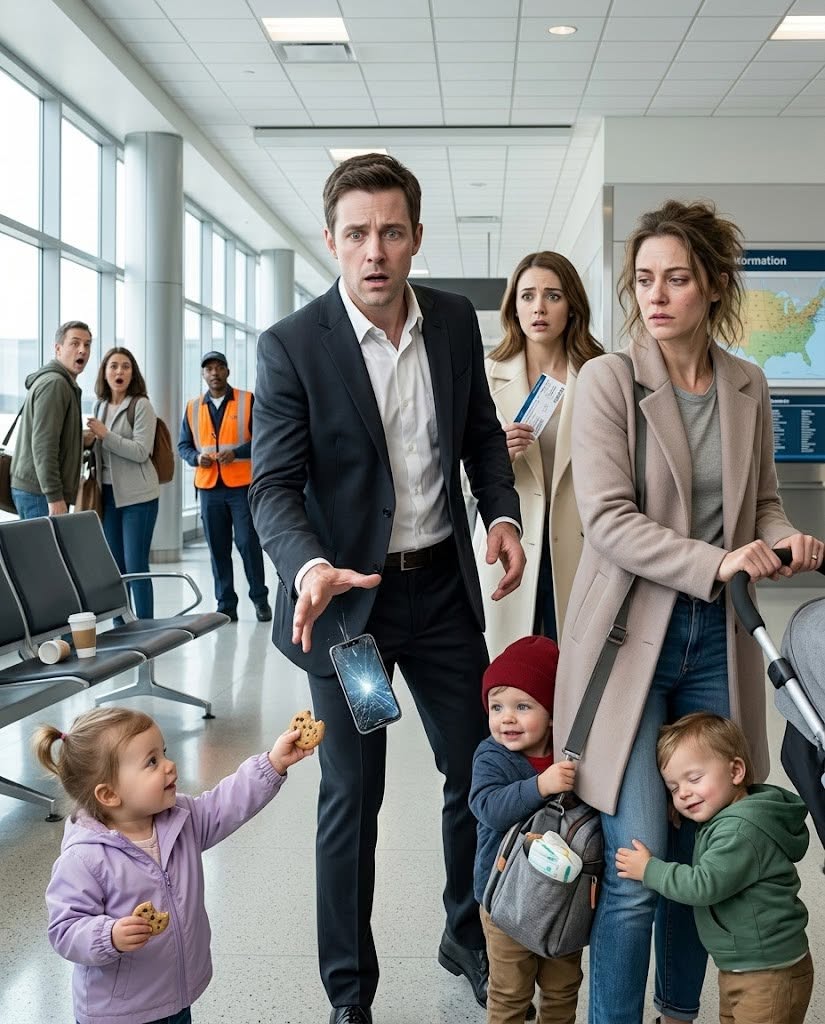
The first time Callum Pierce saw the children he had walked away from, he stopped in the middle of Seattle-Tacoma Airport as if the whole terminal had gone silent just for him.
A gate agent’s voice crackled through the speakers.
Suitcase wheels hissed over the polished floor.
Somewhere behind me, a paper coffee cup hit the rim of a trash can and bounced off with a hollow little tap.
My daughter stood in front of him in her lavender jacket, holding out a half-eaten cookie as if she had just found the friendliest stranger in the world.

“Hi,” she said. “Do you want some?”
Callum did not answer.
He was wearing a dark suit that probably cost more than my rent had back when he knew me.
His hair was cut perfectly.
His shoes were polished.
His phone was pressed to his ear, and a man’s voice on the other end kept talking about contracts, investors, and hotel timelines.
But Callum was no longer listening.
His eyes moved from my daughter’s face to the little boy gripping the strap of my diaper bag.
Then to the second little girl leaning against my leg, sleepy and warm from the flight.
All three had his gray eyes.
All three had his smile.
And all three were children he had decided he would never have to know.
My name is Nora Ellwood.
Eighteen months before that morning, Callum Pierce told me fatherhood was not part of the life he wanted.
He did not scream when he said it.
He did not throw anything.
That almost made it worse.
Cruelty is easier to recognize when it arrives with noise.
Callum’s came neatly dressed, softly spoken, and already halfway out the door.
We met in Portland at a children’s reading fundraiser where I worked as an event coordinator.
It was the kind of event held in a community room with folding tables, donated cupcakes, construction-paper bookmarks, and parents pretending they were not exhausted.
Callum arrived twenty minutes late.
He walked in wearing a dark coat still damp from rain, carrying a cardboard tray of expensive coffee he had brought for people he did not know.
Everyone noticed him.
That was how his life worked.
Rooms noticed him.
People adjusted.
He was wealthy, confident, and used to being admired without having to ask for it.
I was standing by the sign-in table with a stack of name tags and a blue marker that had started drying out.
He smiled and said something charming about rescuing the event from bad coffee.
I thought he was joking, so I laughed at him instead of with him.
His smile changed.
Not offended.
Interested.
Later, he told me that was the moment he noticed me.
I should have heard the warning inside that sentence.
He liked me because I did not treat him like he was special.
Men like that often mistake resistance for a challenge and attention for a prize.
For almost a year, I believed I had found the version of him nobody else got to see.
He stayed in my small apartment on weekends.
He made terrible coffee and acted proud when I drank it anyway.
He helped me carry a thrift-store bookshelf up two flights of stairs, then watched me paint it bright blue on a Sunday afternoon.
“Blue?” he asked.
“Homes need color,” I said. “Especially when your bank account says beige.”
He laughed so hard he had to sit on the floor.
That was the version of him I kept remembering after he left.
The version who knew how I took my coffee.
The version who held my hand in grocery store aisles.
The version who once fixed the broken chain on my apartment door without being asked.
When he was gentle, he was very gentle.
That is how people survive in your memory after they hurt you.
They do not only give you pain.
They give you enough tenderness to make the pain confusing.
Then I found out I was pregnant.
It was a Tuesday night at 7:18 p.m.
I remember the exact time because the microwave clock glowed above the stove while the takeout noodles went cold on the counter.
I had taken two drugstore tests that afternoon.
Then I went to a clinic because I needed something official before I told him.
The clinic discharge summary was folded in my purse when he came over.
Positive pregnancy test.
Estimated gestational age: six weeks.
I had read those words so many times they stopped looking real.
Callum came in talking about a new hotel property and a delayed investor meeting.
He kissed my cheek.
He took off his coat.
He asked why I looked so pale.
I told him.
His face changed before he said a single word.
Not panic.
Not joy.
Calculation.
“This is not what I planned,” he said quietly.
I reached for his hand.
“We can figure it out together.”
He looked down at my fingers on his and pulled away.
That small movement told me more than the next thirty minutes did.
He paced my kitchen.
He asked how sure I was.
He asked if the clinic could be wrong.
He asked what I wanted from him in a voice that made love sound like a contract dispute.
“I want you to be honest,” I said.
He stared at me as if honesty were an unreasonable demand.
For three weeks, he became someone I had to chase.
Texts took hours.
Calls went to voicemail.
He said he was overwhelmed.
He said he needed space.
He said he was thinking.
Thinking, I learned, is sometimes what people call leaving when they want credit for not running.
Then one rainy evening, he ended everything in the parking lot outside my apartment complex.
His car smelled like leather and his expensive cologne.
A grocery bag sat between us on the passenger seat because I had still been foolish enough to buy the cereal he liked.
Rain tapped on the windshield.
He did not look at me when he said it.
“You can raise the baby however you want, but I can’t be part of it.”
I cried.
I asked him to think again.
I reminded him that this child was ours.
He looked straight through the windshield at the apartment building lights.
“I’ll send money,” he said. “But I’m not ready to be anyone’s father.”
Money is an easy apology for people who have never had to count diapers before buying gas.
It sounds responsible until you realize it is just another way of leaving without carrying anything heavy.
Then he drove away.
What Callum did not know was that there was not one baby.
There were three.
Triplets.
I found out two weeks after he left.
The ultrasound room smelled like hand sanitizer and warm plastic.
The paper sheet under my legs kept sticking to my skin because I was sweating through my fear.
The technician was cheerful at first.
Then she got quiet.
Everyone who has ever sat in a medical room knows that kind of quiet.
It makes the walls move closer.
She turned the screen toward me and pointed.
“There are three heartbeats,” she said softly.
For a second, I laughed.
Not because it was funny.
Because fear came out wearing the wrong face.
Then I cried so hard she had to hand me tissues from the counter.
Three heartbeats.
Three tiny flickers.
Three lives forming inside a woman who had just been abandoned by the man who helped create them.
I called Callum that night.
He did not answer.
At 9:42 p.m., I sent him a photo from the ultrasound.
Three little shapes.
Three tiny proof marks.
Three reasons my life had just become impossible and sacred at the same time.
The message delivered.
No reply.
The next morning, I received an email from his assistant.
Not from him.
His assistant.
Attached was a wire transfer confirmation.
The message said Mr. Pierce believed direct communication was no longer productive.
I sat on the edge of my bed and read that sentence until it became a shape instead of language.
Direct communication was no longer productive.
Not, I am scared.
Not, I am sorry.
Not, I got your ultrasound.
Productive.
As if I were a meeting he could remove from his calendar.
That was the last time I tried to make him care.
Pregnancy with triplets is not romantic in the way people imagine pregnancy when they are not the ones living inside the body.
It was swollen ankles and back pain.
It was night sweats and appointments and doctors using careful voices.
It was making lists of things I needed and crossing half of them out because the money did not stretch.
My mother moved in for six weeks.
She slept on an air mattress in the living room and pretended it did not hurt her hip.
My best friend Ashley drove me to appointments when I was too tired to trust myself behind the wheel.
A downstairs neighbor brought casseroles in foil pans and never once asked where the father was.
That was kindness.
Not fixing.
Not judging.
Just showing up with food and leaving me my dignity.
By the time I was admitted to the hospital, my body felt less like mine and more like a crowded house with every light left on.
The babies came early, because triplets often do.
There were monitors, wristbands, nurses, alarms, and forms I signed while my hands shook.
At 2:13 a.m., under fluorescent lights, I filled out the birth certificate paperwork.
Father listed: blank.
Not because I did not know.
Because Callum had chosen blank first.
My daughters and son spent their first days under hospital lights, tiny and furious and alive.
I kept every bracelet.
Ashley took pictures of every label because she said one day I would need proof that I survived the beginning.
I laughed when she said that.
Later, I understood she was right.
For eighteen months, I built a life around three cribs.
Three tiny jackets by the door.
Three different cries in the dark.
I learned which child hated socks.
I learned which child loved peas.
I learned which child needed her back rubbed in circles before she could sleep.
I learned to fold laundry with one foot holding a cabinet closed.
I learned to drink coffee cold because hot coffee belonged to women with two free hands.
I learned that exhaustion could become a climate.
I also learned that love could be louder than abandonment.
Callum’s money came every month through an account number and a note from his assistant.
No messages.
No questions.
No birthday acknowledgment.
No asking whether the baby had been born, let alone whether there had been three.
At first, I wanted to tell him.
Not because he deserved it.
Because they did.
Children deserve to be known.
But every time I opened a message window, I remembered the words direct communication was no longer productive.
So I documented what mattered.
Hospital discharge papers.
Pediatric appointment summaries.
The ultrasound photo.
The birth certificates with the blank line.
Every wire transfer confirmation from his office.
Not because I planned revenge.
Because single mothers learn quickly that memory is not enough when powerful people decide to rewrite history.
Then my sister needed surgery.
My mother could not travel alone to help her.
That was how I ended up flying through Seattle-Tacoma with three toddlers, one stroller, one diaper bag, two backpacks, a packet of animal crackers, and the kind of patience that should have qualified me for government recognition.
The airport was crowded that morning.
Families moved in tired clusters.
Business travelers threaded through them with tight faces and rolling bags.
My son kept trying to help by holding the diaper bag strap, which mostly meant pulling it sideways.
One daughter was sleepy and stuck to my leg.
The other had a cookie and the confidence of a child who had never been taught that some people are not safe.
I turned for one second to adjust the stroller brake.
She slipped away by three steps.
Just three.
Enough to step in front of Callum Pierce.
Enough to offer him a cookie.
Enough for his perfect world to crack down the middle.
“Hi,” she said. “Do you want some?”
Callum stared at her.
Then at the other two.
Then at me.
The color drained out of his face.
“Nora?” he said.
I tightened my hand around the stroller handle.
“Callum.”
His phone was still near his ear.
The man on the other end kept saying his name.
“Callum? Are you there?”
But Callum was no longer with his investors.
He was not in a conference call.
He was not in the clean, polished version of his life where choices stayed buried because he had paid enough money to make them quiet.
He was standing in an airport looking at three toddlers with his face.
My son smiled at him.
Same dimple.
Same chin.
Same impossible gray eyes.
Callum’s fingers opened.
His phone hit the floor with a sharp crack and skidded under the edge of a metal bench.
Several people turned.
My daughter held up the cookie again.
“You can have it,” she said.
Callum looked at me like the answer was already standing between us in three tiny bodies.
His voice came out thin.
“Nora… why do they look exactly like me?”
Before I could answer, a woman in a cream coat stepped out from behind him.
She was holding a boarding pass and wearing a ring that caught the overhead light.
She saw the children.
She saw his face.
Then she slowly lowered the boarding pass.
“Callum,” she said. “Who is she?”
He did not answer.
That silence did more damage than any confession could have.
The woman looked at me.
There was no anger in her face yet.
Only confusion.
I knew that confusion.
It is the small room women are placed in right before the truth kicks the door open.
My son tugged on the diaper bag strap.
“Mama,” he whispered, “is that man sad?”
Callum flinched.
He bent down to pick up his phone, but his hand shook so badly he fumbled it twice.
The cracked screen lit up on the floor.
Across it, bright and cruel, was a calendar notification.
Engagement Dinner — 7:30 PM.
The woman saw it.
So did I.
For one second, all three adults stood inside the same truth from different doors.
He had not only erased me.
He had built a new life so cleanly that the woman beside him had no idea what was buried underneath it.
“Engagement?” I said quietly.
The woman turned toward him.
“Callum, what does she mean?”
He looked at her, then at me, then at the children.
The confidence I remembered was gone.
Not softened.
Gone.
It left him standing in public with nowhere to put his hands.
My daughter unzipped her tiny backpack because toddlers believe every crisis can be improved by showing someone paper.
Before I could stop her, she pulled out the folded ultrasound photo I kept there with spare stickers and emergency wipes.
I kept it because the children liked looking at it.
They called it the before picture.
She held it up to Callum.
Three little shapes.
Three tiny proof marks.
One date in black ink.
Callum stared at it.
His lips moved before sound came out.
“You knew?”
The woman in the cream coat took one step back.
“You knew what?”
I took the photo gently from my daughter’s hand.
The paper had softened at the folds from being opened too many times.
I looked at the woman first, because she was the only other person in that moment who had been betrayed without consenting to any of it.
“I sent this to him,” I said. “At 9:42 p.m., eighteen months ago. He never replied. The next morning, his assistant sent money and told me direct communication was no longer productive.”
Callum closed his eyes.
That was the first honest thing his face had done.
The woman pressed her fingertips to her mouth.
“Is that true?” she asked him.
He said nothing.
She laughed once, but it was not humor.
It was the sound of a person realizing the floor she trusted had been painted over a hole.
“We have an engagement dinner tonight,” she said.
Callum whispered her name.
I will not use it here, because she did not ask to become part of his story.
She stepped away from him anyway.
“No,” she said. “Answer her first.”
People were watching now.
Not a crowd, exactly.
Just enough strangers to make privacy impossible.
An airport worker paused near a column.
A man with a rolling suitcase slowed down.
A woman on the metal bench looked from the toddlers to Callum and then at the floor like she wished she had not seen anything.
Nobody moved.
My daughter leaned against my leg.
My son held the diaper bag strap tighter.
The sleepy one rubbed her eye with a fist.
They did not understand adult shame.
They only knew the air had changed.
Callum finally looked at me.
“I thought there was one,” he said.
It was such a small sentence for such a large failure that I almost smiled.
“You thought there was one,” I repeated.
“Nora, I didn’t know.”
“You didn’t ask.”
The woman beside him inhaled sharply.
That was the line that landed.
Not because it was dramatic.
Because it was plain.
He did not know because not knowing had served him.
He had mistaken silence for innocence.
He had mistaken money for responsibility.
He had mistaken absence for an erased record.
But children are not erased because a man stops reading messages.
Callum looked down at the toddlers again.
“Their names?” he asked.
For a moment, I almost refused.
That ugly little impulse rose in me fast.
You do not get their names now.
You do not get to collect the soft parts after skipping every hard part.
But the children were watching my face.
And I had promised myself long ago that I would not let his failures teach them cruelty through me.
So I told him their names.
One by one.
Each name hit him differently.
By the third, his eyes were wet.
The woman in the cream coat turned away and wiped under one eye.
I felt sorry for her.
That surprised me.
I had imagined, in darker moments, that if I ever saw Callum with someone else, I would hate her.
But standing there, I saw only another woman who had trusted the edited version of him.
“I need to go,” I said.
Callum stepped forward.
“Wait. Nora, please. Can we talk?”
“We are talking.”
“Not here.”
I looked around at the airport, at the people pretending not to listen, at the phone still cracked on the floor.
“You chose not here eighteen months ago,” I said. “You chose not anywhere.”
His fiancée looked at him as if the word chose had just opened another door.
“Did you know she was pregnant when you met me?” she asked.
Callum’s silence answered first.
Then he said, “It was complicated.”
She stepped back again.
“No,” she said. “It was hidden.”
That was when I knew she was going to be all right.
Maybe not that day.
Maybe not that week.
But eventually.
Because she had heard the difference between a mistake and a pattern.
Callum reached for his phone.
The cracked screen flashed again.
This time I saw a missed call from someone labeled Investor Group.
His two worlds were calling at the same time.
Neither one was going to save him from the other.
My boarding group was already moving beyond the glass.
My mother texted me from the curb asking where we were.
The children were tired.
I had snacks left for maybe twelve more minutes of peace.
Real life does not pause just because a man finally recognizes the wreckage he caused.
I shifted the diaper bag higher on my shoulder.
“You can contact me through an attorney,” I said.
His head snapped up.
“An attorney?”
“Yes.”
“Nora, don’t do that.”
I almost laughed then.
Not because it was funny.
Because men like Callum always want tenderness at the exact moment consequences become official.
“I have pediatric records, hospital records, the ultrasound message, the wire transfers, and every email from your office,” I said. “If you want to know them, you can start by doing one thing correctly.”
His face went pale again.
“I sent money.”
“You sent distance. It just arrived electronically.”
The woman in the cream coat covered her mouth.
The airport worker looked away.
Callum had no answer.
For once, his silence was not power.
It was exposure.
I knelt in front of my children and adjusted one tiny zipper.
My daughter asked if the sad man was still getting the cookie.
I looked at Callum.
His eyes broke.
“No, baby,” I said softly. “You can keep it.”
Then I stood.
Callum whispered my name.
I did not stop.
Behind me, I heard the woman in the cream coat say, very clearly, “The dinner is canceled.”
I kept walking.
Not fast.
Not dramatic.
Just steady.
One stroller wheel squeaked.
The diaper bag bumped my hip.
My son waved at a pilot passing by.
The sleepy one yawned so wide it made an older woman smile.
And my daughter finished the cookie herself.
Later, people would ask me whether that airport meeting felt like justice.
It did not.
Justice sounds too clean.
It felt like a door opening in a room I had learned to live without.
It felt like watching a man discover that the blank line he left on three birth certificates had not stayed blank in the world.
It had filled itself with birthdays.
With doctor visits.
With first steps.
With songs in the car.
With three tiny people who did not need his permission to exist.
Callum did contact an attorney.
So did I.
There was testing, paperwork, formal communication, and a long process that did not move at the speed of regret.
He asked for meetings.
Some were granted.
Some were not.
He sent gifts at first, too many and too expensive.
I sent most of them back.
Children need consistency before they need impressive boxes.
They need someone who shows up when there is no audience.
That was the rule I gave him.
If he wanted to be known, he would have to become reliable in small, boring ways.
He would have to learn snack preferences.
He would have to remember appointment times.
He would have to sit on the floor and be ignored until they trusted him enough to hand him a block.
He would have to understand that fatherhood is not a dramatic airport scene.
It is Tuesday morning socks.
It is car seats.
It is paperwork.
It is staying after the shame stops being public.
I do not know yet what Callum will become for them.
I know what he was.
I know what he missed.
And I know what I built without him.
For eighteen months, I thought the cruelest thing he had done was leave.
I was wrong.
The cruelest thing was assuming that because he walked away, nothing would grow in the space he abandoned.
But three children grew there.
A family grew there.
I grew there.
And that morning in Seattle-Tacoma, when his phone cracked against the airport floor and his perfect world began to fall apart, I finally understood something I wish I had known from the beginning.
A man can leave a blank line.
That does not mean the story stays empty.