The courtroom was too cold for a place where people were deciding whether my son belonged with me.
It was not only the air, though the air had teeth.
It was the polished wood, the gray walls, the silver clock over the judge’s bench, and the way every small sound seemed to accuse somebody.
Crew sat beside me with his feet swinging above the floor.
He was seven years old, skinny as a pencil, with careful hands and a face that had already learned how to read a room before adults started speaking.

That morning, I had combed his hair under the bathroom light while the heater clicked in the wall.
I had tucked his gray T-shirt into his jeans.
I had wiped a black scuff off his left sneaker with a wet paper towel until the white rubber looked decent again.
I had smoothed the little rocket on his sleeve with my thumb because Crew loved that rocket.
He said it made him feel like the shirt was going somewhere.
I remember thinking he looked small but clean.
He looked loved.
Most of all, he looked like a boy whose mother tried.
That was all I knew how to bring into that courtroom.
I did not have a lawyer.
I did not have a polished binder, a leather briefcase, or a voice trained to sound calm while saying cruel things.
What I had was a folder from the kitchen drawer.
Inside were pay stubs, school notes, pediatric appointment cards, two handwritten pickup confirmations from the school office, and a printed work schedule from Millard’s Market.
My manager had circled my name in blue ink.
Wednesday, 11:00 p.m. to 6:30 a.m.
Thursday, 11:00 p.m. to 6:30 a.m.
Friday, 11:00 p.m. to 6:30 a.m.
Those hours were the shape of my life.
They were the reason my hands smelled like cardboard boxes, cold produce, and bleach wipes.
They were the reason I drank gas-station coffee so bitter it made my jaw ache.
They were the reason I had learned to fold laundry sitting up because lying down meant I might not wake before Crew’s alarm.
The truth had kept me upright.
It had not made me impressive.
It had not made me wealthy.
It had only made me stubborn enough to survive.
Across the aisle, Logan sat beside his attorney.
My ex-husband looked clean in the way money looks clean.
Navy suit, polished shoes, fresh haircut, silver watch, and the expression of a man who had never been asked to prove that he loved his child in receipts.
He did not look at me.
That had always been one of Logan’s gifts.
He could sit ten feet from the woman who once packed his lunches, signed a lease beside him, and held his hand through his father’s funeral, and look through her like she was fog.
We had not always been like that.
There was a time when Logan and I ate pasta out of a saucepan because we only owned one clean bowl.
There was a time when he kissed Crew’s newborn head and cried so hard the nurse brought him tissues.
There was a time when I thought tired people could still be kind if they remembered why they were tired.
Then the promotions came.
Then the new friends came.
Then came the little corrections.
You should dress better.
You should keep the house cleaner.
You should stop making everything about money.
It is strange how quickly a person can enjoy the life your labor helped build and still call you unstable once the marriage ends.
Mr. Brackley, Logan’s attorney, rose with a stack of folders in his hand.
He had a face made for disappointment.
“Your Honor,” he said, “this case is not about sentiment. It is about stability.”
Crew’s knee bumped mine under the bench.
I placed my hand over it lightly.
Not a squeeze.
Not enough to make him feel trapped.
Just enough to tell him I was there.
Judge Elwood watched from behind silver-rimmed glasses.
He had listened all morning while Logan’s side painted me as exhausted, scattered, and barely capable.
They were careful.
They never called me cruel.
Cruel would have sounded too ugly.
Instead they chose words that wore clean shoes.
Overwhelmed.
Financially fragile.
Inconsistent.
Words can be dressed up so nicely they almost pass for truth.
But a dressed-up lie is still a lie.
Mr. Brackley lifted a photograph.
“This is the child last Tuesday.”
My stomach dropped before he turned it toward the bench.
I knew that picture.
It was Crew at school pickup, holding his backpack strap with one hand and rubbing his eye with the other.
He was wearing the gray T-shirt.
The one with the tiny rocket on the sleeve.
The one I had bought after working an extra overnight shift because Crew had outgrown two shirts in the same month.
That week, after rent, groceries, and gas, I had forty-three dollars left.
I remembered counting it at the kitchen table.
Three tens.
Two fives.
A single dollar bill.
The rest in quarters.
I remembered Crew standing beside me in the store aisle, touching that rocket with one finger and saying, “This one looks fast.”
So I bought it.
“The shirt is visibly worn,” Mr. Brackley said.
His voice was smooth.
“Small stain near the hem. Collar stretched. Your Honor, this is not an isolated issue. It reflects a larger pattern.”
My face burned.
Crew looked down at himself.
I wanted to stand up so badly that my legs trembled.
I wanted to tell them the stain was blueberry jam because Crew liked making his own toast on Sunday mornings.
I wanted to tell them the collar stretched because he pulled it over his nose when he got nervous.
I wanted to tell them that clean did not always look new when a child was growing faster than your paycheck.
But I had learned something ugly in that courtroom.
Poor mothers are expected to explain everything.
Comfortable fathers are allowed to imply.
So I stayed still.
Judge Elwood gave one small nod.
Maybe it did not mean agreement.
Maybe it only meant continue.
But it landed inside me like a door locking.
Mr. Brackley turned slightly, like a man who could feel a room leaning toward him.
“If a parent cannot consistently provide clean, properly fitted clothing,” he said, “how can she provide the emotional and developmental structure this child requires?”
The courtroom froze around that sentence.
The court reporter’s fingers hovered over the keys.
A woman in the back row lowered her paper coffee cup without drinking from it.
One man near the aisle looked down at his shoes.
Logan’s mouth pulled into the smallest satisfied line.
I knew that line.
He used to make it when someone else paid a bill and he still found a way to take credit for being responsible.
Crew stopped swinging his feet.
At first, I thought he was scared.
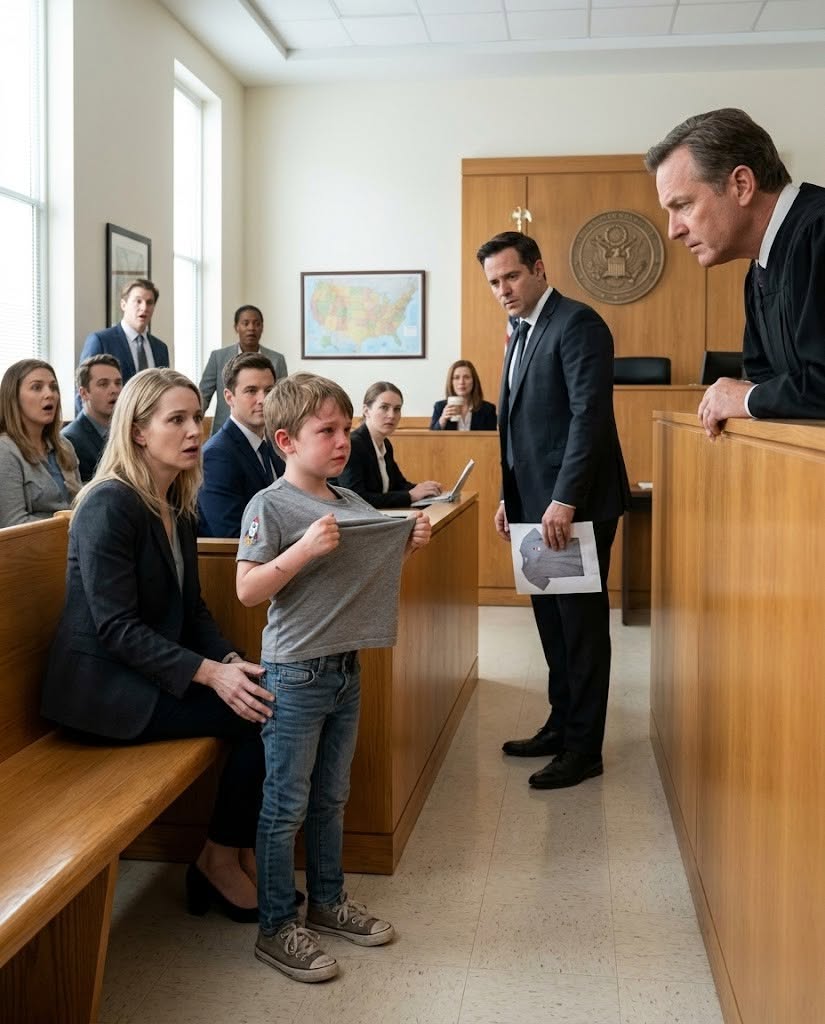
Then he stood up.
No one asked him to.
No one expected him to.
His little sneakers touched the courtroom floor with two soft taps.
Every adult in the room turned toward him.
Crew held the front of his gray T-shirt in both hands.
His voice was quiet.
But it carried.
“This is the shirt he’s talking about.”
For the first time since we walked into that family court room, Logan looked directly at his son.
Crew’s fingers tightened around the hem.
That was when I realized my child knew something I did not.
He looked up at Judge Elwood and said, “My mom worked all night to buy this.”
The words were not dramatic.
That made them worse.
They were plain.
They were true.
They were a seven-year-old trying to defend his mother with the only proof he understood.
Mr. Brackley lowered the photograph half an inch.
Judge Elwood leaned forward.
Crew swallowed.
“I wrote something inside it,” he said.
The bailiff took one step closer, then stopped when the judge lifted his hand.
“Would you like me to see it?” Judge Elwood asked.
Crew nodded.
He did not pull the shirt up high.
He was a child, but he still understood dignity.
He only tugged the inside hem outward and turned it carefully so the writing could be seen.
Before the judge reached for it, something slipped from Crew’s pocket.
A folded receipt landed on the floor.
It was soft at the edges and wrinkled from being carried too long.
I recognized the blue circle immediately.
Millard’s Market.
The date was the morning after my extra shift.
Crew must have taken it from the kitchen counter.
For one second, nobody moved.
Then Judge Elwood nodded toward the bailiff.
The bailiff picked up the receipt and handed it to the bench.
Mr. Brackley went very still.
Logan’s face changed.
Not fear exactly.
Recognition.
The kind a person gets when the story he has been telling starts rearranging itself in front of witnesses.
Judge Elwood looked first at the receipt.
Then he looked at the printed work schedule in my folder.
Then he looked at Crew.
“Son,” he said gently, “did anyone tell you to bring this?”
Crew shook his head.
“No, sir.”
“Did your mother know you had it?”
“No, sir.”
I could barely breathe.
The judge turned the shirt hem toward the light.
The writing was uneven, printed in the careful block letters Crew used for school assignments.
Some letters were too big.
Some leaned down.
One word had been crossed out and written again beside it.
Judge Elwood read it silently first.
Then he removed his glasses.
That was when the courtroom went silent in a new way.
Not judgmental.
Not bored.
Human.
“Your Honor,” Mr. Brackley started.
Judge Elwood did not look at him.
“Not yet.”
Two words.
That was all.
But Mr. Brackley closed his mouth.
The judge read the message aloud, slowly enough for every person in the room to hear.
“My mom worked all night for this shirt. I picked it because of the rocket. She was tired and still smiled. Please don’t say she doesn’t care about me.”
The last line wavered.
It had taken Crew more room than the hem allowed.
So he had written smaller.
“She always comes back.”
I covered my mouth.
I did not want to cry in front of Logan.
I did not want Mr. Brackley to turn my tears into another argument about instability.
But the sound that came out of me was not something I could stop.
Crew looked at me like he was worried he had done something wrong.
That almost broke me worse than the words.
Logan shifted in his chair.
“Your Honor,” he said, “I had no idea he wrote that.”
Judge Elwood finally looked at him.
“That is not the first question I have, Mr. Hale.”
Logan blinked.
The judge held up the photograph.
“My first question is why this photograph was taken.”
Mr. Brackley stepped in quickly.
“Your Honor, it was taken to document concerns regarding the child’s appearance.”
“By whom?”
There was a pause.
Logan adjusted his cuff.
“By me.”
“And instead of addressing those concerns with the child’s mother, the school, or this court through appropriate channels, you photographed him?”
Logan’s jaw tightened.
“I was gathering evidence.”
Judge Elwood set the photo down.
“Against whom?”
Nobody answered.
The question sat there like a weight.
Against me, of course.
Against the mother working overnight shifts.
Against the woman counting quarters at the kitchen table.
Against the child who loved a rocket shirt enough to defend it.
Judge Elwood turned to me.
“Ms. Carter, did you purchase this shirt?”
“Yes, Your Honor.”
My voice sounded smaller than I wanted it to.
“When?”
“The morning after the Wednesday overnight shift. I got off at 6:30 and stopped before school pickup. The receipt shows the time.”
The bailiff handed the receipt back to the judge.
Judge Elwood read it.
“7:12 a.m.”
I nodded.
“I remember because I almost fell asleep in the parking lot before going home to make breakfast.”
The woman in the back row closed her eyes.
The court reporter began typing again, faster now.
Mr. Brackley cleared his throat.
“Your Honor, while this may be emotionally compelling, one shirt does not resolve broader concerns about stability.”
“No,” Judge Elwood said. “It does not. But it does change the weight I give to the argument you just made.”
Mr. Brackley looked down at his folder.
For the first time all morning, he did not look disappointed in me.
He looked careful of himself.
Judge Elwood turned toward Crew again.
“Do you understand why you are here today?”
Crew nodded slowly.
“A little.”
“What do you think is happening?”
Crew looked at Logan.
Then at me.
Then down at his shirt.
“Dad says Mom is always tired,” he whispered. “But she is tired because she works. And when she is tired, she still checks my backpack.”
The judge’s face changed.
Just slightly.
Enough.
Crew kept going because children do that when they finally find the truth and nobody stops them.
“She makes toast with me on Sundays. She puts gas in the car. She knows I don’t like the green medicine. She comes to school when I forget my lunch.”
His voice got smaller.
“Dad has a bigger house. But Mom knows my stuff.”
There it was.
Not a legal argument.
Not a polished statement.
A child’s whole world, sorted into what mattered.
Judge Elwood sat back.
Logan looked away.
I remembered all the times he had told me I was too emotional, as if remembering a child’s medicine flavor was not a kind of evidence.
The judge called for a brief recess.
The sound of the gavel was not loud, but it made Crew flinch.
I wrapped my arm around him immediately.
“You didn’t do anything wrong,” I whispered.
“Are you mad?”
“No, baby.”
I pulled him close, careful not to squeeze too hard.
“I am so proud of you I don’t know where to put it.”
In the hallway, Logan tried to approach us.
Crew moved behind my hip.
That movement did more than any speech could have done.
Logan stopped.
“Buddy,” he said, voice soft in the way people get soft when other people are listening, “you know I just want what’s best for you.”
Crew did not answer.
I did not answer either.
For once, silence belonged to us.
When we returned to the courtroom, Judge Elwood had both folders open in front of him.
Mine looked thin beside Logan’s.
But thin does not mean empty.
The judge went through the school pickup confirmations.
He went through the pediatric appointment cards.
He went through the work schedule.
He asked me about childcare.
He asked Logan about his availability.
He asked why Logan had not provided clothing directly if he believed Crew lacked it.
Logan said he did not want to interfere.
Judge Elwood looked at the photograph again.
“You were comfortable interfering enough to document humiliation,” he said.
Mr. Brackley stared at the table.
That was the moment I knew the room had shifted.
The final order that day was temporary.
It did not solve our whole life.
Family court does not hand anyone a clean ending in one afternoon.
But Judge Elwood denied Logan’s emergency request to change primary custody.
He ordered a review of support.
He appointed a child advocate to speak with Crew privately before the next hearing.
He instructed both parents not to photograph Crew for litigation purposes unless there was an immediate safety concern.
Then he looked at me.
“Ms. Carter,” he said, “poverty is not neglect.”
I started crying then.
Quietly.
Not because everything was fixed.
Because someone in that room had finally said the thing out loud.
Crew reached for my hand under the table.
His fingers were warm and sticky from the fruit snacks I had packed in my purse.
I held on.
After court, we walked to the parking lot under a bright sky that felt almost rude after all that cold air.
My blazer smelled like old paper and nerves.
Crew’s shirt was wrinkled from where he had gripped it.
The rocket on his sleeve was still there.
“Can I still wear it?” he asked.
I looked down at him.
“Of course.”
“Even with the writing?”
“Especially with the writing.”
He smiled then.
Not big.
Not like a child in a commercial.
Just a tired, careful little smile that had survived a room full of adults.
I buckled him into the back seat of our old car.
Before I closed the door, he touched the hem of his shirt.
“Mom?”
“Yeah?”
“You always come back.”
I leaned against the car for a second because my knees almost gave out.
Then I bent down and kissed his forehead.
“I always will.”
Logan still had the bigger house.
He still had the better suit.
He still had the attorney with the smooth voice and the folders arranged in perfect rows.
But that day, my son stood up in a courtroom with a worn gray T-shirt and reminded every adult there what care actually looks like.
It looks like gas-station coffee at 6:45 in the morning.
It looks like a receipt folded in a child’s pocket.
It looks like a mother too tired to smile and smiling anyway because her son chose the shirt with the rocket.
He had walked into that courtroom looking like a boy whose mother tried.
He walked out looking like a boy who knew it.