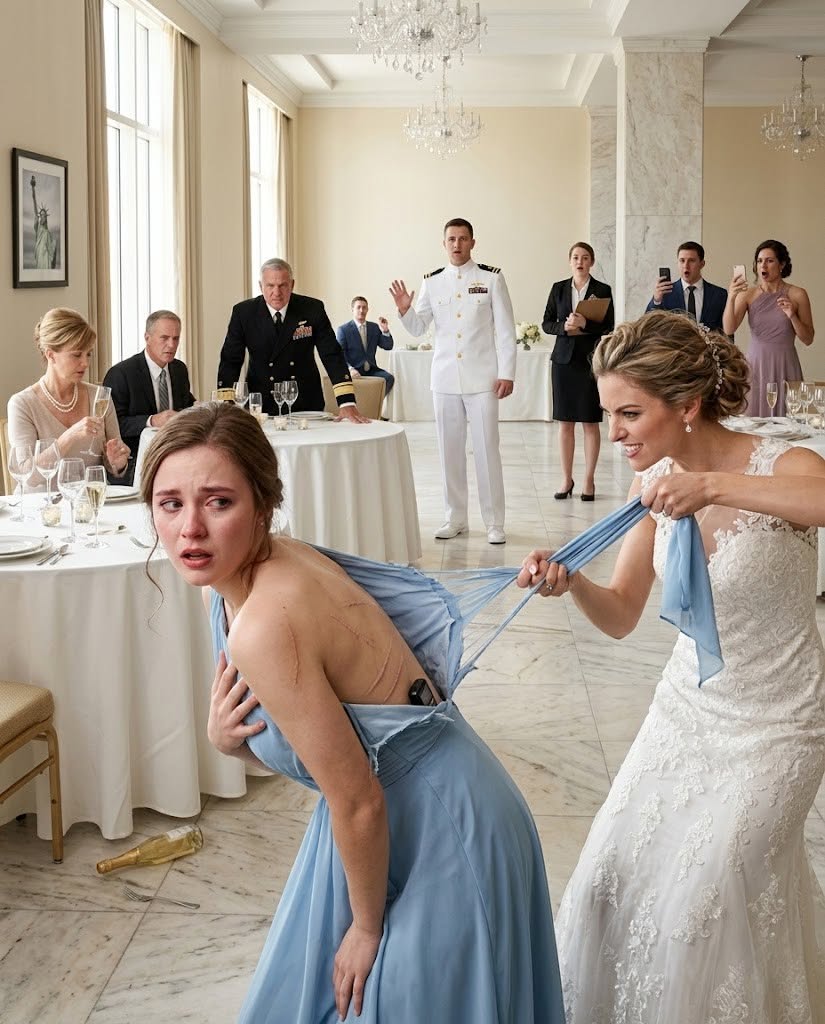
At my sister’s wedding, she ripped the back of my dress open in front of three hundred guests and laughed at the scars crossing my spine.
My parents watched from the front table with champagne glasses in their hands and said nothing.
For one frozen second, the ballroom went so quiet I could hear the torn fabric settle against my skin.
Crystal chandeliers glittered above us.
White roses climbed the walls.

The string quartet had stopped playing halfway through a note, leaving the air thin and strange, like the whole room had forgotten how to breathe.
My younger sister, Celeste Harlow, stood behind me with a strip of pale blue silk clenched in her manicured fist.
She was beautiful in the way our mother had always wanted her daughters to be beautiful.
Polished.
Photographed.
Approved.
Her bridal smile was sharp enough to hurt from across the room.
“You ugly devil,” she hissed. “You’re going to ruin my big day.”
The first two rows heard her clearly.
So did my parents.
So did Aaron Vale, the man she was about to marry.
I pressed one hand to my chest to keep the torn bodice from sliding lower.
Across my exposed back, the scars pulled tight under the bright wedding lights.
They were old scars, raised and pale now, but they still had a way of making strangers stare like pain was public property.
Whispers moved through the room.
Gasps followed.
Then phones came up.
That was the modern shape of cruelty.
Someone always reached for a camera before they reached for a coat.
My mother looked away first.
She turned her face toward the floral centerpiece as if roses could save her from being a mother.
My father leaned toward his empty salad plate.
He studied it with the full concentration of a man trying to disappear inside a fork.
That hurt more than Celeste’s hands.
Celeste had always been cruel when there was an audience.
My parents had always been silent when the truth asked too much of them.
But somehow, every time they chose silence again, it found a fresh place in me.
“Get her out,” Celeste snapped at the wedding planner.
The planner stood near the aisle with a clipboard pressed to her chest, looking from Celeste to me and back again.
“I told you I didn’t want her here,” Celeste said. “She only came to make people pity her.”
The room stayed frozen.
Forks hung above plates.
Champagne glasses hovered near mouths.
A bridesmaid stared at the floor so hard she might have been trying to count the threads in the carpet.
Nobody moved.
That was the part people never understand about public humiliation.
It is not only the person who hurts you.
It is the hundred people who decide, all at once, that your pain is inconvenient.
I had been invited because my parents insisted on the appearance of unity.
Not love.
Appearance.
The Harlows were masters at it.
My father built luxury homes with glossy brochures and handshakes that lasted just long enough for people to trust him.
Behind the polished renderings and marble kitchen samples were missing subcontractor deposits, fake invoices, and change orders no one remembered approving.
My mother wore pearls to charity lunches and called waiters by the wrong names.
She treated kindness like table decor.
It looked good as long as no one expected it to function.
Celeste smiled for cameras and bled people dry behind closed doors.
She knew exactly which insecurity to press, exactly which room to perform in, and exactly how to make her cruelty sound like wounded innocence after the fact.
And me?
I was the family disgrace.
That was the version they sold.
I was the difficult daughter.
The scarred one.
The one who refused to smile in family portraits.
The one who made people uncomfortable because I remembered things the rest of them needed buried.
The truth was uglier than that.
It was also better documented.
At 9:18 that morning, I had clipped a tiny black recorder inside the lining of my dress.
At 11:06, the final scan came through on my phone.
It was an insurance report my father had sworn never existed.
Two weeks before the wedding, I had copied contractor ledgers, a hospital discharge summary, a signed settlement letter, and a short timeline I had written myself.
I sent them in a sealed packet to Admiral Richard Vale.
Not because I wanted to ruin a wedding.
Because I refused to let my sister marry into a family without them knowing what kind of family she came from.
The recorder was my insurance.
The paperwork was my spine.
Shame only works when the lie is louder than the evidence.
So when Celeste ripped my dress open, I lowered my gaze.
Not from shame.
To check the recorder.
It was still there.
Still clipped inside the torn bodice.
Still running.
The groom, Aaron Vale, stood near the altar in his white naval dress uniform.
He looked stunned in a way that made him younger than he had seemed all day.
His hand lifted halfway, then stopped.
I do not know if he was looking at my scars or the strip of fabric in Celeste’s fist.
Maybe both.
His father sat at the head table beside several senior officers.
Admiral Richard Vale was a broad-shouldered man with silver hair, medals on his jacket, and eyes that made loud people lower their voices without being asked.
He had been polite all evening.
Reserved.
The kind of man who noticed more than he said.
When his chair scraped back, the sound cut through the ballroom like metal across stone.
“Stop!” he roared.
His hand came down on the table so hard the glasses jumped.
A fork clattered against china.
A bridesmaid gasped.
Celeste’s fingers tightened around the torn silk.
Admiral Vale looked straight at her.
“Do you even know who she is?”
Every face turned.
Celeste’s smile faltered.
For the first time all day, my mother stopped looking away.
The admiral reached into the inside pocket of his jacket and pulled out a sealed envelope with my name written across the front.
The envelope hit the table softly.
Celeste flinched anyway.
Aaron turned toward his father.
“Dad,” he said, barely above a whisper.
Admiral Vale did not answer him yet.
He looked at me first.
Not at my scars.
At my face.
It was the first decent thing anyone in that room had done since the fabric tore.
“Miss Harlow,” he said, quieter now, “do I have your permission?”
That question nearly broke me.
Not because it was dramatic.
Because it was simple.
Permission.
After a lifetime of people using my pain as family property, one stranger thought to ask whether it was his to reveal.
I nodded once.
Celeste laughed, but the sound came out wrong.
“This is insane,” she said. “She’s always like this. She makes everything about herself.”
Aaron stared at her.
“What did you just do?” he asked.
His voice had changed.
He was not angry yet.
He was trying to understand how the woman in front of him had become someone unfamiliar in the space of ten seconds.
Celeste turned on him immediately.
“Oh, please,” she said. “You don’t know what she’s like. She has been jealous of me since we were kids.”
I almost laughed.
Not because it was funny.
Because she still thought childhood was a place she could hide.
Admiral Vale opened the envelope.
The first document he pulled out was a copy of the hospital discharge summary.
The second was the insurance report.
The third was a photograph from the old accident file.
My mother’s champagne glass slipped from her fingers and shattered beneath the table.
My father whispered, “Richard, don’t.”
That was when I knew he had read enough to be afraid.
Admiral Vale glanced at my father with a coldness that made the whole table shrink.
“You had years to speak,” he said. “You do not get to choose silence now.”
My father’s mouth closed.
Celeste looked from him to my mother, then to me.
The color left her face in slow degrees.
Aaron stepped closer to the table.
“What is that?” he asked.
The admiral did not hand it to him right away.
He turned the first page so Aaron could see only the top half.
“This is from the night your fiancée’s sister was injured,” he said.
Celeste snapped, “It was an accident.”
The word cracked too fast out of her mouth.
Too practiced.
Too ready.
Some lies age badly because the people who tell them forget which parts are supposed to sound natural.
I felt every eye return to me.
My back was still exposed.
My dress was still torn.
But I was no longer the only thing being looked at.
Admiral Vale lifted the photograph.
I did not look at it.
I knew what it showed.
A staircase.
A broken banister.
A smear of blood on a white baseboard.
A little girl’s blue dress caught on a jagged nail.
I had been twelve.
Celeste had been nine.
My father had been screaming about a missing ledger.
My mother had been upstairs pretending not to hear.
Celeste had watched from the landing with both hands over her mouth.
For years, the family story was that I had fallen because I was careless.
For years, my father said I exaggerated the pain.
For years, my mother told me not to bring it up because it upset Celeste.
That was how my family worked.
The person who bled became responsible for everyone else’s comfort.
At the head table, my mother began to cry.
I had seen those tears before.
They never came when I needed her.
They came when other people might judge her for not needing me enough.
Aaron reached for the page.
Admiral Vale let him take it.
Celeste grabbed Aaron’s arm.
“Don’t,” she said.
One word.
Small.
Panicked.
Aaron looked at her hand, then at the torn fabric still clenched in her other fist.
“Let go,” he said.
She did.
The whole ballroom watched him read.
A string player lowered her bow completely.
Somewhere near the back, a guest whispered, “Oh my God.”
Aaron’s eyes moved line by line.
Then he stopped.
His face changed when he reached the witness statement.
That was the line my father had buried.
That was the line I had needed someone else to see.
Aaron looked up slowly.
“Celeste,” he said.
She shook her head before he asked anything.
“No,” she whispered.
He looked at my parents.
My father stared at the table.
My mother covered her mouth with both hands.
Aaron read aloud, but his voice was rough now.
“Minor witness stated older male adult pushed subject backward during argument. Family declined police involvement.”
A sound moved through the room.
Not a gasp exactly.
More like three hundred people realizing they had been laughing at the wrong woman.
Celeste stepped back.
“You cannot possibly believe her,” she said.
I lifted my head.
“I did not write that report,” I said.
My voice came out steady.
That surprised me.
“I did not take that photograph. I did not forge the hospital intake form. I did not make Dad sign the settlement letter three months later using money from a subcontractor escrow account.”
My father’s head snapped up.
There it was.
The part he had feared most.
Not my scars.
The money.
The wedding had gone silent before.
Now it went dead.
Admiral Vale pulled out the contractor ledger.
“I was sent copies of these documents two weeks ago,” he said. “I verified what I could. Enough to know this family has lied to mine.”
Aaron looked at his bride.
“Did you know?” he asked.
Celeste’s mouth opened.
For once, nothing came out.
My mother whispered, “She was a child.”
I looked at her.
“So was I.”
Those three words did what years of screaming had not done.
They made my mother look at me like I was real.
Not useful.
Not embarrassing.
Real.
But it was too late for that to feel like a gift.
Aaron took another step back from Celeste.
The movement was small, but everybody saw it.
Celeste saw it most of all.
Her perfect bridal smile collapsed.
“You are choosing her over me?” she asked.
Aaron stared at her.
“I am choosing not to marry someone who humiliates her injured sister in front of three hundred people and then lies while holding the evidence in her hand.”
Celeste looked down.
She was still gripping the torn strip of my dress.
As if remembering it burned her, she dropped it.
The silk landed near my feet.
For a moment, nobody spoke.
Then the admiral removed his jacket.
He walked around the table and placed it over my shoulders with the kind of careful respect that made my throat tighten.
“Come with us,” he said. “You do not have to stand here exposed for one more second.”
That nearly undid me.
Not the papers.
Not the gasps.
Not Celeste’s ruin.
A jacket.
A simple act of covering what my own family had allowed to be displayed.
Aaron came toward me, but he stopped a few feet away.
“Emily,” he said softly, using my name like an apology. “I didn’t know.”
“I know,” I said.
And I did.
He had not known.
But knowledge was a strange thing.
Once it arrived, it required action.
Celeste began crying then.
Loudly.
The way she always cried when she needed the room to move back toward her.
“She is ruining my wedding,” she sobbed.
No one moved toward her.
Not even my mother.
My father stood so quickly his chair almost tipped.
“This is private family business,” he said.
Admiral Vale turned on him.
“Not anymore.”
Those two words landed harder than the hand on the table.
My father looked around the ballroom and seemed to realize the same thing I had realized the moment Celeste tore my dress.
There were witnesses now.
Phones.
Recordings.
People who would repeat what they saw before the centerpieces were cleared.
The lie had finally outgrown the room my family built for it.
The wedding did not continue.
There was no first dance.
No cake cutting.
No smiling send-off under sparklers.
Guests left in clusters, whispering behind their hands, clutching programs, checking their phones, avoiding my parents as if dishonesty might stain their sleeves.
Aaron called off the ceremony before the officiant could ask anything sacred of him.
Celeste screamed at him in the bridal suite hallway.
I heard pieces of it through the door.
“You promised.”
“You embarrassed me.”
“She did this on purpose.”
Aaron’s answer was quiet enough that I almost missed it.
“No, Celeste. You did.”
By 6:42 that evening, I was sitting in a small hotel office with Admiral Vale, Aaron, and the wedding planner.
The planner had brought me a sewing kit, a bottle of water, and a plain gray cardigan from her own car.
Her hands shook when she handed it to me.
“I am so sorry,” she said.
She looked like she meant it.
I thanked her.
Then I removed the recorder and placed it on the desk.
The tiny red light was still blinking.
Aaron stared at it.
“You recorded everything?”
“Yes,” I said.
Admiral Vale nodded once, not surprised.
“Good.”
I expected to feel victorious.
I did not.
I felt tired.
I felt cold.
I felt like a twelve-year-old girl standing at the bottom of a staircase, waiting for someone to admit what they had seen.
But beneath all of that, under the shaking and the humiliation and the ache in my back, there was something steadier.
Relief.
Not because my family had finally told the truth.
They had not.
Because the truth had survived them anyway.
In the weeks that followed, my father’s business came under scrutiny from people far more interested in ledgers than family excuses.
Several subcontractors came forward after the story spread.
The old settlement letter became the first loose thread.
The escrow transfers became the second.
By the time investigators started asking questions, my father had stopped calling me difficult.
He started calling me ungrateful.
That was how I knew he was scared.
My mother sent one message.
It said, “You should have handled this privately.”
I stared at it for a long time.
Then I typed back, “I tried. You looked away.”
She did not answer.
Celeste sent dozens of messages at first.
Some were furious.
Some were pleading.
Some were rewritten versions of history where she had only been stressed, only been joking, only been trying to protect her perfect day.
I did not reply.
There are apologies that ask for forgiveness.
There are apologies that ask for access.
Celeste’s were the second kind.
Aaron and I spoke once after everything settled.
He asked if I was okay.
I told him the truth.
“Not yet.”
He nodded.
“I am sorry I didn’t see it sooner,” he said.
“You were not raised inside it,” I told him.
That was all.
I did not need him to rescue me.
I did not need the admiral to become some permanent guardian in my life.
What they gave me was smaller and rarer.
They believed what they saw.
They acted when it mattered.
An entire ballroom had taught me how quickly people could turn pain into entertainment.
But one man standing up at a table taught me something else.
Silence is not neutral when someone is being stripped of dignity.
It chooses a side.
For years, my parents chose theirs.
That day, in front of three hundred guests, I finally chose mine.
The scars on my back did not ruin my sister’s wedding.
They revealed it.
And for the first time in my life, the room did not look away.