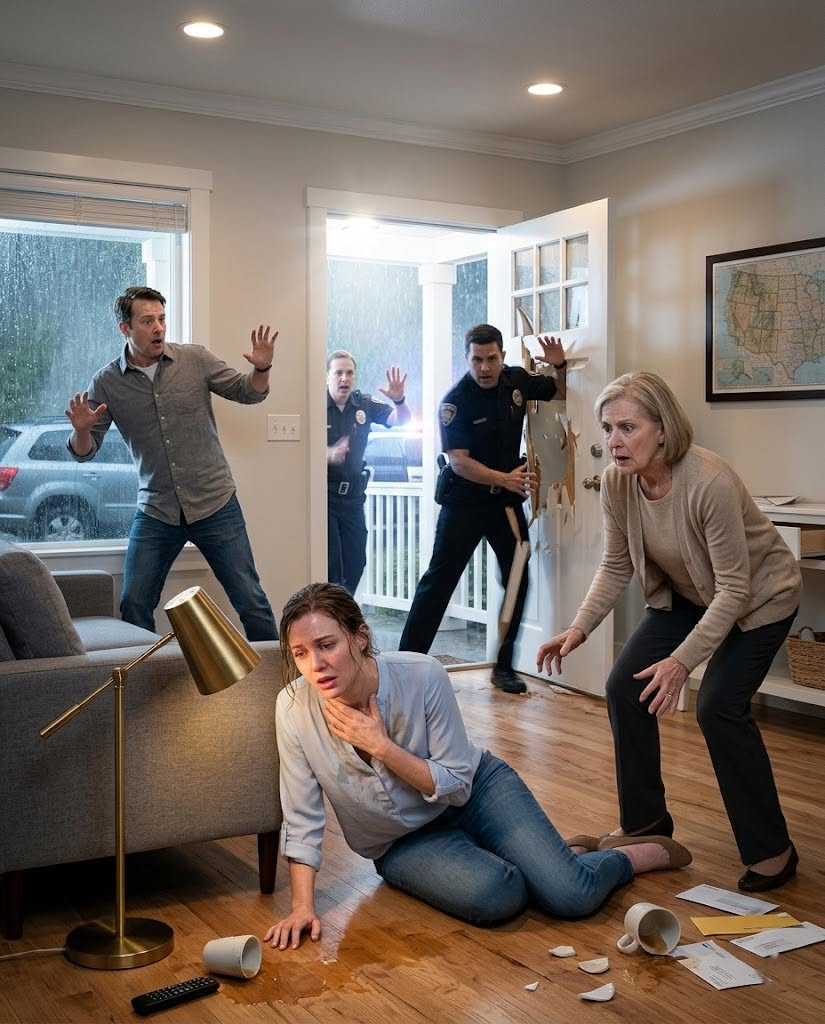
The nightmare began with one taste of almond sauce.
I remember the smell first.
Warm garlic.
Toasted butter.
That faint sweet edge that should have made me suspicious before I ever lifted the fork.
But I was tired, and I was trying to survive one more dinner in my own home without giving Patricia Walker the satisfaction of seeing me flinch.

The rain had been tapping against the living room windows all evening, steady and cold, turning the glass black enough to reflect the room back at us.
The brass lamp beside the couch threw a soft circle of light over the hardwood floor.
Ethan sat across from me with that careful husband-face he had perfected in public.
Patricia stood near the sideboard, pouring tea as if she were hosting something civilized.
Then the almond touched my tongue.
My body knew before my mind did.
My throat tightened so fast I could not swallow.
The air that had been moving in and out of my lungs all my life suddenly became impossible.
I dropped the fork.
It hit the plate with a tiny sound that should not have mattered, but in that room it sounded like a warning bell.
Ethan looked up.
Patricia did not.
For one second, I tried to convince myself I was wrong.
Maybe it was panic.
Maybe it was a spice.
Maybe my own fear had finally learned how to strangle me.
Then my chest locked.
I pushed back from the table so hard the chair legs scraped the floor, and I stumbled into the living room, one hand clawing at my throat.
The room tilted.
The lamp blurred.
The couch seemed too far away, then suddenly too close.
I hit the hardwood floor on my side, and pain shot up my hip and shoulder.
Above me, Patricia stepped into view.
She did not scream.
She did not reach for the phone.
She looked down at me calmly, with her tea cup still in one hand.
That was how I knew.
Not because she spoke.
Not yet.
Because no innocent person watches someone suffocate with that much patience.
“Just die quietly,” she said.
Her voice was low enough that it almost blended with the rain.
“Then Ethan can finally collect what he deserves and marry someone worthy of carrying on this family.”
I tried to speak, but all that came out was a broken rasp.
My eyes found Ethan.
He stood three feet away with both hands shaking.
His mouth was open.
His face looked terrified.
It was a beautiful performance, if you did not know him.
But I knew Ethan’s performances better than anyone.
I knew the way his eyebrows lifted when he wanted pity.
I knew the way his voice cracked when he needed people to think he had been blindsided.
I knew the difference between panic and rehearsal.
Then I saw what was missing.
His EpiPen.
He always carried one because my allergy was severe.
There was one supposed to be in the kitchen drawer.
One in his jacket.
One in the glove compartment.
He had promised me, more than once, that I would never have to wonder where it was.
Now it was gone.
All of them were gone.
That was the moment my terror sharpened into something colder.
This was not an accident.
This was an operation.
“The cameras?” Ethan asked.
His voice shook, but not with grief.
With fear of being caught.
Patricia rolled her eyes at him.
“I disconnected the hallway system hours ago,” she snapped. “And Emma would never spend money on real security anyway.”
Cheap.
There it was again.
That had been the word they used whenever I refused to let money disappear without questions.
Cheap when I stopped buying Patricia’s prescriptions with my card after discovering Ethan had been reimbursing himself from our joint account.
Cheap when I sold my engagement necklace after the first strange bank transfer showed up.
Cheap when I hired a forensic accountant instead of accepting Ethan’s explanation that the life insurance premiums had changed because of a clerical error.
Cheap when I asked why my signature looked different on paperwork I had never seen.
People call you cheap when they are angry you stopped being useful.
Ethan had not always been like that in the beginning.
Or maybe he had been, and I had been too exhausted by hope to notice.
When we first married, he seemed steady.
He remembered my coffee order.
He carried grocery bags in from the SUV without being asked.
He sat beside me in urgent care after a restaurant cross-contamination scare and held my hand while my breathing steadied.
That night he cried and told me he could not imagine losing me.
For years, I treated that memory as proof of who he really was.
Now I understood it was only proof of what he could imitate.
Patricia had been harder to misread.
From the first Thanksgiving I hosted, she made it clear that I was an outsider who had somehow wandered into her bloodline and needed constant correction.
My potatoes were too plain.
My curtains were too cheap.
My job before marriage was too masculine.
My decision to step back from federal work was too convenient.
No matter what I did, Patricia found a way to make it sound like I had done it to offend her.
Still, I let her into my home.
I gave her the spare key.
I kept tea bags she liked in the pantry.
I told myself that family sometimes started as endurance before it became love.
That was my mistake.
Some people do not soften because you are kind to them.
They just learn where the door is unlocked.
For six years before I became Ethan’s wife, I worked as a federal investigator.
I helped build cases against people who smiled at neighbors while hiding violence behind paperwork, timing, and charm.
I knew what predators sounded like when they believed they had cleaned up every trace.
They talked too much.
They always did.
By the time Ethan started raising my life insurance coverage without telling me, I had already learned not to confront him too soon.
The first premium notice came on a Tuesday.
The second arrived three weeks later.
The third had my name on a beneficiary adjustment page with a signature close enough to fool a busy office and wrong enough to make my stomach go cold.
I scanned it.
I saved it.
I did not say a word.
At 8:17 p.m. that night, I emailed the first copy to a forensic accountant I had used years ago as an expert witness.
By 10:42 a.m. the next morning, he called me and said, “Emma, I need you to listen carefully. This is not messy. This is structured.”
Structured.
That word followed me for weeks.
Not anger.
Not confusion.
Structure.
A plan with receipts.
I canceled the policy changes quietly.
I moved copies of our financial records into a password-protected archive.
I photographed the kitchen drawer where the EpiPen was supposed to be.
I took pictures of prescription labels, grocery receipts, insurance letters, and the small places where Ethan’s story kept changing.
Then I called Detective Marcus Reed.
Marcus was attached to the police substation at St. Anne Medical Center, where emergency cases and violent incidents often crossed paths.
He had worked with me twice during my investigator years.
He was not a friend in the casual sense.
He was better than that.
He was the kind of man who listened to facts before emotion, and who understood that fear often sounds unbelievable until the evidence arrives.
I told him everything.
Not dramatically.
Not all at once.
I sent the documents first.
Insurance change requests.
A canceled policy notice.
The forensic accountant report.
Photos of missing medication.
Screenshots of Ethan’s withdrawals.
Then I asked him one question.
“How do I prove it before they try?”
There was silence on the line.
Then Marcus said, “You do not confront them. You let them think the obvious camera is the system.”
That was how the hallway camera became bait.
It was cheap, just like Patricia said.
A visible little device above the entry hall, easy to unplug, easy to brag about disabling.
The real system was smaller.
One lens inside the smoke detector.
One inside the brass reading lamp by the couch.
A microphone threaded through the lamp housing.
A secondary speaker that could be activated remotely.
At 6:31 p.m. on the night of the dinner, both hidden feeds went live.
At 6:48 p.m., Marcus texted me one line.
We are watching.
I deleted the message.
Then I walked into my living room and sat down across from the man who had sworn to protect me.
Now, lying on the floor with my throat closing, I wondered whether I had miscalculated.
Evidence is powerful, but it does not breathe for you.
The hidden camera could record Patricia’s face.
It could record Ethan standing still.
It could record my suffering.
It could not open my lungs.
Patricia leaned closer.
Her perfume and tea breath drifted over me.
“You never belonged in this family,” she whispered.
Then she tipped her mug.
Scalding tea poured across my chest.
The pain was white and immediate.
My body arched against the hardwood before I could stop it.
I screamed, or tried to.
The sound came out torn and thin.
Patricia smiled.
She dragged her fingernails lightly over the soaked fabric, not enough to break skin, just enough to make sure I knew she was enjoying the pain.
“Trash,” she hissed.
Ethan looked away for half a second.
That was the closest he came to guilt.
Then he looked back at Patricia.
“How long?” he asked.
She glanced down at me like I was a timer.
“With that much exposure? Not long.”
I forced my eyes to stay open.
I needed the cameras to catch her mouth.
Every word mattered.
Every second mattered.
The hardwood smelled faintly of lemon cleaner beneath the tea.
The lamp hummed near my ear.
Rain pressed against the windows.
My own breath kept shrinking.
Patricia straightened and looked toward the hallway.
“You did check the drawer?” she asked Ethan.
He nodded too quickly.
“I moved it.”
“All of them?”
“Yes.”
The room seemed to tilt again, but this time the horror came with a strange, hard satisfaction.
There it was.
The missing injector.
The plan.
The confirmation.
Ethan had just said it out loud.
A siren cut through the storm.
At first it was distant enough that Patricia did not react.
Then another joined it.
Then another.
Ethan’s head snapped toward the window.
Patricia’s face tightened.
“Did you call them?” Ethan asked.
Patricia gave him a look of pure contempt.
“She can’t even move.”
The sirens grew louder.
Tires hissed outside on wet pavement.
Car doors slammed.
Heavy footsteps hit the porch.
Ethan crossed the room and yanked the curtain back.
His face changed so completely that, even through my blurred vision, I saw the blood leave it.
“It’s the police,” he whispered. “Three cruisers.”
Patricia stared at him.
“That’s impossible.”
The brass lamp crackled beside my head.
For one wild second, Patricia looked at it like furniture had betrayed her.
Then Detective Reed’s voice filled the room.
“Patricia Walker. Ethan Walker. We have been listening the entire time.”
Ethan stumbled backward.
Patricia’s mouth opened, but nothing came out.
Outside, something slammed into the front door.
The first impact rattled the windows.
The second split the frame.
The third sent the door inward with a violent crack of wood and metal.
Two officers came through first.
Behind them, Marcus Reed stepped into the living room with rain on his jacket and a medical kit in one hand.
He did not look at Ethan first.
He looked at me.
“Emma,” he said, “stay with me.”
One officer ordered Ethan to show his hands.
Another moved Patricia away from me.
She tried to point at Ethan.
“She did this,” Patricia said, voice suddenly high and shaking. “She set us up.”
Marcus knelt beside me.
“That is an interesting defense,” he said, opening the medical kit, “considering we heard you tell her to die quietly.”
Patricia went silent.
Ethan did not.
“She planned it,” he blurted. “My mother planned it. I didn’t know she was going to use almonds.”
Patricia turned on him so sharply she nearly fell.
“You pathetic coward.”
The officer near Ethan tightened his stance.
“Hands where I can see them.”
Marcus found the injector in his kit and pressed it hard against my thigh.
The click sounded small.
The relief did not come instantly.
That is something people do not understand about rescue.
Sometimes help arrives, and your body still has to climb back from the edge one inch at a time.
My throat fought him.
My lungs burned.
My eyes streamed.
Marcus kept one hand on my shoulder and talked me through every breath.
“In through what you can. Good. Again. Stay with the sound of my voice.”
Behind him, Patricia kept talking.
She said Ethan had misunderstood.
She said she had been joking.
She said I was unstable.
She said the tea spill was an accident.
Then the lamp speaker crackled again, and her own voice played back through it.
“Just die quietly.”
Nobody moved for a second.
Even the rain seemed quieter.
Ethan sank into a chair like his knees had forgotten their job.
Patricia stared at the lamp.
For years she had called me cheap.
Now a cheap-looking brass lamp was the thing holding her whole life by the throat.
Paramedics entered next.
They moved quickly, cutting through the room with practiced calm.
One checked my airway.
One checked the burn across my chest.
One asked Marcus for the exposure time.
“Approximately six minutes since collapse,” he said. “Possible almond ingestion, confirmed missing epinephrine, scald injury from tea, recorded confession.”
Recorded confession.
The phrase landed in the living room like a judge had already spoken.
Ethan started crying then.
Not because I was hurt.
Because the story he planned to tell no longer existed.
At the hospital, the ceiling lights slid past above me in long white panels.
The world came in pieces.
A nurse saying my oxygen was improving.
A doctor asking if I could hear her.
A blood pressure cuff tightening around my arm.
Marcus standing near the curtain, speaking softly into his phone.
I slept, woke, slept again.
By morning, my throat felt scraped raw, and my chest burned beneath clean dressings.
Marcus returned with a folder.
He did not dramatize it.
He never did.
He placed the file on the rolling tray beside my bed.
“We recovered three EpiPens from Ethan’s truck,” he said.
I closed my eyes.
“Where?”
“Locked glove box.”
Of course.
He continued.
“We also found the grocery receipt for almond extract. Purchased yesterday at 4:12 p.m. Store security shows Ethan at checkout.”
I stared at the ceiling.
There are moments when grief does not feel like crying.
It feels like inventory.
Item one: the husband bought the poison.
Item two: the mother-in-law served it.
Item three: both waited.
Marcus turned one page.
“The remote Patricia reached for controlled the visible hallway system only. She thought she could wipe what she understood. She never knew about the lamp feed.”
That almost made me laugh.
It came out as a painful cough.
A nurse looked in, and Marcus stepped back until she finished checking me.
Later that afternoon, I gave my full statement.
I described the sauce.
The missing injector.
Patricia’s words.
The tea.
Ethan’s question about the cameras.
Every sentence cost me, but every sentence gave me something back.
By the time I signed the statement, my hand was shaking so badly the pen dragged at the end of my last name.
The detective who witnessed it did not rush me.
He slid the paper closer and said, “Take your time.”
That kindness nearly broke me more than the cruelty had.
The charges came quickly.
Attempted murder.
Conspiracy.
Evidence tampering.
Insurance fraud inquiries followed after the financial file reached the right desk.
Ethan’s attorney tried to argue coercion.
Patricia’s attorney tried to argue confusion.
But confusion does not hide EpiPens.
Coercion does not buy almond extract and increase a life insurance policy.
And neither of them could explain the recording.
In court, Patricia would not look at me.
Ethan did.
He looked smaller than I remembered.
Not repentant.
Just reduced.
There is a difference.
When the prosecutor played the living room audio, the courtroom changed.
People had read transcripts already.
They knew what was coming.
Still, hearing Patricia’s voice say, “Just die quietly,” made several people shift in their seats.
One juror closed her eyes.
Ethan stared at the table.
Patricia kept her chin lifted until the lamp recording captured Ethan saying, “I moved it.”
Then her confidence drained out of her face.
That was the real ending of their plan.
Not the sirens.
Not the door.
Not even the arrests.
The ending was the moment they heard themselves and understood there was no cleaner version left to tell.
Months later, I went back to the house outside Portland.
Only once.
The hardwood had been cleaned.
The doorframe had been replaced.
The brass lamp still sat beside the couch because I had asked that it not be touched until the case was done.
I stood in the living room for a long time.
The room looked ordinary again.
That was the part that hurt.
The couch was just a couch.
The window was just a window.
The side table still had a faint ring where Patricia’s tea mug used to sit.
I thought about the woman I had been before marriage.
The investigator.
The wife.
The woman on the floor trying to breathe.
For a long time, I had believed those versions of me were separate.
They were not.
The wife survived because the investigator had not fully gone away.
The investigator survived because the wife had learned the cost of trusting the wrong people.
And the woman on the floor survived because she had left proof where cruelty never thought to look.
Ethan and Patricia had believed they were standing over someone weak.
They believed they had planned the perfect crime.
They believed I was cheap, forgettable, and easy to erase.
But every cruel word, every calculated move, and every second of my suffering had been recorded.
Help had already been on the way.
And in the end, the room where they tried to kill me became the room that testified for me.