Five years after my divorce, I thought I had trained my body not to react to Harrison Sterling.
I had learned how to breathe through the sound of his name.
I had learned how to smile when business magazines called him visionary, generous, brilliant, as if the man they were describing had not once stood in our penthouse holding my phone like a prosecutor holding a confession.
I had learned how to raise three little boys with his eyes in my hallway mirror and his smile at my breakfast table without letting bitterness become the fourth person in the room.

Then he walked into first class that morning, and every lesson I had practiced cracked down the middle.
The cabin smelled like black coffee, cold air, leather seats, and the kind of cologne worn by men who never had to wonder whether a card would decline.
I was sitting by the window with a paperback open in my lap and my coat folded over my knees.
I was not reading anymore.
I was watching the runway lights blink through the gray morning and counting the hours until I could get back to Chicago, back to the noise and sneakers and half-finished cereal bowls waiting for me.
Then a shadow paused at the aisle.
I looked up.
Harrison Sterling looked almost exactly the same and nothing like the man I had married.
He was still tall.
Still polished.
Still carrying himself with that expensive stillness that made people step aside before he asked.
But five years had taken something from his face.
Not beauty.
Never that.
It had taken softness.
For one second, we just stared.
Then his mouth tightened.
“You’ve got to be kidding me,” he said.
I closed my book because I refused to let my hands shake around him.
“Trust me, Harrison,” I said. “If I had known you were on this flight, I would have driven.”
A man across the aisle lifted his eyes from his phone.
A woman sipping coffee froze with the cup near her mouth.
Harrison noticed the attention, and something in him settled.
He always liked a room better when it had witnesses.
The flight attendant glanced at his boarding pass.
“Mr. Sterling, your seat is—”
“I know where my seat is.”
He sat beside me.
There were two empty seats across the aisle.
I looked at both of them, then back at him.
“There are other places you could sit.”
“I know.”
“Then why here?”
His smile was small and cold.
“Five years of silence,” he said. “I thought we should catch up.”
Five years.
He made it sound like a distance we had both chosen.
He made it sound like I had walked away one morning with a suitcase and a mood.
The truth was messier.
The truth had lawyers, screenshots, unopened envelopes, medical forms, and a man too proud to ask one more question before burning down a life we had built together.
I turned toward the window.
“You always confused cruelty with confidence,” I said.
“And you always confused secrets with innocence.”
There it was again.
The old accusation.
The blade he had never stopped sharpening.
When Harrison and I married, people loved us because we made a useful story.
He was the founder of a clean-energy empire, a billionaire who looked good on panels and magazine covers.
I was the environmental scientist who had helped build the technology behind some of his most profitable patents.
He was the face.
I was the work he called genius when we were alone and strategy when he spoke to investors.
That was our arrangement at first, though neither of us said it out loud.
We met in a lab, not at a gala.
He was not yet untouchable then.
He was brilliant, restless, and impossible, walking through prototypes with rolled sleeves and too much caffeine in his system.
I loved him before he knew how to wear power.
That is the part people forget about men like Harrison.
They think the money creates the arrogance.
Sometimes it only gives arrogance a better suit.
The night he found the messages, we had already been stretched thin.
He had been traveling constantly.
I had been sick in the mornings and exhausted by noon, trying to hide it until I had something certain to tell him.
I wanted proof before joy.
I wanted a doctor to say it clearly.
I wanted one quiet dinner where I could place the sonogram on the table and watch his face change into wonder.
Instead, he found a message thread on my phone.
The name at the top belonged to a man.
That was enough for Harrison.
“Who is he?” he asked.
We were in the penthouse.
Manhattan glittered outside the windows, all light and height and people who could afford not to look down.
“There is no affair,” I said.
“Then explain the messages.”
I reached for the phone, but he pulled it away.
He scrolled fast, not reading for meaning, only for injury.
A meeting time.
A private note.
A line about waiting until results were final.
A line about not telling Harrison until I was ready.
That was the one that ruined us.
He read it out loud with a laugh that had no humor in it.
“Not telling Harrison,” he said. “That is clear enough.”
“It is not what you think.”
“Of course it is not.”
I remember that moment more than I remember signing the divorce papers.
His face closed.
The man I knew disappeared behind a verdict.
By the next morning, attorneys were involved.
By the end of the week, my marriage had become a stack of documents.
Screenshots.
Calendar notes.
A draft agreement.
A demand for silence wrapped in professional language.
Trust does not always die in a screaming match.
Sometimes it gets printed, copied, forwarded, and filed until love looks like evidence.
I tried to tell him once more.
Then twice.
Then through my lawyer.
The letters came back unanswered.
His attorney called my attorney and said Mr. Sterling wanted no further personal contact.
So I stopped trying.
Not because he deserved peace.
Because I did.
I refused the settlement he offered.
My lawyer said I was being emotional.
Maybe I was.
But I knew Harrison well enough to understand that his money always arrived with a hook in it.
I kept what was mine.
My research.
My name.
My dignity, though some days it felt borrowed.
And then, alone in a small apartment with boxes still taped shut, I sat on the bathroom floor and read the test results that should have been ours.
Triplets.
Three heartbeats.
Three reasons to get up.
I did not tell myself I was brave.
I was terrified.
I had nausea, legal bills, swollen ankles, and a phone that did not ring.
But terror and love can live in the same body.
Mine did.
The boys came early enough to scare me and strong enough to humble me.
For weeks, my world was hospital bassinets, feeding charts, tiny socks, and alarms set for medication times.
I filled out forms with a shaking hand.
I left Harrison’s name where the law and truth required it, but I did not chase him anymore.
There had already been notices.
There had already been letters.
There had already been more chances than my pride wanted to admit.
His silence became an answer.
So I raised them.
I learned how to clip three sets of fingernails while singing the same song over and over.
I learned which cry meant hunger and which cry meant “my brother stole the blanket.”
I learned that one boy needed the dinosaur cup, one needed the blue cup, and the youngest would drink from anything as long as I kissed his forehead first.
The world thought I had disappeared.
I had not disappeared.
I had become necessary.
On the plane, Harrison did not know any of that.
He only saw me in the seat beside him, calm enough to annoy him.
“You vanished,” he said somewhere over the Midwest.
“I moved on.”
“Without taking a dollar.”
“I did not want your money.”
He studied me as if that answer offended him.
“You expect me to believe that?”
“I stopped caring what you believed five years ago.”
His jaw tightened.
The plane hummed.
Ice clicked in plastic cups.
A flight attendant moved softly through the aisle, offering refills with the careful politeness people use when they know tension is awake nearby.
For a while, neither of us spoke.
I watched clouds break beneath us.
He looked forward like the seatback held a hostile witness.
Then he said, “Did you ever think about telling the truth?”
I almost laughed.
Not because it was funny.
Because some questions arrive so late they become insults.
“I did,” I said.
He turned his head.
“When?”
“Before you hired someone to speak for you.”
His eyes flickered.
That was all.
Not regret.
Not yet.
Just the smallest crack in certainty.
When the plane landed in Chicago, I was out of my seat before the aisle cleared.
My hands were steady.
That felt like victory.
I walked through the jet bridge with my bag over my shoulder and his presence somewhere behind me, heavy and unwanted.
At baggage claim, I saw him near a pillar, pretending not to watch me.
At the curb, the air hit cold against my cheeks.
Chicago traffic noise wrapped around the pickup lane.
Suitcase wheels clicked over pavement.
Drivers held tablets.
Black SUVs idled in a line.
A paper coffee cup rolled under a luggage cart.
I looked for the Bentley because the boys loved that car more than they loved cartoons.
It was not mine.
A friend who had become family had sent it because she knew I would be tired and because she had helped me more times than pride should have allowed.
The car eased toward the curb.
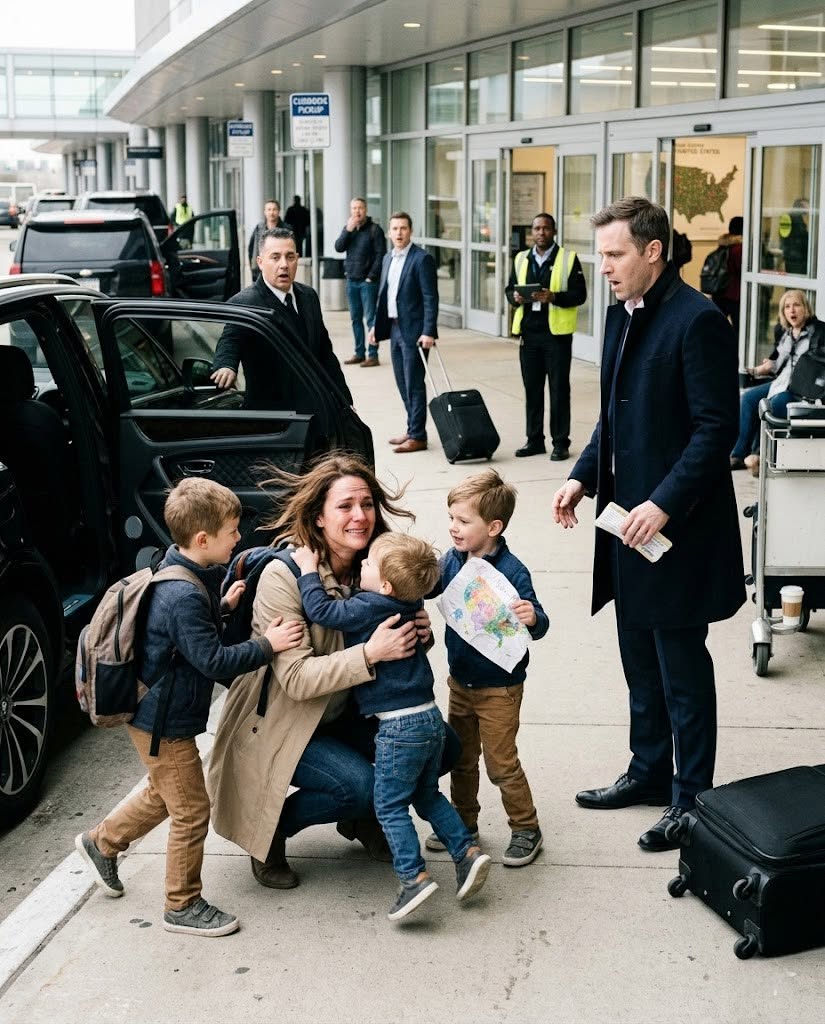
Before the driver reached the rear door, it flew open.
Three little bodies burst out.
“Mom!”
The sound went through me like sunlight.
My oldest reached me first, arms around my waist.
My middle boy grabbed my hand with both of his and started talking before I could hear the words.
The youngest slammed into me so hard I stepped back and laughed while tears blurred the curb, the cars, the morning.
“Hey, my sweet boys,” I whispered.
I kissed hair.
I checked coats.
I tied one shoelace with one hand while the other two leaned into me like I had been gone for a month instead of two days.
Then I looked up.
Harrison stood ten feet away.
He had not moved.
His carry-on sat beside his shoe.
His boarding pass was bent between his fingers.
All three boys had my eyes.
But they had his face.
There are truths the body recognizes before the mind permits them.
Harrison’s body understood first.
His shoulders dropped.
His mouth parted.
His color drained so quickly that the driver took half a step forward as if he might have to catch him.
“Chloe…” he whispered.
The boys went quiet because children always hear the change before adults admit it.
My oldest looked from Harrison to me.
Then my middle son, who never could leave a mystery alone, pulled a folded photo from his backpack.
I had not known he had it.
It was from a box in the hallway closet, one I opened once a year and regretted every time.
Our wedding photo.
Harrison and me in another life.
My son held it up with a frown.
“Mom,” he asked, “is this him?”
Harrison saw the picture.
Then he saw the boys.
Then he covered his mouth with his hand.
No one at that curb moved.
The driver stared at the pavement.
A traveler with a rolling suitcase stood frozen near the doors.
My youngest leaned against my leg and whispered, “Why does he look like us?”
That was the question.
Not legal.
Not polished.
Not filtered through attorneys.
Just a child asking why his face had been living on a stranger.
Harrison stepped closer.
“Are they…” he began.
I stood.
My hand rested on my youngest’s shoulder.
“Yes,” I said.
His eyes filled.
It shocked me, how human he looked when certainty left him.
“All three?” he asked.
“All three.”
He looked as if the pavement had shifted under him.
“I didn’t know.”
That sentence almost undid me.
Not because I believed it fully.
Because a part of me had waited five years to hear it, and the hearing was uglier than I expected.
“You chose not to know,” I said.
His eyes snapped to mine.
“I never got anything from you.”
“Yes, you did.”
“I didn’t.”
“My attorney sent notices. Medical updates. A copy of the birth record. Your office returned the first envelope. Your lawyer acknowledged the second. The third went unanswered.”
His hand fell from his mouth.
The boys were watching both of us now.
So I kept my voice low.
I would not turn their first meeting with their father into a public trial.
“You told everyone I betrayed you,” I said. “You told yourself I left because I was guilty. But the messages were about a pregnancy I was trying to confirm before I told you. The man you hated was the doctor coordinating the testing and appointments, not a lover.”
Harrison closed his eyes.
For one second, I saw the memory pass through him.
The phone.
The message.
His anger.
My voice begging him to listen.
When he opened his eyes, he was not crying the way people do in movies.
His grief was quieter.
More humiliating.
His eyes were wet, and his face looked stripped.
“What are their names?” he asked.
I told him.
One by one.
Each name landed like a debt.
The boys stared up at him.
My oldest stepped half behind me.
My middle boy clutched the wedding photo.
The youngest asked, “Are you mad?”
Harrison flinched.
“No,” he said quickly, crouching down until he was closer to their height. “No. I am not mad at you.”
“At Mom?”
His eyes lifted to mine.
“No,” he said again, and this time the word almost broke. “Not at your mom.”
That was the first honest thing he had said all day.
Maybe in five years.
We did not have a reunion at the curb.
Real life is not that generous.
There was no music.
No perfect apology.
No instant forgiveness because three children deserved better than being used as proof in an old argument.
I told Harrison he could speak to my attorney.
He nodded.
Then he asked if he could say goodbye to them.
I almost said no.
Not because they needed protection from a goodbye, but because I needed protection from watching it.
Still, I stepped aside.
He did not touch them at first.
He asked if it was okay.
My oldest nodded after a long pause.
Harrison held out his hand, and three small hands studied it like it was a strange object.
Then my youngest took one finger.
Just one.
Harrison’s face folded.
I turned away for a second because even anger has limits when children are watching.
The weeks after that were not simple.
Harrison hired lawyers, then fired them when they spoke about strategy instead of responsibility.
He requested a meeting.
I brought my attorney.
He brought a folder of questions and a face that looked ten years older.
There were tests, not because I needed them, but because the world runs on paper when trust has been destroyed.
The results said what my sons’ faces had already said at the curb.
Harrison Sterling was their father.
He did not fight child support.
He did not ask to erase the years.
He asked for a beginning he did not deserve.
I did not give him one quickly.
The boys met him in supervised little pieces.
A lunch.
A park walk.
A museum afternoon where he spent twenty minutes listening to one child explain dinosaurs with total seriousness.
He was awkward.
They noticed.
He was patient.
They noticed that too.
One evening, my oldest asked me, “Did Dad leave because of us?”
I sat beside him on the bed and felt the question hit the oldest wound.
“No,” I said. “He left because grown-ups sometimes make terrible choices when they are hurt and proud.”
“Did you want him to stay?”
I looked at the night-light on the wall.
“Yes,” I said. “At first.”
That was enough.
Children do not need every adult wound laid at their feet.
They need the floor to stay steady beneath them.
Months later, Harrison asked to speak to me alone after dropping the boys home.
We stood on the porch while the evening cooled around us.
There was a little mud on his expensive shoes because the boys had made him inspect a backyard worm situation before dinner.
That detail pleased me more than I wanted to admit.
“I read everything,” he said.
“The old files?”
He nodded.
“The letters. The returned envelope. The message thread. The appointment confirmations. All of it.”
I waited.
He swallowed.
“I did exactly what you said. I chose not to know.”
The porch light hummed above us.
Inside, one of the boys laughed so hard another one yelled, “Mom!”
Harrison looked toward the sound like it was both gift and punishment.
“I am sorry,” he said.
It was not enough.
No apology can hand back five first steps, five birthday mornings, five years of fevers, drawings, nightmares, and tiny shoes lined up by the door.
But it was not nothing.
That is the hardest thing about certain apologies.
They arrive too late to fix the damage, but still matter enough to hurt.
“I believe you are sorry,” I said.
His eyes closed briefly.
“I do not know how to live with what I missed.”
“You live with it by not making them carry it.”
He nodded.
That became our rule.
The boys would not be asked to heal him.
They would not become proof of his regret.
They would not perform forgiveness on command so a powerful man could feel redeemed.
He could show up.
He could listen.
He could earn every inch.
And slowly, in the ordinary ways that do not look impressive from the outside, he did.
He learned the dinosaur names.
He learned who hated peas.
He learned that one boy got quiet when overwhelmed and another covered fear with jokes.
He came to school events and stood in the back.
He brought snacks and forgot napkins.
He built a Lego set wrong and let the boys correct him for an hour.
He apologized to them in language they could understand.
He apologized to me in language I could believe.
We never became the couple from the magazines again.
That couple had been beautiful and fragile and too easy for strangers to admire.
We became something harder to photograph.
Two adults standing on opposite sides of a wound, deciding every day not to let our children fall into it.
People still ask whether I regret not forcing him to listen five years earlier.
They do not understand.
I did try.
I tried until trying became another way to bleed.
At some point, silence becomes information.
At some point, a woman has to stop begging a man to believe she is worth one more question.
Harrison thought I had spent five years regretting him.
He thought I had lost the life.
He thought I had been alone.
He was wrong.
I had been tired.
I had been scared.
I had been angry.
But I had also been loved every morning by three little voices yelling for pancakes, lost shoes, clean socks, bedtime stories, and one more hug.
The truth did break everything Harrison thought he knew.
But it did not break me.
It introduced him to the life he had missed, and it reminded me of the one I had built without waiting for him to come back.
Years later, when the boys ask about that day at the airport, I do not tell it like a revenge story.
I tell them their father made a terrible mistake, and then he spent a long time learning how to be better than the man who made it.
I tell them I was proud of them for running to me first.
I tell them that sometimes the most powerful thing a person can do is keep walking toward the people who already know how to love them.
And whenever Harrison hears that part, he looks down.
Not because he is ashamed of them.
Because he finally understands what he lost when he mistook cruelty for confidence and silence for proof.
He lost years.
He lost trust.
He almost lost the chance to be known by his own sons.
But at that curb in Chicago, three little boys ran into my arms, and the truth he had ignored for five years finally stood right in front of him.
This time, he listened.