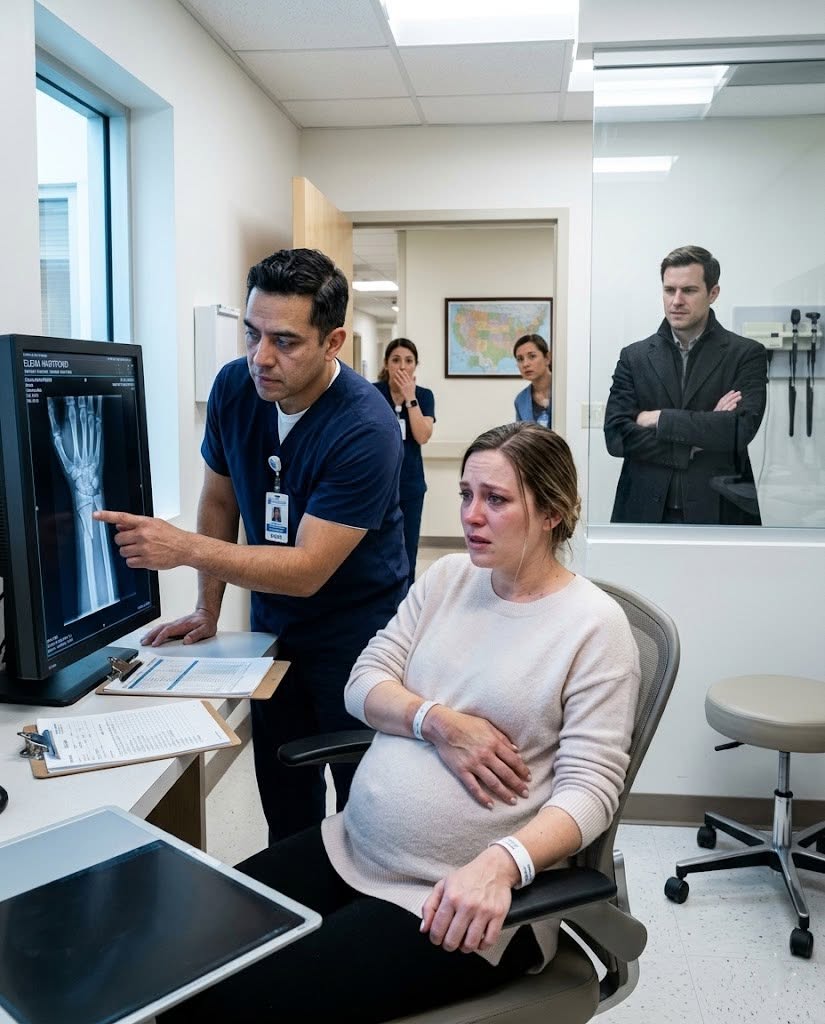
The sound of Elena Hartford’s wrist breaking was smaller than she thought a life-changing sound should be.
It did not fill the house.
It did not rattle the windows.
It did not wake the neighbors on that quiet Westchester street where every trimmed hedge and porch light made the houses look safer than they really were.
It was just a thin, dry crack under the warm kitchen lights, followed by the copper taste of blood because Elena had bitten the inside of her cheek to keep from making the wrong sound.
For one frozen second, there was no pain.

There was only the pan hissing on the stove, garlic burning black, white cabinets shining too clean, and Garrett Hartford’s polished shoes planted on the tile like he had walked into a meeting he controlled.
Then Elena looked down.
Her left wrist bent at an angle that made her stomach turn.
Her hand sat wrong against the curve of her eight-month belly, and the baby kicked hard beneath her ribs.
That frightened her more than the arm.
Garrett looked at the wrist, then at her face, then at the pan on the stove.
He did not look shocked.
He looked inconvenienced.
“Look what you made me do,” he said.
Elena held the broken arm close to her stomach and backed into the marble counter.
The edge hit her hip, and she had to swallow a sound that might have turned into a scream if she let it.
“I was at the doctor,” she whispered.
That was all.
That was the offense.
Her appointment at St. Matthew’s had run late because the baby was measuring big and the doctor wanted another ultrasound, another monitor strip, another note in the chart.
Elena had texted Garrett from the parking lot.
She had called twice.
He had not answered because he was in a meeting, and in Garrett’s world, a meeting always mattered more than whatever fear she was carrying.
She came home twenty-two minutes later than usual.
Dinner was not ready.
That was enough for Garrett to turn the kitchen into a courtroom and himself into the judge.
A certain kind of man does not need the truth to win.
He only needs everyone else to get tired of correcting him.
Garrett’s face had already started changing by the time Elena tried to breathe through the pain.
The rage left first.
Then came regret.
Then concern.
Then the careful tenderness that made other people trust him and made Elena feel the floor moving beneath her.
“Honey,” he said, stepping closer. “I didn’t mean that.”
She shook so badly he stopped.
The pain arrived all at once, a white-hot line shooting up her arm.
Her knees dipped.
She gripped the counter with her good hand because falling would give him a better story.
“You could have called,” he said.
“I did.”
His jaw tightened.
Not because she had lied.
Because she had answered.
He glanced at her wrist again, and Elena watched a plan settle into his eyes.
“We need to go to the hospital,” he said.
He grabbed his keys, phone, and wallet, then came back and touched the small of her back.
It was light.
Too light to bruise.
Just enough to remind her that he was still in charge.
“Come on,” he murmured. “Let me help you.”
She hated him most when he was gentle.
In the yelling, danger had a shape.
Afterward, it became polished and reasonable, like a lie wearing a clean shirt.
He settled her into the passenger seat of the black Range Rover and placed her small pregnancy pillow under her wrist as if he were a husband who noticed pain before causing it.
Every bump sent sparks up her arm.
Outside the window, the neighborhood looked calm in the way neighborhoods look calm when nobody has to see what happens behind the front door.
Brick houses.
Mailboxes.
Trimmed hedges.
Family SUVs tucked into driveways.
Everything looked safe from the street.
Garrett drove five minutes in silence.
Then he said, “You tripped on the stairs.”
Elena looked at the window.
“You were carrying laundry,” he continued. “You lost your balance. You fell. That is what happened.”
The baby shifted under her ribs.
“Can you hear me?”
She nodded once.
She knew the rules.
By the time they reached the emergency entrance at St. Matthew’s, Garrett had become the version of himself strangers always preferred.
Worried.
Attentive.
Terrified for his wife.
He rushed around the car, opened the door, and called for help before Elena could put both feet on the pavement.
“My wife fell,” he told the triage nurse. “She’s thirty-three weeks pregnant. I think she hurt her arm.”
The nurse looked at Elena.
Elena opened her mouth.
Garrett’s hand settled in the center of her back.
Not hard.
Just enough.
“Stairs,” Elena whispered.
They put her in a wheelchair.
The baby monitor came first, then the blood pressure cuff, then quiet questions behind the curtain.
A machine filled the room with steady beeps.
A hospital intake bracelet printed her name in black letters: ELENA HARTFORD.
The nurse wrote “fall at home” because that was the story Elena had been trained to survive.
Garrett answered half the questions before she could.
“They’ve been telling her to slow down for weeks,” he said, adding a small embarrassed laugh. “She never listens.”
The nurse looked at Elena for one second too long.
Elena looked down.
A doctor ordered X-rays of her wrist and forearm.
Garrett stood immediately.
“I’ll go with her.”
The radiology room was colder than the rest of the hospital, bright in that clean way that made every breath sound too loud.
The technician who came through the inner door was in his forties, broad-shouldered in navy scrubs, with tired eyes and a kind face.
His badge read MATEO RUIZ.
He glanced at Garrett.
Then at Elena’s chart.
Then at her wrist.
“Her husband can wait behind the protective glass,” Mateo said.
Garrett gave him the banker smile.
“She gets anxious without me.”
“It’s hospital policy,” Mateo replied.
For the first time that night, Garrett’s expression tightened.
Still, he stepped behind the glass, folded his arms, and watched.
Mateo positioned Elena’s arm with a gentleness that nearly undid her.
She bit down and tasted blood again.
“I know,” she whispered when she flinched. “I’m sorry.”
Mateo did not tell her not to be sorry.
He adjusted the plate.
He checked the screen.
Then he went still.
No gasp.
No shout.
Just a man in navy scrubs staring at an X-ray monitor while recognition moved across his face.
His eyes went from the image to Elena’s name on the file.
Then to the bruising at her wrist.
Then to her face.
“Mrs. Hartford,” he said quietly, “has anyone asked whether you feel safe going home tonight?”
The lump in Elena’s throat almost choked her.
Behind the glass, Garrett straightened.
Mateo tapped the screen once, as if making sure the image could not be argued with.
Then he looked at Elena with something she had not seen directed at her in a very long time.
Belief.
He finished the images.
He walked into the hallway.
As soon as the door shut behind him, he pulled out his phone, checked Elena’s name on the file one last time, and called the number he had been told to use if Elena Hartford ever showed up injured and afraid.
Six minutes later, the elevator doors at the end of the corridor opened.
Garrett’s smile slipped.
The woman walking out with two agents was not hospital security.
Her eyes landed on Elena first.
“Mrs. Hartford,” she said, “don’t look at him. Look at me.”
The words were simple, but Elena felt them move through the hallway like a hand reaching through water.
Garrett lifted both palms slightly.
“I’m sorry,” he said. “Who are you?”
One of the agents stepped between him and Elena’s wheelchair before he could move closer.
Mateo came back holding the X-ray packet and the intake form.
The triage nurse stood near the counter, her hand over her mouth now, staring at the line she had written.
Fall at home.
Elena saw her see it differently.
The woman in the navy blazer took a folded patient-safety note from Mateo.
It had been clipped behind Elena’s chart, easy to miss if no one knew to look.
Elena’s name was at the top.
Beside it was one instruction.
Call this number if she arrives injured.
Garrett saw it.
For once, he did not correct anyone.
He did not smile.
He did not touch Elena’s back.
His face simply emptied.
“Garrett,” Elena whispered.
She did not know whether she was asking him a question or saying goodbye to the version of her life she had been pretending was survivable.
The woman looked at him.
“Mr. Hartford, before you say another word, you should understand that the X-ray is not the only record we came here for.”
Garrett blinked once.
Then twice.
He looked toward the nurse, then Mateo, then Elena, as if one of them might return the script to him.
Nobody did.
The agent opened the folder in her hand.
“Mrs. Hartford,” she said, still watching Garrett, “did your husband do this to you tonight?”
Elena’s good hand pressed against her belly.
The baby kicked again.
This time, the kick did not feel like panic.
It felt like a small, fierce reminder that someone inside her was still alive, still moving, still waiting for her to choose the truth.
Garrett’s voice dropped.
“Elena.”
The agent turned her head slightly.
“Do not answer him. Answer me.”
The hallway became silent in the strange way public places become silent when everyone realizes a private lie has finally stepped into the light.
A nurse stopped pushing a supply cart.
A man in a visitor badge lowered his paper coffee cup.
Mateo stood with the X-ray packet against his chest, his thumb pressed so hard into the folder corner it bent.
Elena looked at Garrett.
She saw the face other people loved.
She saw the magazine smile.
She saw the donor dinners, the careful photos, the way strangers thanked him for generosity he could afford.
Then she saw the kitchen.
The garlic burning.
The marble counter.
The tiny sound of bone giving way.
“Yes,” she said.
The word did not come out loud.
It did not need to.
Garrett’s mouth opened.
“Absolutely not,” he said. “She’s in shock. She’s confused. She fell. She told the nurse she fell.”
The nurse’s face crumpled.
“She said that with you touching her back,” Mateo said.
Garrett turned on him so fast that Elena flinched.
The agent saw it.
So did everyone else.
“Mr. Hartford,” the second agent said, “step away from your wife.”
“My wife is pregnant,” Garrett snapped. “She needs me.”
“No,” Elena said.
It was the second word.
It came out stronger than the first.
The agent’s face did not change, but something in her eyes softened.
“Elena,” Garrett said, and now there was warning under the polish. “You do not want to do this here.”
That was the sentence that finally broke something clean inside her.
Not her wrist.
Not her marriage.
The fear.
She looked at him and understood that he had never been afraid of hurting her.
He had been afraid of being seen.
“I already did it there,” she said, nodding toward the kitchen that was not in the hospital but was still burning in her mind. “I covered for you there. I am not doing it here.”
The agent gave the smallest nod.
The doctor arrived with security and an obstetric nurse, and Garrett tried to recover his charm so quickly it almost looked painful.
He asked for a private room.
He asked to call his attorney.
He asked whether everyone understood who he was.
Nobody answered the question he wanted answered.
The two agents escorted him away from the radiology doorway, not roughly, not dramatically, but with the quiet certainty of people who had already decided the room no longer belonged to him.
His voice echoed once down the corridor.
“Elena, tell them.”
She did not.
The obstetric nurse crouched in front of her wheelchair and checked the fetal monitor strap with careful hands.
The baby’s heartbeat filled the small space in fast, steady beats.
For the first time all night, Elena cried.
Not because Garrett was gone.
Because the sound proved something he had made her forget.
She and the baby were still here.
Mateo stood near the doorway, giving her space.
“I’m sorry,” he said.
Elena wiped her face with the heel of her good hand.
“For what?”
“For needing an X-ray to make the room believe you.”
She looked at the packet in his hands.
Then at the nurse.
Then down at her hospital bracelet.
Her name looked so plain there.
So official.
So impossible to erase.
The woman in the navy blazer came back after a few minutes and pulled a chair close enough that Elena would not have to strain to hear her.
She explained only what Elena needed to know right then.
Garrett’s company had already been under federal scrutiny.
There had been questions about forged signatures, missing investor money, and pressure placed on people who knew too much.
Elena’s name had appeared where it should not have appeared.
Weeks earlier, after one appointment when Elena had quietly asked a nurse what happened if a woman was afraid to go home, a safety note had been created in the system.
That note had not saved her from the kitchen.
But it had found her in radiology.
It had found her before Garrett could drive her home with a cast and a better lie.
Elena listened without interrupting.
Every sentence felt too large to hold.
She had thought her world was only a house, a husband, a baby, a wrist, a dinner that was twenty-two minutes late.
Now she understood that Garrett’s control had reached farther than the kitchen.
It had names on papers.
Money in accounts.
People afraid to speak.
Her silence had been one piece of a larger machine.
The agent did not ask her to be brave.
That helped.
People always talk about bravery like it is a clean door you walk through.
Most of the time, it is just a shaking hand signing the truth while your whole body wants to apologize.
The doctor set her wrist.
The pain was awful, but it was honest.
There was no pretending it was anything else.
The baby was checked again, and the nurse said the heartbeat was strong.
When a social worker came in, Elena expected to feel ashamed.
Instead, she felt tired.
A deep, old tiredness that had been living in her bones longer than the fracture.
By morning, Garrett’s attorney had called twice.
Elena did not take either call.
Her phone sat on the rolling tray beside a paper cup of hospital water, a stack of discharge forms, and the X-ray packet Mateo had signed.
The triage nurse came in before her shift ended.
She stood at the foot of the bed for a moment, twisting her badge between her fingers.
“I’m sorry I wrote it down the way he said it,” she told Elena.
Elena looked at her.
Then she looked at the cast on her arm.
“I said it too.”
The nurse’s eyes filled.
“You were trying to survive.”
That sentence stayed with Elena longer than anything Garrett had ever said.
Later, when the agents returned, they asked whether she could give a statement.
Elena looked through the narrow hospital window at the pale morning over the parking lot.
The Range Rover was still outside.
For some reason, that made her laugh once, softly and without humor.
It looked expensive.
It looked untouched.
It looked like the life Garrett had built for strangers to admire.
Inside, her wrist throbbed beneath the cast, her cheek hurt where she had bitten it, and the baby shifted as if turning toward the sound of her breath.
“Yes,” Elena said.
The agent opened her notebook.
Mateo had already given his account.
The nurse had added hers.
The doctor had documented the fracture, the bruising, the inconsistency, and Elena’s delayed answer when Garrett was present.
There were records now.
Not just feelings.
Not just fear.
Records.
Elena told them about the kitchen.
She told them about the garlic.
She told them about the stairs that had never happened.
She told them about the hand on her back.
She told them what it felt like to be trained into a lie so thoroughly that the lie came out of her mouth before the truth could stand up.
When she finished, nobody told her she should have left sooner.
Nobody asked why she stayed.
The agent only closed the notebook and said, “Thank you.”
That was when Elena understood how low Garrett had trained her expectations to be.
Being believed felt like mercy.
It should have been normal.
By the time Elena left St. Matthew’s, she did not leave with Garrett.
She left through a side exit in a wheelchair, with a cast on her arm, discharge papers in a plain folder, and a safety plan tucked underneath them.
The morning air was cold.
A nurse rolled her past the row of parked cars, past the Range Rover, past the life that still looked safe from the outside.
Elena did not look at it for long.
She looked down at her belly.
The baby kicked once.
This time, Elena smiled.
Not because the story was over.
It was not.
There would be statements, attorneys, medical appointments, and long nights when fear tried to make her reach for the old script.
There would be people who said they could not believe Garrett would do that.
There would be people who believed the house, the car, the photos, the smile.
But there would also be an X-ray.
A chart.
A nurse’s amended note.
A technician who noticed her name.
A phone call placed at the exact moment Garrett thought he still controlled the room.
And there would be Elena, finally telling the truth in her own voice.
The first life-changing sound had been small and cruel.
The second was even smaller.
A whispered yes in a hospital corridor.
But that one did not break her.
That one opened the door.