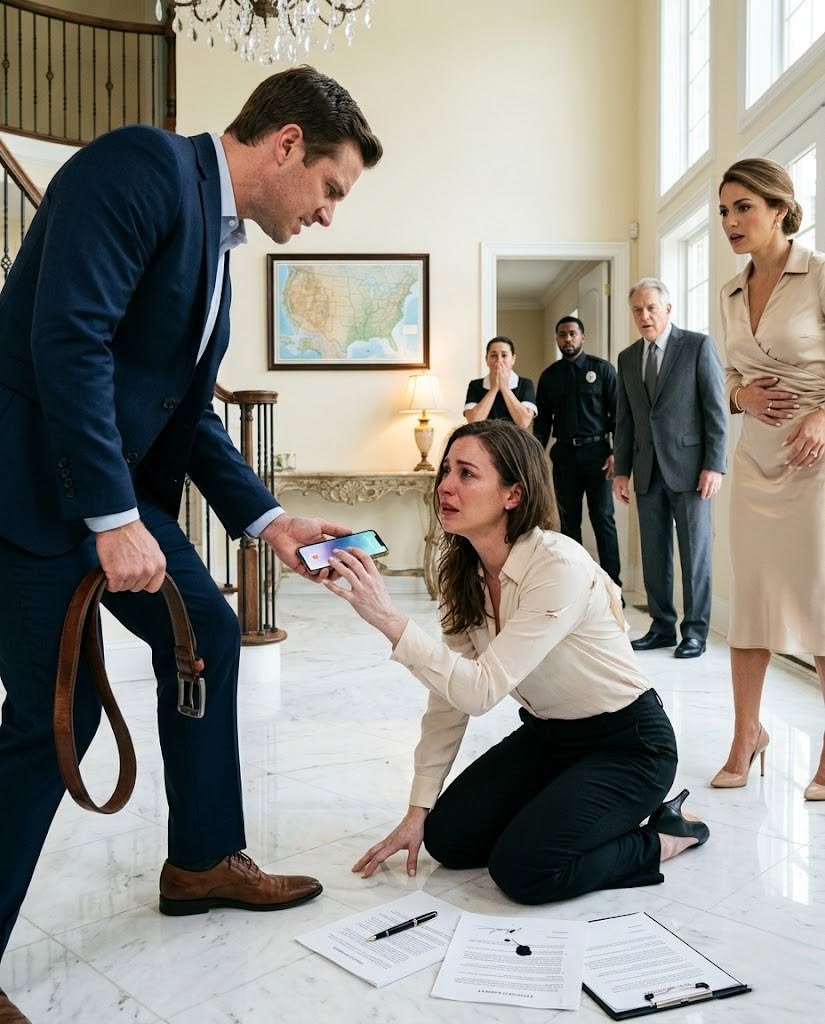
The first strike landed before I believed Nathaniel would really do it.
There is a strange second when pain arrives faster than understanding.
Your body knows first.
Your mind catches up later.
Leather cracked through the marble entry hall, sharp and ugly, and my breath broke somewhere in my chest.
I was not standing in a dark alley or a stranger’s house.

I was in my own home.
A Bel Air estate with a curved staircase, white marble floors, a chandelier Nathaniel had flown in from Italy, and a framed map of the United States hanging near the office hallway because he liked investors to think he was building a national empire.
That was the kind of man my husband had become.
He arranged symbols around himself until people mistook decoration for character.
Savannah stood beside him in a champagne silk dress and watched like the scene had been staged for her approval.
The dress caught the chandelier light every time she shifted.
So did the diamond bracelet on her wrist.
I knew both charges.
I had paid both balances quietly through accounts Nathaniel told me not to ask about.
“Look at her,” Savannah said, her voice soft and pleased. “She’s still pretending she’s the victim.”
I pressed one palm to the floor and tried to breathe through the fire across my back.
The marble was cold under my fingers.
The whole hall smelled like whiskey, expensive perfume, and the copper edge of blood.
Nathaniel adjusted his cuffs like the belt had been an inconvenience to his tailoring.
He wore the navy suit he saved for directors’ dinners.
The one that made him look controlled.
Successful.
Safe.
For years, people had told me I was lucky.
Nathaniel Cross was handsome in a way that made strangers forgive him before he even spoke.
He had a warm voice in public, a careful smile, and the ability to make cruelty sound like strategy.
At charity lunches, women leaned toward me and said, “You must be so proud of him.”
I always smiled.
I had learned early that silence made fewer messes.
I met Nathaniel at twenty-eight, when he was ambitious, brilliant, and already angry at the world for not recognizing him fast enough.
He told me he wanted to build something permanent.
He told me I calmed him.
He told me I was the first person who believed in the man he would become.
That was not entirely true.
My father believed in him too, once.
Or at least, my father believed in me enough to test him.
Nathaniel never understood the difference.
To Nathaniel, my father was Eddie Whitmore, the man with grease under his nails who showed up at our small engagement dinner in work boots because he had driven straight from what Nathaniel thought was a repair shop.
My father had smiled that night and let Nathaniel talk.
He let him brag about leverage, acquisition targets, and market timing.
He let him explain business like he was teaching a beginner.
Then my father went home, called me once, and said, “Be careful with men who need an audience to feel tall.”
I should have listened harder.
For three years, I played the wife Nathaniel wanted.
I wore quiet colors.
I hosted dinners.
I remembered birthdays for men who could not remember my name.
I sat through investor calls where Nathaniel said “my company” and “my risk” and “my vision” as if the first bridge loan had not come through a private channel my father opened after I asked for one favor.
I never corrected him.
Not once.
Maybe that was love.
Maybe it was cowardice.
Maybe it was the dangerous habit women learn when peace becomes more important than truth.
Tonight had started at the long dining table in the west room.
Six board members had come with their spouses.
Savannah arrived late, laughing too loudly, one hand on Nathaniel’s shoulder as though she had been invited into the marriage instead of the house.
At 9:18 p.m., she told the table people had questions.
She said it lightly, with a little smile, while the staff changed plates behind us.
“Questions about what?” I asked.
Savannah tilted her head.
“About why there’s still no heir. You know how old families talk.”
One of the wives looked down at her salad.
Another took a long drink of wine.
Nathaniel did not defend me.
He watched Savannah, not me.
At 9:26 p.m., Savannah laughed and said some women married into power because they could not build any of their own.
The finance committee chair cleared his throat.
His wife stared at the centerpiece.
Nobody moved to help me.
There is a special kind of humiliation that happens in expensive rooms.
It arrives wrapped in manners.
People call it awkward instead of cruel because the glasses are crystal and the napkins are folded.
I sat there with my hands in my lap and felt every eye choosing a side by choosing silence.
At 9:44 p.m., Nathaniel stood.
“We’re done,” he said.
The room went quiet.
I followed him into the entry hall because part of me still believed this would become an argument, not a punishment.
Savannah followed too.
That should have told me everything.
The belt was hanging near the coat closet, looped through a tan leather bag Nathaniel used for weekend trips.
When he pulled it free, I froze.
“Nathaniel,” I said.
He did not look like my husband then.
He looked like a man trying to impress someone watching.
The first strike landed.
Savannah smiled.
The second made my knee hit the marble.
The third turned the chandelier into a blur of white light.
By the time it stopped, I could hear my own breath louder than anything else in the room.
Savannah touched her stomach.
“Nathaniel, darling,” she said, “tell the maid to bring sparkling water. The baby can’t stand the smell of whiskey.”
That was how she announced it.
Not with shame.
Not even with fear.
With ownership.
Nathaniel slipped the belt down to his side and looked at me as if I had become furniture he meant to remove.
“You humiliated Savannah tonight,” he said.
I laughed once, but it came out broken.
“She told your directors I couldn’t have children.”
Savannah lifted one shoulder.
“I said people had questions.”
“She said I married you for money.”
Nathaniel tilted his head.
“Didn’t you?”
The words hurt more than the belt.
Pain can be survived by the body.
Betrayal has to be survived by the story you told yourself.
Mine collapsed right there on the marble.
Nathaniel walked to the console table and picked up a leather folder.
He had prepared it.
That was the detail that steadied me.
Not anger.
Preparation.
Not one drunken loss of control, not one cruel mistake, not one fight gone too far.
Paperwork.
A plan.
A deadline.
He threw the stack at my knees.
The top page slid across the marble and stopped against my wrist.
Spousal asset transfer.
Confidential separation agreement.
Emergency removal authorization.
A signature pad blinked beside an expensive fountain pen.
The time in the corner read 10:07 p.m.
Nathaniel had always loved timestamps when they protected him.
He had forgotten they could protect me too.
“Sign,” he said.
I looked up at him.
Savannah stepped closer, her silk dress whispering against her legs.
“Be practical, Isabella,” she said. “You don’t have anywhere else to go.”
Nathaniel wrapped one arm around her waist.
“Savannah is carrying my child,” he said. “She is giving me the future of the Cross family. As of tonight, you are no longer part of my life.”
The housekeeper, Maria, had stopped near the hallway with a tray in her hands.
She was pretending not to see.
A security staff member hovered near the front corridor.
He looked at the belt.
Then at Nathaniel.
Then at the floor.
Nobody moved.
I do not blame them as cleanly as I once thought I would.
Fear makes people small in ways they spend years explaining to themselves.
But I remember the silence.
I remember every person who chose it.
Nathaniel crouched just enough to bring his face closer to mine.
“Chief Harris from the Los Angeles Police Department owes me a favor,” he said. “If you refuse, he’ll remove you in handcuffs.”
It was a ridiculous threat.
It was also exactly the kind of threat that works when a woman is bleeding, cornered, and surrounded by people who have already decided her pain is inconvenient.
I looked at the signature pad.
Then at the legal pages.
Then at Savannah’s hand resting on her stomach.
“Fine,” I said.
Savannah blinked.
Nathaniel smiled.
He mistook obedience for surrender because that was what he had trained himself to expect from me.
I pressed my thumb to the pad.
Blood had dried near the nail.
The machine beeped.
Nathaniel exhaled like a man taking possession of a building.
Savannah gave a tiny laugh.
In that exact second, something inside me went quiet.
Not numb.
Clear.
I had spent three years trying to save a marriage with a man who had been studying how to profit from its ending.
He thought the agreement was his trap.
It was about to become my receipt.
I reached into my pocket.
Nathaniel’s eyes narrowed.
“What are you doing?”
“Calling my father,” I said.
Savannah laughed before she could stop herself.
It was a small sound, but it filled the hall.
“Your father?” she said. “The mechanic?”
Nathaniel snatched the phone from my hand before the call could ring twice.
He hit speaker and held it out like a microphone.
“Good,” he said. “Let’s tell your broke mechanic father what a disappointment his daughter really is.”
The line clicked.
A low breath came through the speaker.
Nathaniel leaned toward it, smiling.
“Hey, old man. Your daughter is barren, worthless, and—”
“Nathaniel Cross.”
My father’s voice filled the entry hall.
Everything stopped.
It was not the voice Nathaniel expected.
There was no uncertainty in it.
No pleading.
No workingman’s embarrassment for Nathaniel to mock.
It was the voice of the man Nathaniel had spent years quoting in boardrooms.
Edward Whitmore.
Founder of Whitmore Global.
Private investor.
The man on three business magazine covers Nathaniel kept in his office like religious icons.
The man Nathaniel had tried to meet at two conferences and one private dinner.
My father.
Savannah’s smile fell so quickly it almost looked painful.
Nathaniel’s fingers tightened around my phone.
“Edward?” he whispered.
My father did not answer the question.
He did not need to.
“You touched my daughter,” he said. “You forced her signature. You put your mistress on speaker for a witness. Thank you for making this efficient.”
Nathaniel looked down at me.
For the first time all night, he seemed uncertain where the floor was.
“This is a private matter,” he said.
“It was,” my father replied. “Until 10:07 p.m.”
The signature pad beside me blinked again.
Nathaniel saw it.
So did Savannah.
So did Maria in the hallway, who slowly lowered the tray to the console table with shaking hands.
My father continued.
“At 10:07 p.m., Isabella’s biometric signature was taken under visible coercion in a house where three cameras are currently active, one staff witness is present, and a forced asset transfer agreement was initiated from a device registered to your office.”
Nathaniel swallowed.
“You don’t know what you’re talking about.”
“I know exactly what I’m talking about,” my father said. “I also know where the first twenty-two million dollars in Cross Meridian Holdings came from.”
Savannah turned toward Nathaniel.
“What is he saying?”
Nathaniel did not look at her.
The gate buzzer screamed through the hall.
A second later, the security monitor beside the console table lit up.
Two black SUVs stood outside the front gate, headlights cutting through the driveway.
A woman in a charcoal suit faced the camera with a leather folder held against her chest.
Beside her stood another woman with a tablet, and a man carrying a sealed document box.
My father’s voice dropped.
“I did not come myself. I sent the people who know where every dollar came from.”
Savannah stepped back.
The heel of one shoe caught the edge of the scattered agreement.
The pages slid under her foot.
Nathaniel stared at the monitor.
“No,” he said. “You can’t do this.”
“I already did,” my father said.
The gate opened.
The security guard did not ask Nathaniel for permission.
He pressed the button with a hand that was visibly shaking.
That was the first visible shift in the room.
Power is not always loud when it changes hands.
Sometimes it is a gate opening for the person everyone was told did not matter.
The woman in the charcoal suit entered the hall three minutes later.
She did not look surprised by the marble, the chandelier, Savannah’s dress, or Nathaniel’s suit.
People like her had seen men like him before.
Her eyes moved to me first.
Then to the belt.
Then to the phone in Nathaniel’s hand.
“Mrs. Cross,” she said, “my name is Claire Bennett. I represent Edward Whitmore and the Whitmore Family Trust. Are you able to stand?”
Nathaniel barked out a laugh that sounded nothing like humor.
“This is absurd. She signed. She signed willingly.”
Claire looked at the legal pages on the floor.
“Did she?”
Her tone was almost gentle.
That made Nathaniel angrier.
“Get out of my house.”
Claire opened the folder.
“Your house is titled through a financing structure secured by Whitmore-controlled instruments. Your company’s primary credit facility is also tied to a personal conduct clause you signed on March 14, three years ago, witnessed by your own counsel.”
Savannah looked at Nathaniel again.
This time there was fear in her face.
“What personal conduct clause?”
Nathaniel snapped, “Be quiet.”
Claire removed a document and held it where he could see the heading.
Conditional Capital Covenant.
I had seen it once.
At my father’s kitchen table.
Before the wedding.
He slid it toward Nathaniel and said, “If you want my backing, you will sign this because my daughter is not collateral.”
Nathaniel signed.
Then he spent three years pretending the money came from him.
Claire turned one page.
“Clause nine,” she said. “Domestic coercion, fraudulent transfer of spousal assets, reputational misconduct, or documented abuse triggers immediate review and potential acceleration of all outstanding obligations.”
Nathaniel’s mouth opened.
No words came out.
Savannah’s hand slid from her stomach.
“Nathaniel,” she whispered, “what does that mean?”
I answered before he could.
“It means my father didn’t give him an empire. He leased him the chance to build one.”
The words hung there.
For three years, I had let Nathaniel own the story.
For three years, he let people believe I was lucky to have been chosen.
Now the story had witnesses.
Claire looked at the security staff member.
“Please preserve all hallway footage from 9:30 p.m. forward. Do not delete, overwrite, or transfer anything. You will receive a preservation notice within the hour.”
The man nodded too quickly.
Maria covered her mouth.
Savannah sat down on the bottom stair as if her legs had stopped trusting her.
“I didn’t know,” she said.
No one asked her what part.
Nathaniel tried to recover.
Men like him always do.
They mistake a pause for an opening.
“Isabella,” he said, softer now. “This got out of hand.”
I looked at him.
There was blood drying near my thumb, his papers at my knees, and my phone still in his hand.
“No,” I said. “It got documented.”
Claire’s mouth barely moved, but I saw the smallest flicker of approval.
My father was still on speaker.
“Bella,” he said.
That one word almost broke me.
Not because it was dramatic.
Because it was ordinary.
It was what he called me when I was seven and scraped my knee outside his garage.
It was what he called me when I was seventeen and cried in his old pickup because a teacher said scholarship girls should be grateful.
It was what he called me the night before my wedding, when he told me that love should make my world bigger, not smaller.
I closed my eyes.
“I’m here,” I said.
“Good,” he replied. “You do exactly what Claire tells you. Nothing else.”
Nathaniel laughed again, but now the sound was thin.
“You think you can take my company because of a marital disagreement?”
Claire looked at him with the exhaustion of a woman hearing the same bad lie in a better suit.
“No, Mr. Cross,” she said. “We can take action because of the documents you signed, the transfer you initiated tonight, the recorded call you created, and the footage your own house captured.”
She turned to the man with the sealed document box.
He placed it on the console table.
Nathaniel stared at it.
The label on top read Cross Meridian Holdings Review File.
Savannah saw it too.
Her lips parted.
“Review file?” she asked.
Claire opened the lid.
Inside were copies of wire transfer ledgers, account authorizations, board notes, and correspondence.
The kind of paper Nathaniel loved when it proved he was powerful.
The kind that destroys men who forget paper keeps memory better than people do.
Claire lifted one packet.
“This is the emergency notice to your board.”
She lifted another.
“This is the preservation demand.”
Then she lifted a third envelope, smaller and cream-colored.
My name was written across the front.
Nathaniel went completely still.
That was when I understood there was something even I had not been told.
Claire handed it to me.
“Your father asked me to give this to you only if Mr. Cross forced the issue before you were ready.”
My hands shook as I opened it.
Inside was a single page.
A trust appointment document.
My full legal name appeared on the second line.
Isabella Whitmore Cross, Successor Managing Trustee.
I read it twice before I understood.
Nathaniel understood faster.
“No,” he whispered.
Savannah stood from the stair.
“What does that mean?”
Claire answered, still watching Nathaniel.
“It means Mrs. Cross has authority over the Whitmore-controlled holdings tied to your husband’s company. Effective upon documented coercion or incapacity concerns.”
The room seemed to tilt.
Nathaniel stepped toward me.
Claire stepped between us.
She did not raise her voice.
She did not need to.
“Do not move closer to her.”
He stopped.
That was the second shift.
The first was the gate opening.
The second was Nathaniel obeying a woman he could not charm, threaten, or buy.
I stood slowly.
My knees shook.
Maria moved forward, then stopped, unsure if she was allowed to help.
I held out my hand.
She came immediately.
Her arm went around my waist with a gentleness that made my throat close.
“I’m sorry,” she whispered.
I believed her.
Fear had made her small.
But she came when she could.
Nathaniel watched us like the room had betrayed him personally.
“Isabella,” he said, “listen to me.”
I turned.
There he was.
My husband.
The man who had once brought me coffee in bed because I had stayed up all night helping him rehearse a pitch.
The man who cried when his first board seat was approved.
The man who told me no one understood him like I did.
The man who had just called me barren, worthless, and disposable to impress the woman carrying his child.
“I did listen,” I said. “For three years.”
Savannah made a small sound.
It was not a sob yet.
It was the sound of a woman realizing the story she had bought did not include the debt attached to it.
“Nathaniel,” she whispered, “you said she had nothing.”
He closed his eyes.
That was answer enough.
My father’s voice came through the speaker again.
“Bella, you do not need to say anything more tonight.”
But I did.
Not a speech.
Not revenge.
Just the truth, finally placed in the room where the lies had been living.
I looked at Savannah first.
“I hope you never have to learn what it feels like to be reduced to whether your body gives a man what he wants.”
Her face crumpled.
Then I looked at Nathaniel.
“And I hope you remember this moment every time you tell someone you built your empire alone.”
Claire handed me my phone after Nathaniel surrendered it without being asked twice.
His fingers brushed mine.
He flinched like I was the dangerous one.
Maybe, by then, I was.
Not dangerous like him.
Not violent.
Not cruel.
Dangerous because I no longer needed him to agree with the truth before I lived by it.
The next hour unfolded in clean, precise motions.
Claire photographed the papers.
The security footage was preserved.
Maria gave a statement.
The guard gave his.
The signature pad was sealed in an evidence bag by Claire’s investigator, who labeled it with the time and device number.
A medical team arrived through the side entrance because my father had insisted.
I did not want to go to the hospital.
I said that twice.
Then Maria looked at me with wet eyes and said, “Please.”
So I went.
Not because Nathaniel had broken me.
Because someone finally asked me to protect myself.
By 1:43 a.m., I was in a private exam room with a hospital intake form on my lap and a paper cup of water in my hand.
Claire sat outside the curtain, speaking quietly into her phone.
My father arrived at 2:10 a.m.
He was wearing the same old work jacket he had worn to my engagement dinner.
There was still a faint line of grease near one cuff.
Nathaniel had seen that jacket and thought he understood the man inside it.
That was his first mistake.
My father stepped into the room and stopped.
For a second, Edward Whitmore disappeared.
The billionaire, the founder, the man who could move markets with a call, all of it fell away.
He was just my dad.
His face changed when he saw my back.
I had not seen that expression since my mother’s funeral.
“Bella,” he said.
I tried to be strong.
That lasted exactly three seconds.
Then I cried so hard the paper cup bent in my hand.
He sat beside me and did not tell me to calm down.
He did not say he warned me.
He did not say anything grand.
He just took the cup, set it on the tray, and held my hand until the shaking slowed.
Love is not always a speech.
Sometimes it is someone taking the thing you are crushing before it cuts your palm.
By morning, Nathaniel’s board had received the notice.
By noon, the emergency review had frozen two credit lines.
By the next afternoon, Savannah had left the estate with one suitcase, sunglasses, and no champagne dress.
I do not know whether she loved him.
I know she loved the version of him that came with marble floors and other people’s silence.
That version was gone.
Nathaniel called me seventeen times in two days.
I answered none of them.
He sent flowers.
Claire had them photographed, logged, and returned.
He sent an email with the subject line We Need To Talk.
My attorney replied with one sentence.
All further communication will be through counsel.
The divorce did not happen overnight.
Stories like this never end as quickly as people think.
There were filings, statements, medical records, financial disclosures, and board interviews.
There were mornings when I still woke up reaching for an apology that would never be honest enough to matter.
There were afternoons when I found one of his cufflinks in a drawer and had to sit on the floor until the room stopped spinning.
Leaving does not erase the years.
It only stops them from taking more.
Three months later, I walked into a boardroom Nathaniel used to dominate.
I wore a gray suit, low heels, and my mother’s small gold bracelet.
My father sat at one end of the table.
Claire sat beside me.
Nathaniel sat across from us, thinner than before, his tie slightly crooked.
For once, nobody rushed to fix it for him.
The directors would not look at him for long.
The finance committee chair looked at me, then down at the folder in front of him.
I remembered him from the dinner.
I remembered his silence.
He remembered it too.
That was enough.
Claire presented the final review.
The forced transfer was voided.
The personal conduct clause had been triggered.
Nathaniel was removed from operational control pending restructuring.
Cross Meridian Holdings would not vanish, but it would no longer be his stage.
When the vote passed, Nathaniel stared at me.
There was no belt in his hand.
No mistress beside him.
No room laughing along.
Just the truth, documented and witnessed.
“You destroyed me,” he said.
I looked at the man I had loved, the man I had excused, the man I had mistaken for a future.
“No,” I said. “I stopped helping you hide what you were.”
He looked away first.
That was the last time I saw him in person.
Months later, people still asked why I had stayed so long.
They asked it gently, most of them.
Some asked it with judgment dressed up as concern.
I never gave them the full answer.
Because the full answer is never simple.
You stay because the first year was beautiful.
You stay because the apology sounds real.
You stay because everyone admires him.
You stay because leaving feels like admitting the people who warned you were right.
You stay because shame is heavy, and sometimes it is easier to carry quietly than unpack in public.
But I also tell them this.
An entire room once watched me on the floor and acted like silence was the polite response.
That room taught me something I will never forget.
It taught me that silence protects the person with power, not the person in pain.
So now I speak.
Not loudly every day.
Not perfectly.
But clearly.
My father still wears that old work jacket sometimes.
He says it keeps him humble.
I think he wears it because it reminds men like Nathaniel not to trust the costume they invented for someone else.
And every time I see the faint grease line near the cuff, I remember the night my husband put my father on speaker to humiliate me.
I remember Nathaniel smiling.
I remember Savannah laughing.
I remember the whole marble hall holding its breath when my father said his name.
Then I remember the gate opening.
And I remember standing up.