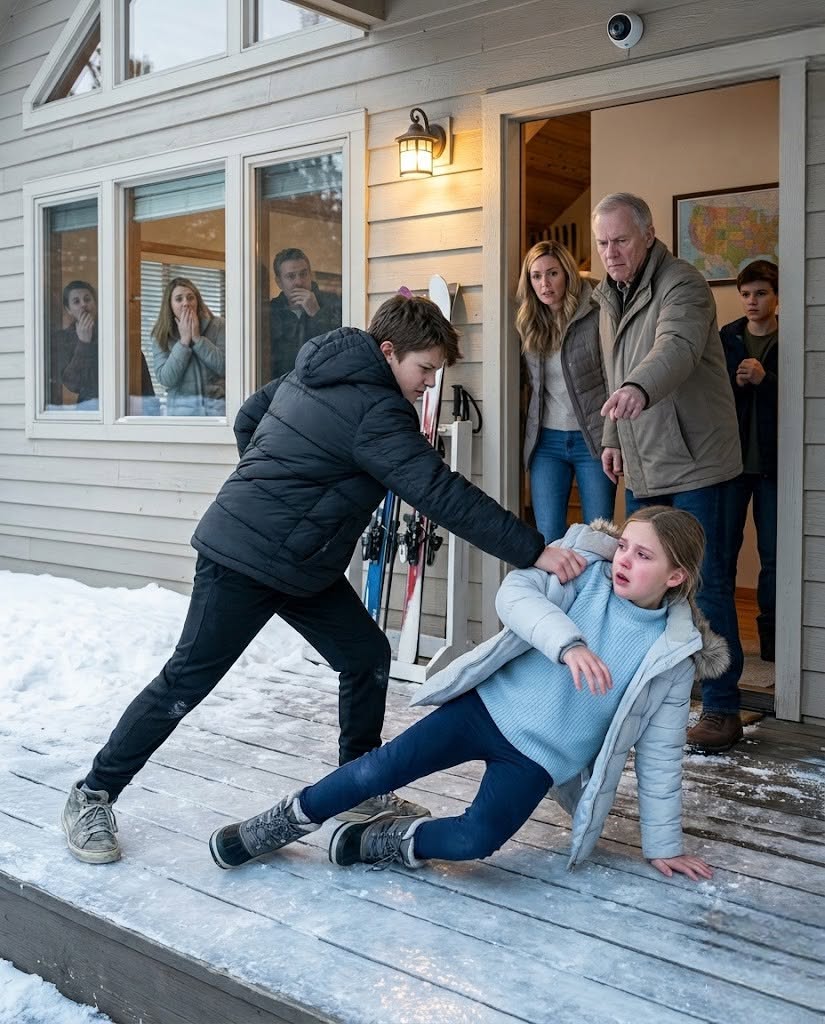
After I paid for my father’s bills and the Christmas cabin, my nephew shoved my 10-year-old onto the icy porch.
Dad looked at her swollen shoulder and ordered, “Apologize to Bryce right now. In this family, my grandson does whatever he wants.”
I did not argue.

I saved the rental-cabin security footage showing the shove and the hospital report saying the impact dislocated Peyton’s shoulder.
And later, at the pharmacy counter, Dad’s card was declined and he went pale.
The wind outside that mountain rental had a cruel edge to it, the kind that slid under sleeves and made every breath feel sharp.
But it was not the cold that froze me in the doorway.
It was Peyton.
My daughter was sitting on the icy porch boards with one hand clamped over her right shoulder, her knees pulled half-under her, her face gone a frightening gray.
She was trying not to scream.
That was what I noticed first.
Not the way she had fallen.
Not the ice.
Not Bryce standing nearby.
My child was trying to be quiet because our family had trained her to believe pain was only acceptable if it did not inconvenience anyone else.
Bryce, my brother Nelson’s son, stood a few feet away in his winter coat, breathing hard through his nose.
He was fourteen, big for his age, and old enough to know exactly what he had done.
Peyton was ten.
She still slept with a night-light when we traveled.
She still asked me to check the closet in unfamiliar rooms, even though she pretended she was joking.
She still tried to make homemade Christmas cards for people who barely remembered to call her.
My father had seen the whole thing.
He had been standing near the door when Bryce lowered his shoulder and drove into her.
He had watched Peyton hit the boards hard enough that the ski rack beside the entrance rattled against the wood siding.
He had seen her curl around herself, unable to get up.
And he did not kneel.
He did not ask if she could move her fingers.
He stepped over her boot and pointed down at her like she was a stain he wanted scrubbed out of the holiday.
“Apologize to your cousin,” he snapped.
Peyton’s lips trembled.
“He pushed me,” she whispered.
Dad’s eyes did not even soften.
“In this family, my grandson does whatever he wants.”
For years, that sentence had been living in our family in quieter forms.
It lived in the way Dad called Bryce “all boy” when he broke things and called Peyton “too sensitive” when she cried.
It lived in the way Nelson laughed off his son’s behavior because admitting the truth would require parenting.
It lived in the way everyone looked at me when money was needed and looked past my daughter when kindness was needed.
Money can make you lie to yourself in very expensive ways.
I had been buying peace for so long that I mistook silence for family.
I paid Dad’s health insurance when he said the premiums were too much.
I paid his heating bill the winter he claimed he had forgotten the due date.
I paid his property taxes after he told me, with a shaking voice, that he could lose the house Mom had loved.
I sent groceries when he said he was fine but the refrigerator was empty.
I covered prescriptions.
I replaced his water heater.
I never corrected him when he told relatives he was managing well on his own.
That was the arrangement.
I carried the weight, and he carried the pride.
When I booked the Christmas cabin, I told myself it was for Peyton.
She had asked me earlier that month why we never had big family holidays like the kids at school talked about.
I did not know how to tell her that some families look bigger from the outside because one person keeps patching every hole from behind the wall.
So I rented the cabin.
I paid the deposit.
I stocked the groceries.
I packed cocoa mix, snow pants, extra gloves, and the cinnamon rolls Peyton liked on Christmas morning.
The night before we left, she stood beside my bed holding her stuffed rabbit by one ear.
“Does Grandpa actually love me?” she asked.
I looked up from folding her thermal shirt.
The question landed so softly that it hurt more than if she had shouted it.
“Of course he does,” I said.
Then I added the lie adults use when they are too tired to face what children already know.
“He just has a rough way of showing things.”
On that porch, I hated myself for those words.
Peyton was on the ice, and the proof of love I had brought her to find was a grandfather demanding she apologize to the boy who had hurt her.
Nelson came outside when he heard Dad’s voice.
He took in Bryce first.
That detail stayed with me.
He looked at his son, then at Dad, then at me.
Only then did his eyes flick down to Peyton.
Not long enough.
Never long enough.
“What happened?” he asked.
Bryce shrugged.
“She slipped.”
Peyton shook her head once and gasped from the movement.
“Don’t move,” I told her.
Dad reached down like he intended to grab her under the arm and haul her up.
I moved faster than I remember deciding to.
I dropped beside my daughter and put my hand out between them.
“Nobody touches my daughter,” I said.
The porch went still.
The wind moved through the pine branches.
Somewhere behind us, inside the cabin, a mug clinked against the sink.
The holiday wreath on the door swung once and tapped the wood.
Nobody helped.
Nobody moved.
Dad’s jaw tightened.
“Do not start this on Christmas.”
Nelson scoffed.
“She’s always like this,” he said. “Bryce plays rough, and suddenly she wants to make a federal case out of it.”
“She can’t move her shoulder,” I said.
“Because she scared herself,” Nelson replied.
Bryce looked away, but not before I saw the little smirk tugging at his mouth.
That was the moment the old version of me ended.
Not loudly.
Not with a speech.
Something inside me just stopped negotiating.
I pulled out my phone.
Dad stared at it.
“What are you doing?”
“Calling 911.”
“Don’t you dare.”
I looked at him then.
Really looked.
At the man whose bills I had paid.
At the man whose pride I had protected.
At the man standing over my injured child and still somehow making himself the victim.
“Watch me,” I said.
At 4:18 p.m., I called 911 from the icy porch of the cabin I had paid for.
By 4:31, first responders were in the driveway.
Peyton whimpered when they assessed her shoulder.
She apologized to me three times for crying.
That will do something ugly to a mother.
She kept saying, “I’m sorry, Mom. I’m sorry. I’m trying.”
I told her she had nothing to be sorry for.
I said it again and again until I wanted the words to become a blanket around her.
Dad stood near the family SUV with his arms folded, telling anyone who would listen that I was overreacting.
Nelson said Bryce had been playing.
Bryce said he barely touched her.
But the porch camera above the cabin door blinked quietly over all of us.
At the emergency room, the doctor confirmed what my gut already knew.
Peyton had a severe traumatic dislocation from a high-impact shove.
There was damage around the ligaments.
She would need a sling, follow-up treatment, medication, and weeks of careful healing.
The hospital intake form listed the injury.
The clinical note listed the probable mechanism of impact.
The discharge packet listed the restrictions.
Paper tells the truth when families refuse to.
When the nurse gave Peyton medicine and helped ease her into the sling, my daughter finally told me what had been happening when no adult was watching.
Bryce had torn pages out of her notebooks.
He had cornered her near the stairs.
He had called her weak.
He had told her he would break her arm if she ever told me.
She said it in fragments.
Tiny pieces.
As if saying too much at once might make it real.
“I didn’t want to ruin Christmas,” she whispered.
I had to turn my face away for a second.
Not because I was angry at her.
Because I was so angry at myself that I did not trust my expression.
I had taught her to be polite around people who were careless with her.
I had taught her to give Grandpa another chance.
I had taught her that family meant showing up, even when nobody showed up for you.
An entire family had taught my daughter to wonder if her pain needed permission.
I held her good hand until she fell asleep under a thin hospital blanket.
Her cheeks were still blotchy.
A strip of tape from the IV clung to the back of her hand.
The sling looked too big on her small body.
I stepped into the hallway and checked my phone.
Nelson had sent seventeen messages.
Not one asked if Peyton was safe.
Not one asked what the doctor said.
Not one asked if she needed surgery, or medication, or help getting home.
Every message was about embarrassment.
Dad’s blood pressure.
Bryce’s future.
Family reputation.
How I had humiliated everyone by bringing paramedics to the cabin.
One text said, “You made Dad look like a monster.”
I stared at that one for a long time.
Then I typed back, “No. I stopped helping him hide it.”
I did not send another message that night.
By sunrise, I was still sitting in the plastic chair beside Peyton’s bed.
The hallway smelled like disinfectant and burnt coffee from the vending machine area.
Nurses moved softly past open doors.
Peyton slept with her mouth slightly open, exhausted from pain medicine and fear.
At 6:52 a.m., I opened my laptop.
I still had the rental confirmation email.
I still had the host portal login.
I still had the receipt with my name, my credit card, and the cabin address.
Because I had paid for the cabin.
That meant I had access to the cabin records.
The security portal was plain and boring, which somehow made my hands shake more.
Dates.
Times.
Camera labels.
Front Entry.
Driveway.
Side Steps.
I clicked the front entry camera for 4:16 p.m.
The video loaded slowly.
For one awful second, I hoped I was wrong.
Not because I doubted Peyton.
Because some part of me still wanted the world to be less cruel than it was.
Then the clip played.
Bryce did not slip.
Peyton did not exaggerate.
My father did not miss it.
The camera showed Bryce lowering his shoulder.
It showed Peyton turning, surprised, just before impact.
It showed Bryce driving into her hard enough that her feet slid.
It showed her hitting the boards.
It showed Dad watching.
And then it showed Dad stepping forward, not to help her, but to point at her face.
I saved the video.
Then I saved it again under a different file name.
I emailed one copy to myself.
I attached the hospital report.
I took screenshots of Nelson’s texts.
I wrote down the 911 call time.
I copied the rental receipt.
I did not feel powerful.
I felt clear.
There is a difference.
Power wants applause.
Clarity wants a locked door, a record, and no more chances for people who confuse forgiveness with access.
Around noon, my phone rang.
It was Dad.
I almost let it go to voicemail.
Then I looked at Peyton asleep beside me and answered.
His voice came through sharp and irritated.
“Did you move money around?”
No hello.
No how is she.
No what did the doctor say.
“What?” I asked.
“My card isn’t working at the pharmacy.”
I closed my eyes.
The card he meant was mine.
Years ago, I had added him as an authorized user for medical expenses because he said it was humiliating to ask me every time he needed a refill.
I had told myself it was practical.
Then I kept it open because cutting it off felt cruel.
Cruelty is a strange word in families.
They use it for boundaries long before they use it for harm.
“I turned it off,” I said.
The silence on the line was immediate.
“You what?”
“I turned it off.”
Behind him, I heard the pharmacy cashier say the card had been declined again.
Dad lowered his voice.
“You can’t just do that.”
I looked at Peyton’s sling.
I looked at the hospital bracelet on her wrist.
I looked at the frozen frame of the porch video still open on my laptop.
“I can,” I said. “And I did.”
He tried my name then.
Softer.
Almost wounded.
It was the voice he used when he needed something and wanted me to remember I was his daughter before I remembered I was a mother.
“Peyton’s shoulder is dislocated,” I said. “The doctor documented it. The rental camera documented it. Your texts documented what mattered to this family after it happened.”
His breathing changed.
For once, he did not have a ready insult.
Then Nelson was on the phone.
I do not know if Dad handed it to him or if Nelson snatched it away.
“You are out of your mind,” my brother hissed.
I listened.
He told me Bryce was a kid.
He told me I was damaging the family.
He told me Dad was elderly and scared.
He told me I was punishing everyone over one accident.
While he talked, an email notification appeared on my laptop.
It was from the rental host.
My stomach tightened.
They had received my message about preserving the footage.
They confirmed the front entry clip had been saved.
They also confirmed something else.
There was a second camera angle.
Side Steps.
Attached.
Nelson was still talking when I clicked the file.
The thumbnail loaded first.
Bryce was in frame before the shove.
So was Dad.
They were standing near the side steps, partly shielded from the porch door but not from the camera.
Dad had one hand raised.
Not helping.
Not warning Bryce to stop.
Pointing toward the porch.
I pressed play.
The audio was faint, but the video was clear.
Bryce looked annoyed.
Dad leaned down and said something.
Bryce turned toward the porch.
Then Peyton appeared at the edge of the frame, carrying a mug with both hands, careful on the ice.
The next seconds looked exactly like intent.
I stopped the video before the impact because I already knew what came next.
“You need to ask your son what Grandpa told him before Peyton hit that porch,” I said.
Nelson went quiet.
It was not the quiet of confusion.
It was the quiet of someone realizing the story might be bigger than the lie he had chosen.
“What are you talking about?” he asked, but his voice had thinned.
Before I could answer, Peyton stirred in the hospital bed.
Her eyes opened halfway.
She looked small and pale and older than she had looked two days earlier.
“Mom?” she whispered.
I moved to her side.
“I’m here.”
She swallowed.
Her eyes went to the laptop screen.
The side camera was paused on Dad and Bryce.
Peyton’s face changed.
Not surprise.
Recognition.
“That’s not the first time Grandpa saw him do it,” she whispered.
Nelson must have heard her through the phone, because he said my name once, very quietly.
I ended the call.
For a minute, I did nothing but hold Peyton’s hand.
I wanted to ask her everything.
I wanted to run back to the cabin and drag every truth into the snow.
But she was ten.
She was hurt.
And for once, I was not going to make a child carry the adult part of the story.
So I said, “You don’t have to tell me all at once.”
Her chin trembled.
“He said Grandpa told Bryce boys have to teach girls not to be bossy.”
The room seemed to narrow around those words.
Peyton took a shaky breath.
“And Bryce said if I told, Grandpa would say I was lying.”
That was the second time something broke in me.
The first break had been grief.
This one was direction.
I called the hospital social worker.
I asked for the incident documentation process.
I called the non-emergency police line from the hospital hallway and gave them the 911 timestamp, the hospital paperwork, and the preserved rental footage.
I forwarded both video clips to the officer who took the report.
I forwarded the same clips to Nelson with one sentence.
“Do not contact me unless it is about Peyton’s medical needs or Bryce being held accountable.”
He called six times.
I did not answer.
Dad called nine.
I did not answer those either.
Then came the texts.
First anger.
Then guilt.
Then money.
Dad said he could not pick up his medication.
Dad said his heating bill was due.
Dad said I was abandoning him.
Dad said Mom would be ashamed of me.
That last one almost worked.
For one second, I saw my mother in her old kitchen, wiping her hands on a dish towel, telling me to look after my father because he did not know how to be alone.
Then I looked at Peyton.
My mother had also loved her granddaughter.
And I refused to believe love meant teaching a child to lie still under someone else’s pride.
I blocked Dad’s card permanently that afternoon.
I removed him from my utility auto-pay setup.
I canceled the grocery delivery scheduled for his house.
I emailed him a plain list of local assistance resources and Medicare contact numbers.
No insults.
No speech.
No apology.
Just information.
By evening, Nelson finally sent one text that was not a threat.
“Bryce says Dad told him Peyton needed to learn not to talk back.”
I stared at it until the words blurred.
Then another message came through.
“I didn’t know.”
I wanted to believe him.
Maybe part of him did not know.
But ignorance is not innocence when your child has been teaching fear to mine for months and you kept laughing it off as rough play.
I wrote back, “Then start knowing now.”
The police report did not magically fix anything.
The hospital paperwork did not undo Peyton’s pain.
The saved footage did not make my father sorry.
Evidence is not healing.
It is only a door you can close when people try to drag you back into the room where the harm happened.
Peyton came home two days later.
She moved carefully through our apartment, one arm in the sling, her stuffed rabbit tucked under the other.
I put her medication schedule on the refrigerator.
I emailed her school counselor.
I documented every call, every appointment, every bill, every message.
At night, she asked if Grandpa was mad.
I sat on the edge of her bed.
“Probably,” I said.
She looked down.
“Is that my fault?”
“No,” I said. “Adults are responsible for what they do when a child is hurt. You are responsible for healing. That’s all.”
She cried then.
Not loudly.
Just enough to finally let her body believe it was safe.
A week after Christmas, Dad came to my apartment complex.
I saw him from the window before he knocked.
He stood near the walkway in his old coat, holding a pharmacy bag in one hand like proof that someone else had helped him survive my boundary.
For a second, I felt the old pull.
Open the door.
Smooth it over.
Keep the family from splitting.
Then Peyton came out of her room and saw him through the blinds.
Her whole body stiffened.
That decided it.
I did not open the door.
I spoke through it.
“You need to leave.”
“I came to see my granddaughter,” he said.
Peyton stepped behind me.
I kept my voice steady.
“No. You came because losing access feels like punishment to you. But access is not love.”
He hit the door once with the flat of his hand.
Not hard.
Hard enough.
“After everything I’ve done for this family?”
I almost laughed.
Not because it was funny.
Because the lie was so old it had started to sound like furniture.
“You mean after everything I paid for,” I said.
There was no answer.
For the first time, he did not have a story that worked.
The officer I had spoken to earlier had told me to call if he showed up and refused to leave.
I had the phone in my hand.
Dad saw it through the side window.
His face changed.
That was the moment he understood I was no longer negotiating from daughterhood.
I was standing there as Peyton’s mother.
He left.
Not with an apology.
Not with shame.
With anger.
But he left.
Over the next month, Nelson and I had the hardest conversations of our adult lives.
He admitted Bryce had been cruel before.
He admitted he had dismissed it because dealing with it meant admitting his son needed help and discipline.
He admitted Dad had always favored boys in the family and that he had benefited from it too much to question it.
I did not comfort him.
That surprised him.
People who are used to your labor often expect your forgiveness to be just another service.
I told Nelson that Peyton would not be around Bryce without professional intervention, accountability, and clear boundaries.
I told him that Dad would not see Peyton at all.
I told him that if he wanted any relationship with us, he could start by making sure his son understood the truth.
Not that Peyton was dramatic.
Not that I overreacted.
That Bryce hurt her.
That adults protected him.
That it was wrong.
For weeks, Peyton healed slowly.
Physical therapy hurt.
Sleeping hurt.
Putting on a sweatshirt hurt.
Trust hurt most of all.
But little by little, she started leaving her bedroom door open again.
She asked if she could invite a friend over.
She laughed once at a cartoon and then looked embarrassed, like joy had broken a rule.
I told her laughter was allowed in this house.
So was anger.
So was telling the truth.
The final bill from the ER came on a Tuesday.
I put it in a folder with every other document.
Hospital report.
Discharge papers.
Police report number.
Rental footage confirmation.
Screenshots.
Receipts.
A boring little archive of the day my family discovered I could stop funding my own humiliation.
Dad sent one handwritten note in February.
It said he was sorry things had gotten out of hand.
Not sorry Peyton was hurt.
Not sorry he had ordered her to apologize.
Not sorry he had protected Bryce.
Sorry things had gotten out of hand.
I folded the note, placed it in the folder, and did not respond.
Peyton found me at the kitchen table afterward.
“Was it from Grandpa?” she asked.
“Yes.”
“Did he say sorry?”
I looked at her sling, finally gone now, and the careful way she still sometimes held that shoulder when she was tired.
“Not in a way that matters,” I said.
She thought about that.
Then she climbed into the chair across from me.
“I don’t want to go to Christmas next year,” she said.
There it was.
The sentence I had once been too afraid to give her permission to say.
“Then we won’t,” I told her.
She nodded, and for the first time since the porch, her shoulders lowered like her body believed me.
An entire family had taught my daughter to wonder if her pain needed permission.
I spent the next year teaching her it did not.
We had Christmas at home.
Just us.
Cinnamon rolls.
Bad movies.
A small tree near the window.
No icy porch.
No grandfather measuring love by obedience.
No cousin smirking from behind protected adults.
At one point, Peyton looked over at me from the couch and said, “This feels better.”
I smiled.
“Good.”
My father still tells people I tore the family apart over an accident.
Nelson knows better now, even if knowing came late.
Bryce is in counseling, according to my brother, and I hope that is true.
But hope does not require access.
Forgiveness does not require exposure.
And family does not mean handing your child back to the people who watched her fall and told her to apologize for bleeding on their peace.
The day Dad’s card declined at that pharmacy, he thought I had cut him off because I was angry.
He was wrong.
I cut him off because I was finally honest.
The money had never been the real bill.
The real bill was my daughter’s safety.
And I was done making her pay it.