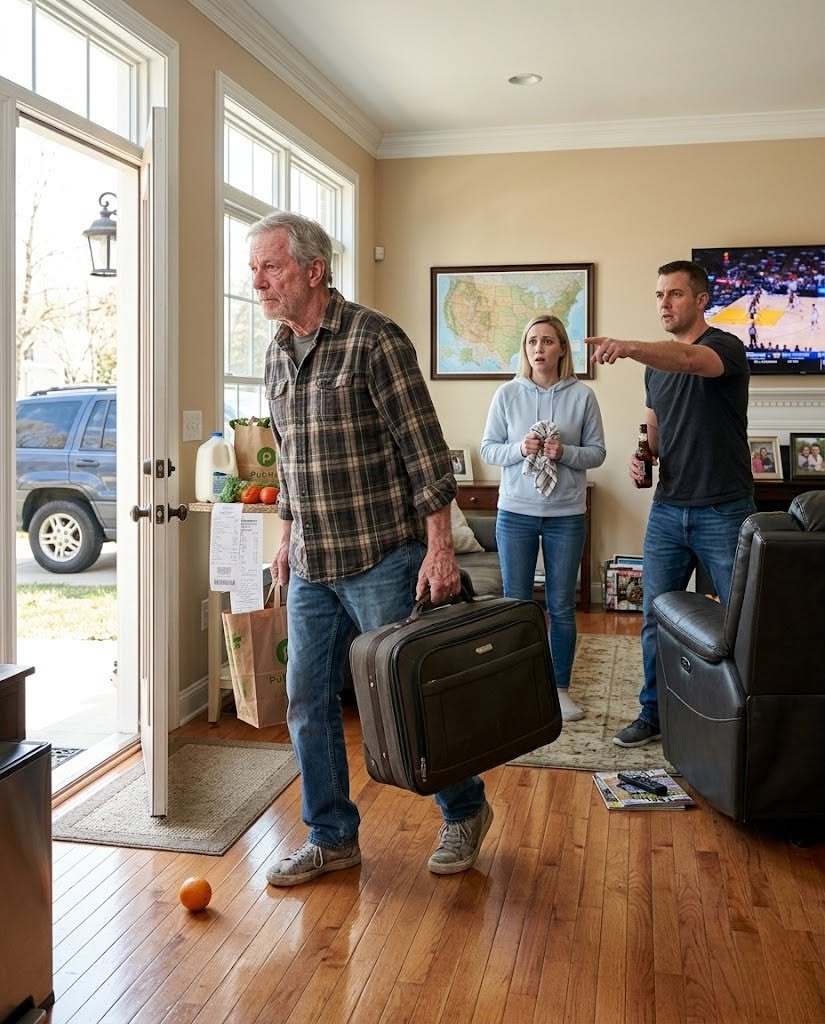
When my daughter told me I could either serve her husband or leave her house, I did not yell.
I did not shame her.
I did not remind her of the mortgage payment I had covered that month, or the power bill I had paid without mentioning it, or the grocery bags I carried through that door every Saturday like an old habit I could not break.
I simply smiled.
Then I packed a suitcase and left the house I had spent most of my adult life paying for.
People imagine a breaking point as something loud.
A slammed door.
A cracked plate.

A voice finally rising after years of being quiet.
Mine was none of those things.
Mine was a stillness so complete it almost felt polite.
That afternoon, the keys were warm in my palm when I came home from the supermarket.
The plastic handles had cut red lines into my wrists, and the milk had started to sweat through the bags because I had stopped for Tiffany’s favorite coffee creamer on the way home.
I still did things like that.
Small things.
Father things.
The house smelled faintly of cut grass through the open window and the lemon cleaner Tiffany used when she wanted the place to look cared for without actually caring for it.
Spring light came through the curtains and stretched across the hardwood floor Martha and I had refinished ourselves twenty years earlier.
Martha had been gone for six years, but sometimes the house still tricked me.
A soft noise in the kitchen would make me think she was there.
A coffee mug left by the sink would make me imagine her hand had just touched it.
That house had never been just walls to me.
It was the place where my wife laughed too loudly at old sitcoms.
It was where Tiffany took her first steps beside the coffee table.
It was where I sat at the kitchen table after Martha’s diagnosis and pretended to read insurance forms while my hands shook under the paper.
So when I walked into the living room and found Harry sprawled in my leather recliner, something old and tender in me tightened.
Not any chair.
That chair.
Martha had bought it for my birthday before the cancer took her strength.
She had saved for it secretly, tucking money away from her part-time work at the school office, laughing when I told her we did not need a new chair.
“You’ll need somewhere comfortable to be stubborn,” she had said.
After she died, I sat there most evenings with coffee in both hands and let the house breathe around me.
Harry had his stocking feet propped over the footrest like the chair had come with him.
A beer bottle hung from his hand.
The basketball game blasted from the television.
The remote sat on his stomach.
He did not turn his head when I came in.
“Old man,” he said, “grab me another beer while you’re up.”
I stopped with the grocery bags in my hands.
At first, I thought I had misheard him.
There are moments when disrespect is so casual that your brain tries to translate it into something else.
A joke.
A bad mood.
A sentence said wrong.
But Harry did not smile like a man joking.
He kept watching the screen.
“Excuse me?” I said.
“You heard me,” he said. “Corona. Not the cheap stuff you drink.”
That was the detail that made my chest go cold.
I had bought those Coronas.
I did not drink them.
I had seen them on sale and remembered Tiffany saying Harry liked to have one after work.
Part of my Social Security check had gone into that cardboard case, not because Harry deserved it, but because I kept mistaking peace for love.
I set the grocery bags down slowly.
Milk knocked against bread.
A receipt slid out and curled on the floor.
“Harry,” I said, “I just got home. I need to put the groceries away.”
He finally looked at me then.
His expression was not rage.
Rage would have been more honest.
It was irritation, the kind a man shows when an appliance does not work on command.
“What’s the big deal?” he asked. “You’re already standing. I’m comfortable.”
“The big deal,” I said, “is that this is my house.”
The room changed after that.
The television kept shouting, but the air around us sharpened.
Harry’s feet hit the floor.
He stood slowly, rolling his shoulders back, using his size the way some men use a threat without having to name it.
He was thirty.
Broad.
Healthy.
Confident in the careless way of someone who had been forgiven too quickly by everyone around him.
I was sixty-eight.
My knees hurt when it rained.
My reading glasses were always somewhere I had just put them down.
But I had spent thirty years in banking, sitting across from men who believed facts became smaller if they spoke over them.
Harry did not frighten me.
He disappointed me.
“Your house?” he said with a laugh. “Funny, because Tiffany and I live here.”
“You live here because I allowed it.”
“We pay bills.”
“With my money.”
“Details,” he said.
There it was.
The whole arrangement, reduced to one word.
The mortgage was a detail.
The utilities were a detail.
The groceries were a detail.
My name on the deed was a detail.
My grief was a detail.
He stepped closer, beer still in hand.
“Listen, Clark,” he said. “You want to keep living here peacefully? Then you play along. Simple.”
The kitchen door opened before I could answer.
Tiffany came in with a dish towel twisted between her hands.
She had Martha’s chin and my stubborn eyes, though she used both differently now.
Her hair was pulled back in a loose ponytail, and she looked tired before she even knew what was happening.
“What’s going on?” she asked.
“Your father is being difficult,” Harry said.
He did not even bother to make it convincing.
“I asked him to get me a beer, and he’s turning it into some big dramatic thing.”
Tiffany looked at me.
There was a time when her face would soften at the sight of grocery bags cutting into my hands.
There was a time when she would have said, “Dad, sit down. I’ll get it.”
That girl had been raised in this house.
That woman stood beside Harry.
“Dad,” she said, “just get him the beer. It’s not worth fighting over.”
I stared at her longer than I should have.
I was not looking at the woman in front of me.
I was looking for the child who used to run to my room during thunderstorms.
She would climb into my lap, press her face to my shirt, and whisper, “Don’t let the sky break, Daddy.”
I always told her I would not.
Fathers make impossible promises when their children are small.
The trouble is, some children grow up believing those promises mean fathers should break themselves forever.
Harry saw her take his side and smiled.
“See, Clark,” he said, “here’s how this works. You live in our house. You contribute. When I ask you to do something, you do it.”
“Our house?” I asked.
“That’s right,” Tiffany said.
She did not hesitate.
That hurt more than Harry’s smirk ever could.
“Dad,” she continued, “you need to decide right now. Either you help Harry and do what he asks, or you can pack your things and leave.”
The room went quiet.
Not silent.
Quiet.
There is a difference.
Silence is empty.
Quiet is full of things nobody wants to say.
The television kept going.
The refrigerator hummed.
One orange rolled out of the grocery bag and stopped against my shoe.
Harry leaned back slightly, already satisfied.
He thought he knew me.
He thought I would sigh, apologize, walk into the kitchen, and hand him his beer.
He thought Tiffany’s disappointment still had the power to move me like a leash.
For years, it had.
I had given Tiffany money after Harry lost jobs he described as “bad fits.”
I had let them move in after their apartment lease ended.
I had told myself it would only be six months.
I had ignored the way Harry called my pension “family money.”
I had ignored the way Tiffany stopped asking and started informing.
I had ignored too much because grief had made me afraid of losing the only family I had left.
But standing there, with the imprint of grocery bags still burning in my palms, I understood something with a clarity that felt almost cruel.
They were not afraid of losing me.
They were afraid of losing what I provided.
“All right,” I said.
Harry’s smile widened.
“Good,” he said. “Now, about that beer.”
I picked up the grocery bags and set them neatly on the counter.
Then I walked down the hallway.
Behind me, Tiffany said, “Dad?”
I did not answer.
In my bedroom, I took out the small brown suitcase Martha and I used for weekend trips.
It still had an old luggage tag from our last anniversary getaway.
I packed two shirts, socks, my shaving kit, my blood pressure medication, Martha’s framed photo, and the file folder from the top dresser drawer.
That folder mattered.
It held copies of the deed.
The beneficiary paperwork.
The revocation form my attorney, Mark, had prepared months earlier after I caught Harry trying to talk Tiffany into refinancing the house.
At the time, I had told Mark I was just being careful.
Mark had looked at me over his glasses and said, “Clark, careful is what people call fear when they are not ready to act.”
I had signed everything anyway.
I zipped the suitcase at 4:17 p.m.
I know because the clock on Martha’s nightstand clicked as I pulled the zipper closed.
At 4:23 p.m., I walked back into the living room.
Tiffany’s face changed when she saw the suitcase.
“Dad,” she said, “don’t be dramatic.”
“I’m not being dramatic,” I said. “I’m being obedient.”
Harry laughed, but it was thinner now.
I walked past him.
Past the recliner.
Past the photos on the wall.
Past the grocery bags I had bought for people who had just told me I was optional.
At the front door, Tiffany said, “Where are you going?”
“I don’t know yet.”
“You can’t just leave.”
I turned then.
That was the first time Harry’s smirk slipped.
“Actually,” I said, “that is exactly what you told me to do.”
I left without slamming the door.
That part matters.
A slammed door gives people permission to call you unstable.
A quiet exit leaves them alone with what they said.
I put the suitcase in my old SUV and drove to a motel off the highway.
The room smelled like old carpet and disinfectant.
The bedspread was stiff.
The coffee was terrible.
I slept better than I had in months.
For seven days, I did not call.
Tiffany called twice the first night, then sent a text that said, “You’re being unfair.”
The next day, she sent, “Harry says you need to cool off.”
On day three, she wrote, “Are you seriously making us apologize?”
On day five, nothing.
That silence told me more than the messages had.
They were waiting for me to fold.
On day seven, Mark called and told me the certified notice had been delivered.
“I expect a reaction soon,” he said.
He was right.
The next morning, I woke at 6:12 a.m. to twenty-two missed calls.
All from Tiffany.
There was one message at the top of the screen.
The preview read, “Dad, Harry found the file…”
I sat on the motel bed and looked at those words until the screen dimmed.
Then Tiffany called again.
This time, I answered.
She was crying.
“Dad,” she said, “why is Harry saying the house isn’t in my name?”
I did not speak right away.
Behind her, Harry shouted something I could not make out.
A cabinet slammed.
Glass broke.
Then a calmer voice entered the call.
“Clark,” Mark said, “I’m here.”
I closed my eyes.
Of course he was.
Mark had promised to arrive the morning after the notice was delivered, not to intimidate anyone, but to make sure nobody could claim confusion later.
He was thorough that way.
“What happened?” I asked.
“Tiffany opened the folder,” Mark said. “Not the first page. The middle.”
Tiffany sobbed harder.
Harry snapped, “This is illegal.”
Mark’s voice did not change.
“No, Mr. Bennett. What is illegal is attempting to pressure an elderly homeowner into vacating while representing the property as yours.”
Harry went quiet.
That kind of quiet is different too.
It is the quiet of a man hearing the word “homeowner” and realizing it is not him.
Mark continued, “Clark, the deed is clear. The house is yours. The beneficiary transfer naming Tiffany was never activated, and the revocation you signed last month is valid.”
Tiffany whispered, “You took my name off?”
“No,” I said. “I stopped pretending you were entitled to everything just because I loved you.”
She made a small sound.
It was not anger.
It was shock.
Maybe shame.
Maybe only fear.
I did not trust myself to name it.
Harry found his voice again.
“You can’t kick us out.”
“I haven’t,” I said.
Mark answered before I could continue.
“The notice gives thirty days to vacate or arrange a lease directly with Mr. Clark. It also documents unpaid contributions, property damage, and recorded statements from the date Mr. Clark was told to leave his own home.”
Tiffany’s breath caught.
“Recorded?” she asked.
I looked at Martha’s photo on the motel nightstand.
The house had cameras at the front door and in the living room because Harry had insisted on them after a package went missing the previous Christmas.
He had wanted them to watch the world.
He forgot they could watch him too.
“Harry installed the system,” I said.
Nobody spoke.
Then Mark said, “I have the clip from 3:58 p.m. through 4:25 p.m. Your words are audible, Tiffany.”
That was when she broke.
Not loudly.
Not theatrically.
Just a thin little breath, followed by my daughter saying, “Dad, I didn’t mean it like that.”
I wanted to believe her.
A father’s heart is a foolish thing.
It can hold evidence in one hand and still reach for excuses with the other.
But I had heard her.
I had seen where she stood.
“You meant it enough to say it,” I told her.
Harry muttered something about lawyers.
Mark said, “You are welcome to retain one.”
That was the first sentence all morning that made me almost smile.
Tiffany asked if I was coming home.
I told her no.
Not yet.
She asked where I was.
I told her I was safe.
She asked what she was supposed to do.
That question landed harder than I expected.
For thirty-eight years, Tiffany had asked me that in one form or another.
What do I do about school?
What do I do about bills?
What do I do about Harry?
What do I do now that you finally stopped absorbing the consequences?
“You read the first page,” I said.
Then I hung up.
I stayed at the motel for three more nights.
During that time, Mark handled every call.
Tiffany sent apologies that began with “I’m sorry you felt” and then, slowly, after Mark explained what a written record looked like, changed into “I’m sorry I said.”
There is a world of difference between those two sentences.
Harry left on the ninth day.
Not because I forced him out that morning.
Because Tiffany finally told him that if he wanted to fight my lawyer, he could do it without using her as a shield.
He took his clothes, his gaming console, and the beer from my refrigerator.
He left the recliner.
That surprised me.
Or maybe it did not.
Men like Harry only want what they can control.
A chair with a dead woman’s love attached to it was useless to him once the house stopped obeying.
When I finally drove back, Tiffany was sitting on the porch steps.
She looked smaller than I remembered.
Not younger.
Smaller.
There were dark circles under her eyes, and her hair was unwashed, and for the first time in years, she looked at me without performing disappointment.
“Dad,” she said, “I don’t know how I became that person.”
I stood at the bottom of the steps with my suitcase beside me.
“I do,” I said.
Her face crumpled.
“It happened one excuse at a time.”
She nodded because there was nothing else to do.
Inside, the house was too clean.
That kind of cleaning people do when they cannot undo what happened, so they scrub counters instead.
The grocery bags were gone.
The orange was gone.
The recliner sat in the living room facing the TV.
For a moment, I could not move.
Then Tiffany walked over, picked up the remote, turned the television off, and set Martha’s old quilt over the back of the chair.
It was not enough.
But it was the first right thing she had done without being asked.
“I’ll leave,” she said. “If that’s what you want.”
I looked around the house Martha and I had built a life inside.
Then I looked at my daughter.
“I want you to learn the difference between needing help and using someone,” I said.
She wiped her face with her sleeve.
“I don’t know if I can fix this.”
“You can’t fix it quickly.”
That was the truth.
Some damage does not heal because someone cries in the kitchen.
Some apologies need rent receipts, therapy appointments, changed locks, and months of ordinary decency before they become more than words.
Tiffany moved into the smaller bedroom for thirty days under a written agreement Mark drafted.
She paid what she could.
She got a second job at a dental office.
She stopped asking me to speak to Harry.
When he called, she let it ring.
When he came by once and pounded on the door, she stood beside me while I called the police non-emergency line and reported trespassing.
Her hands shook the whole time.
But she did not open the door.
That mattered.
Months later, she told me she remembered the thunderstorm promise.
“Don’t let the sky break,” she said, sitting across from me at the kitchen table.
I nodded.
“I remembered it too.”
“I think I used it against you,” she whispered.
I did not correct her.
A father can forgive without pretending the wound was imaginary.
I still live in my house.
Tiffany does not call it hers anymore.
She asks before inviting anyone over.
She buys the groceries on Fridays and leaves the receipts in a small ceramic bowl by the door because she says it helps her stay honest.
Sometimes I find a six-pack of the cheap beer I actually like in the refrigerator.
Not Corona.
Never Corona.
And every evening, I sit in Martha’s recliner with coffee in my hands while the house settles around me.
I do not pretend everything is repaired.
It is not.
But the house is quiet again.
Not empty quiet.
Honest quiet.
The kind that comes after someone finally stops swallowing disrespect just to keep the room peaceful.
And when Tiffany passes through the living room now, she does not ask me to get anyone a beer.
She pauses by the doorway and says, “Goodnight, Dad.”
The first time she said it, I waited until she went upstairs before I answered.
“Goodnight, sweetheart.”