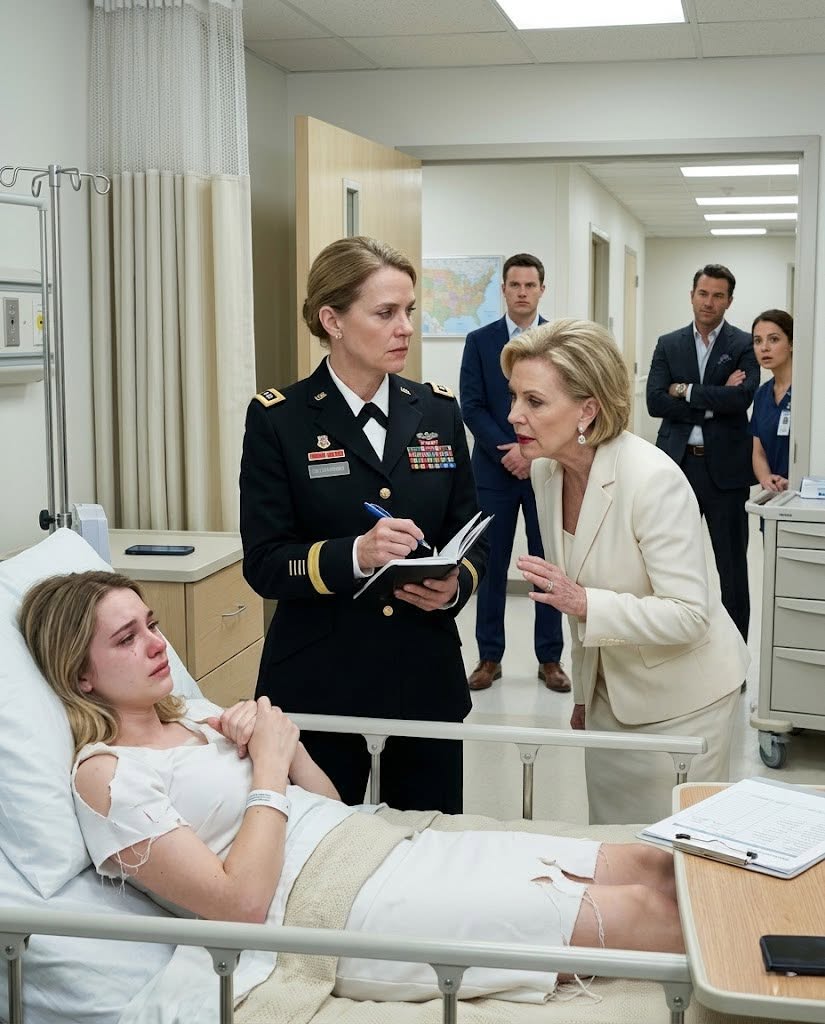
I was still in uniform when my daughter called.
That is the part people always seem to remember when they hear the story later.
The medals.
The black service jacket.
The gold nameplate over my breast pocket that read COLONEL CATHERINE JAMESON.
But the truth is, none of that mattered when my phone rang at 6:18 p.m. from a number I did not recognize.

I was walking across the base parking lot with a cold paper cup of coffee in one hand and a folder tucked under my arm.
Rain had just started, light enough to mist the windshield but heavy enough to make the pavement shine under the fading sun.
I almost let the call go to voicemail.
Then I saw the local area code.
Something in me stopped.
“Hello?” I said.
For two seconds, there was only breathing.
Then I heard my daughter.
“Mom, please come get me… my husband’s family harmed me.”
Her voice was thin.
Not dramatic.
Not angry.
Thin.
Like every word had to crawl over pain before it reached me.
“Kimberly,” I said, already reaching for my keys. “Where are you?”
“Hospital,” she whispered.
Then the line went dead.
I did not call back.
I did not stand in that parking lot trying to convince myself there had to be a reasonable explanation.
Mothers know the difference between a fight and fear.
A fight has heat in it.
Fear has nothing left to spend.
I got into my car, placed my coffee in the cup holder, and drove straight to Saint Jude Memorial Hospital.
The whole ride, my hands stayed steady on the wheel.
That steadiness scares people sometimes.
They mistake it for calm.
It is not calm.
It is training wrapped around terror so the terror does not take over.
Kimberly had been married to Todd Whitmore for three years.
Three years of formal dinners, holiday cards printed on heavy paper, and family photos taken on staircases that looked like they belonged in magazines.
Todd came from money that did not speak loudly because it had never needed to.
His mother, Priscilla, sat on charity boards, hosted benefits, and knew how to make a threat sound like concern.
His older brother, Randall, worked somewhere in the family business, though nobody ever explained what he actually did beyond wearing expensive suits and smiling like every room belonged to him.
I had not liked them.
But I had believed my daughter when she told me she loved Todd.
I had believed her when she said he treated her well.
I had believed him when he shook my hand at Thanksgiving and told me he understood what family meant.
That was the first gift I gave them.
My trust.
People like that know exactly what to do with trust once they get it.
They spend it.
By 6:46 p.m., I was walking through the emergency room entrance with rain darkening the shoulders of my jacket.
The lobby smelled like disinfectant, old coffee, and wet coats.
A toddler cried somewhere near the vending machines.
A man in work boots slept with his chin against his chest.
The television mounted in the corner showed muted weather footage while the closed captions crawled across the bottom.
I went straight for the double doors leading to the treatment area.
A nurse moved quickly into my path.
“Ma’am, you cannot go back there.”
“My daughter,” I said. “Where is Kimberly Jameson?”
She looked at my uniform first.
Then she looked at my face.
I watched the decision happen in her eyes.
She lowered her voice.
“Observation room four.”
Then she stepped aside.
I found Kimberly at the end of the corridor.
The room was small, too bright, and too cold.
A privacy curtain hung from a track in the ceiling, but it had been pulled crooked, leaving half the bed exposed from the doorway.
Kimberly was curled beneath a thin hospital blanket, one hand pressed against her ribs, the other clenched around the edge of the sheet.
Her white designer dress was torn at the shoulder.
The hem was stained.
Her hair, usually smooth and carefully pinned, had fallen loose around her face.
There was a hospital wristband around her wrist.
On the counter sat a clipboard with an intake form.
At the top, someone had written her name.
Kimberly Jameson Whitmore.
Under notes, in careful block letters, I saw the phrase possible domestic assault.
I did not touch the clipboard.
Not yet.
“Mom,” she whispered.
I crossed the room and took her into my arms.
For one second, she tried to sit up straight, like she was embarrassed to need help.
Then her body gave out against me.
She shook so hard the blanket slipped off one shoulder.
I fixed it with my free hand.
She had always done that.
Even as a child, Kimberly had tried to make pain convenient for other people.
When I deployed the first time, she was six years old and missing both front teeth.
She called me every night she could, not to cry, but to tell me what the sunset looked like from her bedroom window.
Once, she mailed me a crayon drawing of a yellow sky, three stick-figure soldiers, and one purple house.
On the back, she wrote, “Come home when you can.”
I had folded that drawing and carried it in my pocket for months.
Now that same child was gripping my jacket like the room might take her back if she let go.
“They took my phone,” she said.
“Who did?”
“Todd. Randall. His mother.”
I kept my voice level.
“What happened?”
She swallowed.
Her lips trembled, but she forced the words out.
“They kept me in the guest house. They said I needed to calm down. They locked the door from the outside. Priscilla told me if I left Todd, she would ruin my reputation. She said nobody would believe me.”
I felt something go quiet inside me.
Not empty.
Focused.
That was when laughter came from the doorway.
“She has always had a flair for drama.”
I turned.
Todd stood there with his mother and his older brother.
Todd wore a navy suit that looked untouched by the rain.
Randall stood slightly behind him, arms folded, a luxury watch shining under the hospital lights.
Priscilla stood in front.
Of course she did.
She wore an ivory suit, diamond earrings, and a smile so controlled it looked less like an expression than a weapon.
“Colonel Jameson,” she said. “Your daughter had an emotional outburst. She fell. Nobody laid a hand on her.”
Kimberly tightened her grip on my sleeve.
“No,” she said.
It came out small.
I looked down at her.
She took a breath and tried again.
“No, Mom. They kept me in the guest house. Todd took my phone. Randall stood there when I begged him to open the door. Priscilla told me I was lucky they were handling this privately.”
Todd rolled his eyes.
“She is exaggerating.”
He said it so easily that I wondered how many times he had practiced the sentence.
“She has always been overly sensitive,” he added.
Randall gave a soft laugh.
“Some women marry into families they are simply not equipped to handle.”
The hallway seemed to shrink around those words.
A nurse paused outside with one hand on a rolling cart.
A clerk down the hall stopped typing.
Someone’s shoes squeaked once on the tile and then stopped.
The monitor beside Kimberly’s bed kept beeping in a steady rhythm, indifferent to every lie being told around it.
Todd looked at the floor instead of his wife.
Randall looked at me like he was waiting for me to understand my place.
Priscilla looked at me like she was disappointed I had arrived before she finished cleaning up the mess.
Nobody moved.
I stayed beside Kimberly.
I did not release her hand.
Priscilla stepped into the room.
“There is no reason to make this difficult,” she said.
Her voice was soft.
That was the dangerous part.
“Our family has influence in the courts, in the media, and throughout state government.”
She leaned closer.
“Your military rank does not intimidate us.”
Randall smirked.
“You should take your daughter home and be thankful we are not pursuing legal action over these accusations.”
Kimberly flinched.
I did not.
At 6:52 p.m., before they arrived, I had asked the nurse to preserve Kimberly’s intake paperwork.
At 6:57 p.m., I had photographed the torn shoulder of her dress, the stain near the hem, and the hospital wristband on her wrist.
At 7:03 p.m., the charge nurse had entered a notation in the medical chart documenting visible distress and injuries consistent with rough handling.
At 7:06 p.m., hospital security had logged a clear property bag from Kimberly’s room.
I had spent twenty-seven years learning a simple rule.
Emotion tells you where the wound is.
Documentation tells you who made it.
I stood up.
Todd’s expression changed first.
He tried to hide it, but I saw the tiny tightening around his mouth.
Randall stopped smiling.
Priscilla did not.
Not yet.
“Colonel,” she said, “I suggest you remember who you are speaking to.”
I looked at my daughter’s face.
I looked at the blanket twisted in Kimberly’s hands.
I looked at the woman in diamonds who believed influence meant immunity.
Then I reached into my jacket pocket.
Priscilla’s eyes followed my hand.
I removed the small black notebook I had carried through more difficult rooms than this one.
It was not fancy.
It was scuffed at the corners, slightly bent at the spine, and full of names, times, statements, and details people wished I had not written down.
I opened it to the page I had started in the parking lot.
Then I clicked my pen.
The sound was small.
In that room, it landed like a door locking.
“Now,” I said, “we are going to put every word on record, starting with what Kimberly told me before you arrived.”
Priscilla’s smile faltered.
Just a fraction.
But I saw it.
So did Kimberly.
The charge nurse stepped back into the doorway holding a sealed clear hospital property bag.
Inside was Kimberly’s phone.
The screen was cracked across one corner, but it was still lit.
There was a property label across the front.
Kimberly Jameson.
ER intake.
7:06 p.m.
Todd stared at it.
Randall looked away.
Priscilla recovered faster than both of them.
“That device belongs to our family account,” she said. “There is private information on it.”
The nurse did not hand it to her.
She handed it to me.
For the first time since I had entered that hospital, Todd looked afraid.
Not regretful.
Afraid.
There is a difference.
Regret looks at the person hurt.
Fear looks at the evidence.
Kimberly made a sound beside me.
A small, broken gasp.
“I hid it,” she whispered.
I looked down at her.
“What?”
“I hid it under the guest house couch after they made me record the statement.”
Todd closed his eyes.
Randall muttered something under his breath.
Priscilla went still.
Too still.
“What statement?” I asked.
Kimberly’s eyes filled.
“Priscilla told me to say I fell. She said if I recorded it, they would let me come back inside the main house. But I didn’t send it. I dropped the phone under the couch when Todd opened the door.”
The property bag felt cold in my hand.
I looked at the screen.
There was a voice memo notification.
I did not ask permission from Todd.
I did not ask permission from Randall.
And I certainly did not ask permission from Priscilla.
I pressed play.
For half a second, the recording was muffled.
Then Priscilla’s voice filled the room.
“You will say you fell near the steps.”
Kimberly sucked in a breath.
Todd whispered, “Mother.”
Priscilla’s face lost color.
The recording continued.
“You will say you panicked. You will say Todd tried to help you. You will not embarrass this family because you lack discipline.”
Randall’s hand dropped from his arm.
The nurse covered her mouth.
Todd took one step back, then stopped when he realized there was nowhere graceful to go.
On the recording, Kimberly’s voice shook.
“I want to leave.”
Then Randall’s voice entered, low and annoyed.
“Then leave with nothing. See how far your mother’s uniform gets you.”
I watched Randall hear himself.
That moment was not satisfying.
It was clarifying.
Some people only recognize cruelty when it comes back to them in their own voice.
The recording ended with a sharp rustle, a thud, and Kimberly crying out.
Nobody spoke.
The hospital corridor outside the room seemed to hold its breath.
Then the charge nurse said, very quietly, “I’m calling the attending physician back in.”
Priscilla turned toward her.
“That will not be necessary.”
“Yes,” the nurse said, and her voice changed into something firm enough to stand on. “It will.”
Priscilla looked at me.
This time, there was no smile.
“You have no idea what you are doing,” she said.
I slid the phone back into the property bag and held it by the sealed edge.
“I know exactly what I’m doing.”
Todd finally spoke to Kimberly.
It was the first time since I arrived that he had addressed his wife directly.
“Kim, don’t do this.”
She looked at him like she was seeing him from far away.
“Don’t do what?” she asked.
“Destroy everything.”
Something in my daughter changed then.
Not healed.
Not strong in the way people like to demand from women the minute they survive something.
But awake.
She pushed herself up a little against the pillow.
Her fingers were still shaking, but her voice was clearer.
“You locked me in a guest house,” she said. “You took my phone. You let your mother tell me what to say. And you think I’m the one destroying everything?”
Todd looked away.
That told me more than an apology would have.
The attending physician came in with hospital security behind him.
Not police.
Not yet.
Just security.
Two men in plain dark uniforms who positioned themselves at the doorway without touching anyone.
The doctor looked at Kimberly first.
“Do you feel safe with these people in the room?” he asked.
Kimberly’s eyes moved from Todd to Randall to Priscilla.
Then to me.
“No,” she said.
It was barely louder than a whisper.
But it was enough.
The doctor turned to the family.
“I’m going to ask you to wait outside.”
Priscilla lifted her chin.
“My daughter-in-law is confused.”
“She answered my question,” the doctor said.
Randall started to object.
One of the security guards shifted his stance.
Randall closed his mouth.
They left the room one by one.
Todd went last.
At the door, he turned back.
His face had changed again.
The fear was still there, but now it was trying to dress itself as hurt.
“Kimberly,” he said, “you know I love you.”
My daughter did not answer.
The door closed.
Only then did she start crying.
Not the soft kind.
The kind that tears through the body because the body has been holding it back too long.
I sat beside her and held her hand.
“I’m sorry,” she kept saying.
“No,” I said.
“I should have called sooner.”
“No.”
“I thought I could fix it.”
“You survived long enough to call me,” I said. “That is enough for tonight.”
The next hour moved in pieces.
The doctor examined her again.
The nurse documented every visible mark without rushing her.
Hospital staff made copies of the intake form, the property bag label, and the notes entered into the medical chart.
I wrote down names.
I wrote down times.
I wrote down exact phrases.
Kimberly gave a fuller statement after the doctor asked whether she wanted an advocate present.
She said yes.
When the advocate arrived, Kimberly told the story from the beginning.
The guest house.
The argument.
The phone.
The locked door.
The rehearsed statement.
The threat about reputation.
The threat about court.
The threat about me.
Each sentence seemed to cost her something.
But she kept going.
Outside the room, Priscilla made calls.
I could see her through the narrow window in the door.
At first, she stood straight, phone against her ear, one hand tucked neatly across her waist.
Then she started pacing.
Then she stopped smiling into the phone.
Then she looked at the closed door as if it had betrayed her.
By 9:14 p.m., hospital security had asked Todd, Randall, and Priscilla to leave the treatment area entirely.
By 9:31 p.m., Kimberly had changed into hospital scrubs because her dress was being preserved with her consent.
By 9:48 p.m., she asked me for water and drank it with both hands around the cup.
That was the first ordinary thing she had done all night.
It almost broke me.
At 10:06 p.m., Todd texted her.
The phone was still sealed, but the notification showed on the cracked screen.
Kimberly read the preview.
Please don’t let your mother turn this into war.
She stared at it for a long time.
Then she laughed once.
It was not happiness.
It was disbelief finally finding air.
“He still thinks this is about you,” she said.
“No,” I said. “He hopes it is.”
“Why?”
“Because then he can call me aggressive. Controlling. Military. Difficult.”
She looked at the phone again.
“And if it’s about me?”
“Then he has to answer for what he did to you.”
Kimberly closed her eyes.
For the first time that night, her hand relaxed in mine.
Not completely.
But enough.
The story did not end in that hospital room.
Stories like this rarely do.
There were statements.
There were lawyers.
There were calls from people who tried to sound neutral while carefully warning us not to make enemies of the Whitmore family.
There were acquaintances who asked whether Kimberly was sure she wanted her private life dragged into public.
There were relatives on Todd’s side who suddenly remembered they had always been worried about her emotional stability.
Power protects itself first.
Truth has to be carried by people willing to be tired.
Kimberly was tired.
So was I.
But we carried it.
The voice memo changed everything.
The medical record mattered.
The intake form mattered.
The dress mattered.
The property bag label mattered.
The timestamps mattered.
Every cold little detail they thought nobody would notice became part of a wall they could not charm their way through.
Todd eventually tried to separate himself from his mother.
He said Priscilla had taken control.
He said Randall had escalated things.
He said he never meant for Kimberly to be harmed.
Kimberly listened to that through her attorney weeks later and did not cry.
When he finished, she asked one question.
“Then why did you take my phone?”
Todd had no answer.
That was when I knew my daughter was coming back to herself.
Not all at once.
Not in some dramatic movie moment.
In questions.
In paperwork.
In sleeping through the night for the first time in weeks.
In changing her emergency contacts.
In choosing a new phone number.
In wearing jeans and an old college sweatshirt to a meeting instead of dressing for a family that had used elegance like a leash.
Months later, she came over to my house for dinner.
Nothing fancy.
Chicken, salad, rolls from the grocery store, and a pie neither of us made.
She stood in my kitchen holding a glass of water, looking at the refrigerator.
There was an old drawing still tucked under a magnet shaped like the Statue of Liberty.
A yellow sky.
Three stick-figure soldiers.
One purple house.
Her six-year-old handwriting on the back.
Come home when you can.
She touched the corner of the paper and smiled in a way that made my throat tighten.
“I forgot you kept that,” she said.
“I keep evidence,” I told her.
She laughed then.
A real laugh.
Small, but real.
Later that night, after she left, I sat alone at the kitchen table and thought about the first words she had said on the phone.
Mom, please come get me.
People think the brave part was walking into that hospital in uniform.
It was not.
The brave part was Kimberly making that call.
The brave part was telling the truth in a room full of people who had trained her to doubt her own pain.
The brave part was surviving long enough to say, “Come get me,” and believing someone would.
That night, an entire family tried to teach my daughter that money could make her disappear.
Instead, every record, every timestamp, every trembling word she spoke made her visible again.
And when Priscilla Whitmore finally understood that her name could not erase Kimberly’s voice, the smile she had worn so carefully in that hospital room was gone for good.