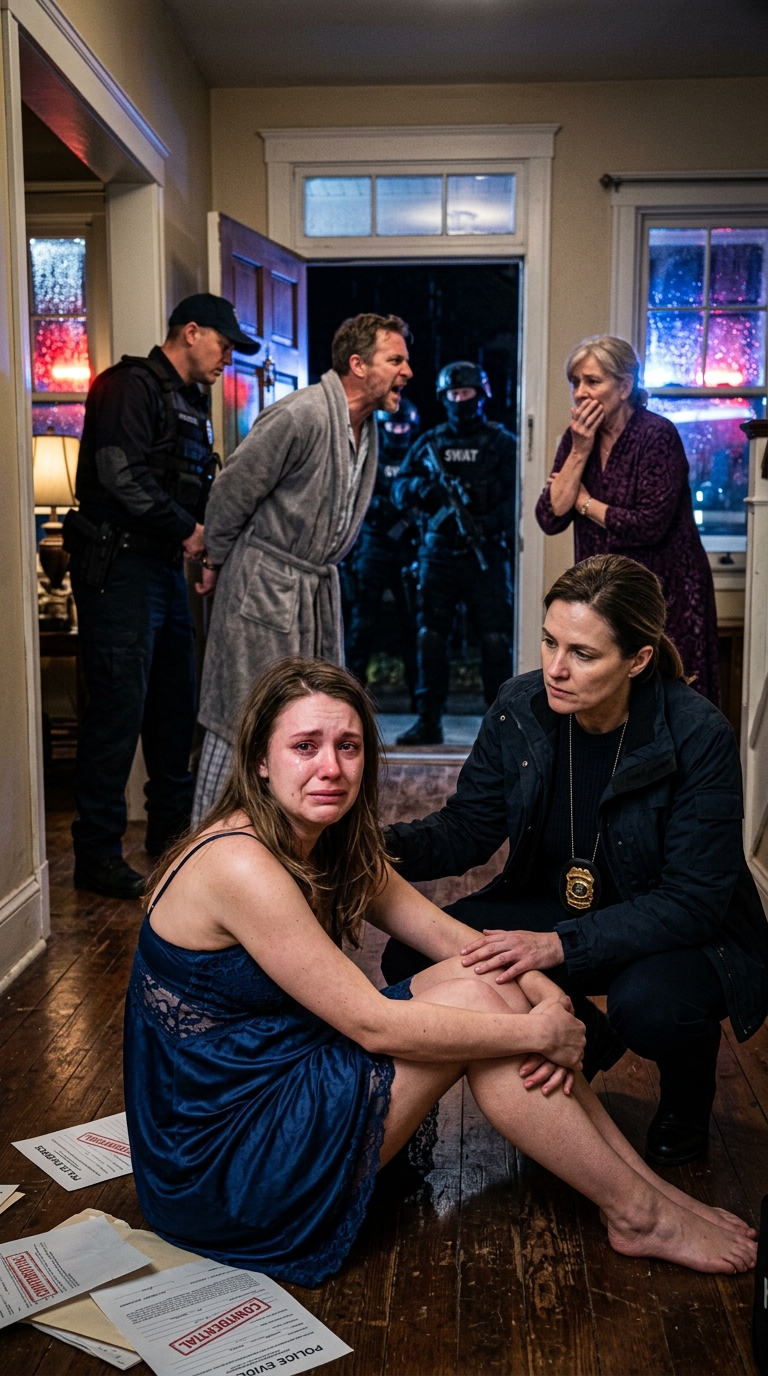
My water broke on the antique mahogany floor of the upper landing at exactly 2:13 a.m. The sound was infinitely softer than I had anticipated. There was just a little splash, a sudden, involuntary gasp escaping my lips, and then the oppressive silence of the sprawling Ashford Manor rushed back in, heavy and suffocating. It was as if this massive, echoing house—the house my great-grandfather had built, the house I had inherited—was finally showing me its teeth.
I clutched the polished oak banister, my knuckles turning a translucent white. My breath locked stubbornly in my throat as a wave of pain, hot and jagged, tore through my lower belly. It wasn’t the dull ache of the Braxton Hicks contractions I’d been enduring for weeks; this was a violent, undeniable tearing sensation, a biological klaxon announcing that my time was up.
“Harrison,” I whispered, my voice trembling in the cavernous, dimly lit hallway. “Harrison, wake up. Call an ambulance.”
The door to the master suite clicked open. My husband, Harrison Vance, stepped out. He wasn’t bleary-eyed or disheveled from sleep. He wore his navy blue silk robe, perfectly tied, his hair flawlessly swept back. In his right hand, he held his cell phone. In his left, he held a thick, manila folder.
A cold dread, entirely separate from the labor pains, began to coil in my gut.
Behind him, emerging from the shadows of the guest wing, was his mother, Beatrice. She was fully dressed in a tailored charcoal pantsuit, her pearls catching the faint light from the foyer chandelier below. She wore a serene, chilling smile, looking for all the world like a woman who had been waiting nine long, agonizing months for this exact, vulnerable moment.
“No ambulance,” Harrison said. His voice was smooth, devoid of any panic or empathy. It was the boardroom voice he used when closing a hostile takeover.
I stared at him, a cold sweat beginning to slide down the curve of my spine. The dim glow of the sconces cast long, monstrous shadows against the imported wallpaper. “The baby is coming, Harrison. Now.”
“Then you’d better hurry.” He didn’t rush to my side. He didn’t offer a hand. Instead, he casually tossed the thick folder onto the mahogany side table. It landed with a heavy, definitive thud. “Sign the estate transfer.”
For one suspended second, the agonizing contraction vanished entirely, buried underneath a landslide of pure, unadulterated disbelief. The Ashford estate had belonged to my father, Leonard Ashford. After his sudden death three years ago, every rolling acre, every offshore account, every controlling voting share of the family trust had gone to me. Harrison had married into this money with weaponized charm and a dazzling smile, calling our union “destiny.”
Now, the mask was entirely gone.
Beatrice stepped forward, lifting her smartphone. The small red light on the screen blinked steadily in the gloom.
“You’re filming this?” I breathed, leaning heavily against the banister as another cramp seized my abdomen.
“For protection, darling,” Beatrice sang out, her voice dripping with artificial sweetness. “In case you become… hysterical. The courts do so hate a hysterical woman.”
Harrison crossed the hallway in three long, predatory strides. He didn’t reach for my hand to comfort me. His fingers bypassed my shoulders entirely, sinking deep into the roots of my hair. He yanked, hard.
A cry of shock and pain ripped from my throat. Fire blazed across my scalp as he dragged me, stumbling and off-balance, down the top three steps. My knees hit the hardwood with a sickening crack. My cheek struck the edge of the stair tread. The impact was a blinding flash, a ringing in my ears that temporarily drowned out the sound of my own ragged breathing. He struck my face—a sharp, open-handed slap that sent the grand chandelier above spinning into a blur of fractured stars.
“Sign it,” Harrison hissed, his face inches from mine, his breath smelling faintly of peppermint and expensive scotch. He shoved a heavy gold fountain pen into my trembling hand. “Or you’re giving birth right here on this floor, you stupid cow.”
Blood, warm and metallic, pooled against my split lip. A fresh contraction, twice as strong as the last, folded me completely in half. I curled into a ball on the landing, gasping for air that refused to enter my lungs.
From above, Beatrice laughed. It was a dry, scraping sound behind the lens of her camera. “Look at her,” she whispered to the digital ether. “All that generational wealth, and she’s still just crawling on the floor.”
I closed my eyes, the world spinning in a vortex of pain and betrayal. I was trapped, bleeding, and entirely at their mercy. At least, that was exactly what they thought.
But as I lay there, staring at the fountain pen resting inches from my trembling fingers, a different kind of fire began to burn in my chest.
I did not beg.
I had begged once, precisely six months earlier. It was a Tuesday evening in late autumn when Harrison had first shoved me against the marble countertop in the kitchen. He had blamed the violent outburst on stress, on a failing quarter at his boutique investment firm, on my “nagging.” I had cried. I had pleaded with him to talk to me, to seek counseling. I had believed the illusion of the man I married.
Then, the bruises faded, but the clarity remained. I stopped begging and started documenting.
Every hushed phone call he took in the study. Every unexplained withdrawal from our joint accounts. I began taking photos of documents he carelessly left on his desk. I recorded audio of his late-night tirades when he thought I was asleep. I tracked bank trails that looped through offshore havens. I collected evidence of forged signatures on minor tax documents.
Most importantly, I began having quiet, unrecorded meetings with my late father’s formidable estate lawyer, Victoria Sterling. Victoria was a woman forged in iron and legal precedent. She had taken one look at the yellowing bruises on my upper arms, steepled her fingers, and said, “When the wolves finally make their move, Eleanor, you must let them believe they have caught you entirely alone.”
So, as I knelt on the hardwood floor, my body seizing with the violent rhythms of labor, I remembered Victoria’s words.
I reached for the heavy gold pen.
Harrison let out a long, slow breath, a triumphant smile spreading across his handsome, patrician face. He loosened the belt of his silk robe, adopting the relaxed posture of a victor.
But I did not take the pen with my right hand.
I am right-handed. I have been right-handed my entire life. But with a subtle, agonizing shift of my weight, I reached out and grasped the cool metal barrel of the pen with my left hand.
Harrison’s smile widened, arrogant and blind. He saw my fingers trembling violently. He saw the sweat dripping from my brow. He thought the shaking meant terror. He thought it meant I had finally been broken into submission.
It did not.
It meant the steel jaws of the trap had finally snapped shut.
I pulled the thick stack of legal documents toward me. The paper blurred in and out of focus as a fresh wave of agony radiated from my lower back. I gritted my teeth, tasting the copper of my own blood, and pressed the nib of the pen to the signature line on the first page.
My left-handed scrawl was atrocious. It leaned the wrong way, the loops were jagged and erratic, the pressure bled ink heavily into the parchment. It looked exactly like the desperate, coerced signature of a woman in unimaginable pain. To Harrison and Beatrice, it looked like absolute surrender.
To Victoria Sterling and the security monitors silently watching the estate, it was a gunshot.
Beatrice stepped closer, bringing the phone’s camera down to capture the ink drying on the page. “Good girl, Eleanor,” she cooed, zooming in on the messy script. “See? Was that so difficult? Now we can be a proper family.”
Harrison didn’t wait for me to finish the last initial. He snatched the document out from under my hand before the ink could even settle, his eyes scanning the page with ravenous hunger. “Finally,” he breathed, the greed radiating off him like heat from an open oven. “The Ashford trust, legally transferred for restructuring.”
I collapsed onto my side, pressing both hands hard against my swelling stomach. I sucked in air through my teeth, a long, ragged hiss. “Hospital,” I croaked. “Now, Harrison. The papers are signed.”
He crouched beside me, the legal folder tucked securely under his arm. Up close, he was smug, beautiful, and completely empty behind the eyes. He reached out and patronizingly patted my cheek, right over the spot where he had struck me moments before.
“In a minute, darling,” he murmured. “Right after my attorney reviews this digital copy and confirms the transfer is initiated with the holding bank.”
“Your attorney?” I laughed. It was a sharp, breathless, ugly sound that startled even me. It echoed off the high ceilings of the foyer.
Harrison’s hand froze on my cheek. His eyes narrowed, the charming facade slipping slightly. “Is there something funny about that, Eleanor?”
I pushed myself up onto one elbow, my breathing shallow but my mind suddenly, brilliantly clear. The pain was still there, a roaring ocean, but I was riding the crest of the wave now.
“You still think I didn’t know,” I said softly.
Above us, Beatrice stopped smiling. She lowered her phone just a fraction of an inch.
Harrison stood up slowly, the folder gripped tightly in his hands. “Know what?”
I looked up at him, letting all the cold, calculated fury I had harbored for six months bleed into my voice. “That you refinanced your mother’s beloved beach house in Nantucket through a dummy shell company in Delaware. That you forged my name on three separate high-yield investment releases in August. That Beatrice has been systematically fencing my grandmother’s vintage jewelry through private, unregulated brokers in Singapore.”
The silence in the hallway was absolute, broken only by the rhythmic ticking of the grandfather clock below.
Harrison’s face went entirely pale, a sickly, chalky white blooming around his mouth.
“She’s delirious,” Beatrice snapped, her voice suddenly shrill and panicked. She took a step back, her eyes darting nervously around the empty hallway. “The pain is making her hallucinate, Harrison. Call the driver.”
“No,” I said, locking eyes directly with the lens of her camera, ensuring every word was captured with crystal clarity. “I am in labor. And I am entirely lucid.”
Harrison lunged. He dropped the folder and grabbed my jaw, his fingers digging into the soft flesh of my neck, cutting off my air. “Shut your mouth,” he snarled, a cornered animal finally realizing it was in a cage. “I will end you right here—”
The front gate security alarm chimed.
A loud, piercing, electronic BING-BONG that echoed through the entire estate.
Once.
Then, two seconds later, again.
Harrison froze, his hands still clamped around my throat. He jerked his head toward the glowing security panel mounted on the wall near the staircase.
Beatrice’s hand began to shake, the phone trembling violently in her grip. “Harrison?” she whispered, the aristocratic confidence entirely evaporated. “Who is at the gates at this hour?”
I smiled, a bloody, terrible smile that felt utterly victorious despite the crushing grip on my neck.
“That,” I choked out, forcing the words past his fingers, “would be the part of the trust you clearly didn’t read.”
Harrison released my throat as if my skin had suddenly caught fire. He stumbled back a half-step, his eyes darting frantically between my bleeding face and the flashing red light of the security panel. “What part?” he demanded, his voice cracking.
“The emergency estate transfer protocol,” I said, my voice gaining strength as I rubbed my bruised neck. I leaned back against the wall, riding out the end of another contraction. “My father, Leonard, was a brilliant man. But more importantly, he was a paranoid man. He didn’t trust anyone. He especially didn’t trust charming, handsome husbands who came from new money and bad debts.”
Harrison looked down at the manila folder scattered on the floor, the pages spilling out, staring at them as if they might suddenly rise up and bite him.
“Any asset transfer over ten million dollars signed under medical distress triggers an automatic, mandatory review by the board,” I continued, reciting the clauses I had memorized during those secret, tear-soaked meetings with Victoria. “But my father went further. We established a duress signal. Any transfer signed with my left hand triggers the emergency fraud protection protocol.”
Beatrice let out a high-pitched, reedy gasp. “You’re bluffing.”
“Am I?” I countered, my eyes locked on Harrison. “A left-handed signature initiates a total, irreversible bank freeze across all global accounts. It triggers an immediate asset lock on all physical properties. It revokes all spousal powers of attorney. And, most inconveniently for you, it automatically dispatches a police wellness check to my GPS location.”
Harrison’s nostrils flared, his chest heaving as panic finally overrode his arrogance. “You’re lying, Eleanor. You’re a stupid, spoiled little girl and you are lying to save your own skin!”
The perimeter alarm didn’t just chime this time. It screamed.
A continuous, wailing siren erupted from the security speakers hidden in the ceiling, a sound designed to wake the dead and alert the neighboring estates. Through the towering floor-to-ceiling windows of the landing, brilliant, strobing beams of red and blue headlights slashed through the darkness, painting the walls in violent, chaotic colors.
The heavy crunch of thick tires tearing up the pristine gravel of the quarter-mile driveway echoed loudly over the siren. Heavy, booted footsteps pounded against the front portico. Men were shouting outside, their voices deep, authoritative, and angry.
Beatrice backed away until her shoulders hit the wall. The phone hung limply in her hand, still recording the destruction of her own empire. “Harrison,” she pleaded, her voice a pathetic whimper. “Harrison, fix this. Do something!”
He snapped out of his paralysis. He spun around, grabbed the smartphone from his mother’s trembling hand, and hurled it with all his might against the marble pillar. The device shattered into a dozen pieces, glass raining down on the carpet.
“Too late,” I whispered.
He whipped his head back to me.
“The video,” I said, my voice calm, almost soothing. “It was already streaming to a secure, encrypted cloud server managed by Victoria Sterling’s law firm. You didn’t just document me signing a paper, Harrison. You documented yourself committing felony assault, coercion, and extortion.”
“How?” he demanded, his eyes wide, wild, and terrified. “How could you possibly—”
I didn’t answer with words. I simply lifted my left wrist.
My bracelet vibrated twice against my skin, a silent confirmation from the outside world.
Harrison stared at it. His eyes dropped to the heavy, intricate gold band my father had given me on my twenty-first birthday. For the past six months, Harrison had mocked it relentlessly. An ugly, gaudy old thing, he had called it. Sentimental trash that ruins your outfits. He had practically begged me to take it off and put it in the vault.
It was neither ugly nor sentimental.
It was a custom-built biometric panic transmitter. It was hardwired directly into the estate’s mainframe security system, Victoria’s private office line, and a private, elite medical response team that had been stationed in an idling ambulance less than ten minutes away since I entered my thirty-sixth week of pregnancy.
Harrison fell to his knees. The aristocratic conqueror was gone, replaced by a hollow, terrified shell of a man realizing he was trapped in a cage of his own making.
“What did you do, Eleanor?” he whispered, his voice trembling. “What did you do?”
A massive contraction—the kind that signals the absolute end of waiting—hit me like a freight train. I gripped the wooden stair rail so hard I thought the wood might splinter. I forced my body upward, fighting gravity, fighting the pain, forcing myself to stand upright on shaking, bruised knees. I looked down at him, a king reduced to ash.
“I survived you,” I said.
Downstairs, the heavy oak front door exploded inward with a deafening crack.
“Police! Armed police! Keep your hands where we can see them!”
The shouts tore through the refined elegance of the foyer like a chainsaw. Flashlight beams cut through the darkness, illuminating the grand staircase. Heavy boots thundered against the imported marble.
Harrison froze entirely, his hands hovering uselessly above the scattered estate papers. Beatrice screamed—a shrill, theatrical sound—and dropped to her knees, burying her face in her hands as half a dozen uniformed officers flooded the lower hall, their weapons drawn and leveled upward.
“Upstairs landing!” one of the officers barked, keeping his flashlight pinned squarely on Harrison’s chest. “Do not move a single muscle!”
Parting the sea of dark blue uniforms came Victoria Sterling. She wore a sharp, gunmetal-gray trench coat, her shoulders dusted with the midnight rain. She carried a sleek leather briefcase, and her eyes, locked instantly on Harrison, were cold enough to shatter glass. She didn’t look like a lawyer arriving at a crime scene; she looked like an executioner arriving at a scaffold.
Right behind her, moving with practiced urgency, were two paramedics carrying heavy trauma bags and a collapsed stretcher.
“Mrs. Ashford?” one of the medics called out, his eyes scanning the bloody scene on the landing.
I raised my left hand, the gold bracelet catching the harsh glare of the flashlights. “I’m here,” I managed to say, my voice breathy and strained. “The baby… it’s happening now.”
Harrison finally found his voice, a desperate, pathetic squeak that tried to masquerade as indignation. “This is a private, family matter! You have no right to break down my door! My wife is—she’s mentally unstable, she’s having a complicated labor—”
Victoria didn’t even blink. She walked up the first few steps, her heels clicking ominously, and stopped just below the landing. She reached into her coat pocket, pulled out a pair of latex gloves, snapped them on, and carefully picked up the blood-speckled manila folder.
“If this were a medical emergency, Mr. Vance,” Victoria said, her voice projecting with terrifying clarity, “you should have called an ambulance. Instead, you spent the last twenty minutes committing coercion, felony battery, domestic abuse, wire fraud, and the attempted unlawful transfer of fifty million dollars in protected assets. All of which we just watched in high definition from the command center.”
Beatrice lifted her tear-stained face from the floor. Her perfect hair was ruined. “She trapped us!” she wailed, pointing a trembling, manicured finger at me. “That evil little bitch set us up!”
I looked down at her, feeling a strange, detached calm settling over me as the medics rushed past the police to reach my side. “I didn’t trap you, Beatrice. You literally recorded yourself committing a felony. I just gave you the rope.”
An officer grabbed Harrison by the shoulder, spinning him around. The metallic snick-snack of handcuffs echoed sharply in the cavernous space. Harrison twisted, his face contorting in panic. He was suddenly no longer the master of the manor. He was just a man in bare feet and a silk robe, begging people he had spent his life thinking he was vastly superior to.
“Eleanor,” he gasped, fighting the officer’s grip as they began to march him toward the stairs. “Eleanor, please! Tell them! Tell them this is a massive misunderstanding! I love you!”
One of the paramedics wrapped a warm, thick blanket around my shaking shoulders while the other gently guided me onto the portable stretcher they had carried up. I sank into the vinyl, the exhaustion finally threatening to pull me under.
“You said I was stupid, Harrison,” I said, my voice carrying easily over the commotion.
His face crumpled, the last vestiges of his pride shattering.
“You said I was weak,” I continued, looking at him with absolute, icy indifference. “You looked me in the eye and said no one would ever believe a hysterical, pregnant woman crying on the floor over a respectable businessman.”
Victoria reached down and carefully bagged the shattered remains of Beatrice’s smartphone in a plastic evidence pouch. She held it up so Harrison could see it. “He’s right, Eleanor. The courts are notoriously biased. But everyone believes a live stream.”
Harrison looked desperately at his mother. Beatrice, sobbing uncontrollably as a female officer hauled her to her feet and clamped cuffs around her wrists, refused to meet his gaze. She looked away, staring blankly at the wall, abandoning him the second the ship began to sink.
That was the first truly beautiful thing I saw that night: betrayal turning back on itself, a snake eating its own tail.
The paramedics lifted the stretcher. “Stay with us, Eleanor,” the medic said gently. “We’ve got you. Let’s go meet this baby.”
As they wheeled me toward the stairs, I heard Victoria’s voice cut through the chaos one last time.
“Take them out through the service entrance,” she instructed the police captain. “They don’t get to use the front doors of this house ever again.”
The second beautiful thing I saw that night arrived an hour later, in the blinding, sterile white light of the hospital delivery room.
The wail of the ambulance sirens had faded, replaced by the steady, rhythmic beeping of the fetal monitor and the calm, encouraging voices of the medical staff. The chaos of the estate felt a million miles away, locked behind the heavy, secure doors of the maternity ward.
With one final, earth-shattering push, the agonizing pressure vanished.
The room erupted in a flurry of movement, and then, a sound pierced the air. It was a furious, wet, indignant cry that seemed to split the very darkness open.
My son had arrived.
The nurse laid him on my chest, a warm, heavy, perfect weight. His tiny fists were clenched tight, his face red with the sheer effort of taking his first breaths in a brand-new world. I wrapped my arms around him, burying my face in his damp hair, inhaling the metallic, sweet scent of life. Tears, hot and fast, streamed down my face—not tears of pain, or fear, but of profound, overwhelming relief.
“He’s perfect,” Victoria murmured from the corner of the room. She had followed the ambulance and stood guard at the door, her trench coat discarded, looking entirely out of place in the clinical environment but refusing to leave my side.
I looked down at my boy, tracing the delicate curve of his ear with a trembling finger. “His name is Leo,” I whispered. “After my father.”
“Leonard would be proud,” Victoria smiled, a genuine, rare softening of her features. “Of both of you.”
I closed my eyes, the adrenaline finally crashing, leaving me adrift in a sea of exhaustion. The trap had worked. The wolves were in cages. The estate was secure. But as I drifted off to sleep, holding my son against my heart, I knew the battle wasn’t entirely over. The courtroom still awaited.
Six months later, the heavy oak doors of the county courthouse swung shut, sealing out the relentless flash of the paparazzi waiting on the courthouse steps.
The scandal had dominated the regional news for months. The Ashford Heiress and the Midnight Coup. The financial world had watched in shock as Harrison’s carefully constructed empire of lies was dismantled brick by brick by forensic accountants.
The courtroom was dead silent, the air thick with anticipation, as the honorable Judge Miller adjusted her glasses and looked down at the defendants’ table.
Harrison sat there, wearing an ill-fitting, state-issued suit. The bespoke tailoring, the silk ties, the arrogant swagger—it had all been stripped away. He looked pale, gaunt, and remarkably ordinary. Beside him sat Beatrice, her hair stripped of its expensive color, looking every bit her age and entirely broken.
“Harrison Vance,” the judge’s voice echoed through the wood-paneled room. “On the charges of felony domestic assault, criminal coercion, wire fraud, and grand larceny… I sentence you to fifteen years in a federal penitentiary, without the possibility of early parole.”
A collective gasp rippled through the gallery. Harrison didn’t move. He simply stared blankly at the polished mahogany table in front of him.
“Beatrice Vance,” the judge continued, turning her cold gaze to the mother. “On the charges of conspiracy to commit fraud, receiving stolen property, and accessory to assault… I sentence you to five years in state custody. Furthermore, all identified stolen assets and properties connected to these crimes are hereby seized for full restitution to the Ashford Trust.”
It was a total, absolute annihilation.
Their secret bank accounts remained frozen indefinitely. Their properties, including the beloved Nantucket beach house, were seized and auctioned off by the state. Their high-society friends, the people who had drunk my wine and eaten at my table while whispering behind my back, vanished like smoke in a hurricane.
I sat in the front row of the gallery, Victoria on my left, and Leo, now a sturdy, babbling six-month-old, bouncing softly on my knee.
As the bailiff stepped forward to lead them away, Harrison stopped. He turned around, his wrists bound in heavy iron chains, and looked at me across the aisle. He looked so incredibly small, a shadow of the monster who had terrorized me in the dark.
“Eleanor,” he said, his voice cracking, a pathetic plea for a mercy he never showed me.
I held his gaze for three long seconds. I didn’t smile. I didn’t gloat. I simply looked at him as if he were a stranger who had asked for directions in a language I didn’t speak.
Then, I turned my attention back to my son, tickling him under the chin until he giggled.
I did not answer.
One year later.
The morning sun poured through the massive, newly installed floor-to-ceiling windows of the upper landing, casting pools of warm, golden light across the restored hardwood floors. The broken banister had been completely rebuilt, stronger than before. The ruined chandelier had been replaced with something modern, bright, and resilient.
The blood was gone. The shadows were banished. The house no longer felt haunted by the ghosts of my mistakes or the lingering malice of the people who had tried to steal my life. It felt, for the first time since my father died, like a home.
I walked barefoot across the warm wood, the frantic, joyful patter of little feet echoing behind me. Leo, now a chaotic, beautiful toddler, chased the family golden retriever down the hall, his laughter bouncing off the walls.
I stepped into my newly renovated home office. The dark, brooding mahogany panels my father had loved had been painted a crisp, hopeful white. The heavy drapes were pulled back, letting the world in.
On my desk sat a plaque, freshly polished. The Ashford-Leo Foundation: Emergency Shelter and Legal Advocacy for Women.
We had opened our first facility three months ago in the city, providing a safe haven, elite legal representation, and financial untangling services for women who found themselves trapped in gilded cages built by men who called abuse ‘love.’ The foundation was funded entirely by the liquidated assets of the Vance shell companies. Harrison was inadvertently paying for the salvation of hundreds of women. I found a deep, profound poetry in that.
Leo trotted into the office, abandoning the dog, and reached up with sticky hands, grabbing the gold panic-button bracelet that still rested on my wrist. I never took it off. It was a reminder, not of my victimhood, but of my victory.
I scooped him up, settling him onto my hip, and kissed his tiny, warm hand.
I looked out over the sprawling green acres of the estate, watching the wind ripple through the ancient oak trees. For a long time, I had believed that peace was simply the absence of conflict. I thought peace was staying quiet, keeping my head down, and hoping the storm would pass.
I was wrong.
Peace, I learned the hard way, is not quiet because nothing bad has happened.
Peace is quiet because justice had been served, the monsters were locked away, and the doors were finally, permanently, secured from the inside.
If you want more stories like this, or if you’d like to share your thoughts about what you would have done in my situation, I’d love to hear from you. Your perspective helps these stories reach more people, so don’t be shy about commenting or sharing.